Here’s the story of a startling real estate deal that doesn’t show up in the history books. During the 1890s, some 400,700 square miles of the Arctic were sold in an international auction.
At the very center of this purchase was the North Pole.
The winner of the auction was a shell company called the North Polar Practical Association, a front for Barbicane & Co., an American munitions firm. You may ask, for what possible reason would anyone pay an astonishing sum to buy an unexplored Arctic wasteland, especially considering that the Pole itself was still believed by some to be forever beyond human reach?
Vast coal fields were believed to lie in that region, and the need for coal was growing daily in an increasingly industrialized world. But how did Barbicane & Co. hope to access those coal fields, presumably buried under massive quantities of ice?
The answer was at once simple, scary, and possibly insane.
The buyers would use a huge explosive device—a stupendous cannon built under Mount Kilimanjaro—to drastically and permanently shift the earth’s axis. Massive climate change would ensue. The polar icecaps would melt, giving the region’s new owners ready access to untold fortunes worth of coal.
Of course, the scheme was widely criticized for its dangers before it ultimately failed, but …

Well, as you may have guessed, none of this really happened. It is the plot of a little-remembered 1889 novel by Jules Verne, the French “father of science fiction.” Its French title is Sans dessus dessous, but in English it is variously titled Topsy-Turvy, Barbicane and Company, or The Purchase of the North Pole.
The Purchase of the North Pole was a sequel to Verne’s better-remembered pair of novels about space travel, From the Earth to the Moon and Around the Moon, which were written some 20 years earlier in 1865. In the days immediately following the Civil War, arms manufacturer Impey Barbicane and his colleagues, “tired of doing nothing,” decided to send a manned spaceship to the moon.

With liquid-fuel rocketry yet to be invented, Barbicane and his colleagues arrived at a solution that once fired my fifth-grader’s imagination: getting shot out of a cannon! Their spaceship was a bullet-shaped projectile, sufficiently large to accommodate three passengers, which was fired out of a 900-foot-long columbiad gun cast perpendicularly into the earth in Tampa, Florida.
I’m not spoiling the story by adding that the projectile missed the moon. This was fortunate for the travelers, who were gambling on the vain hope that the moon had a breathable atmosphere. Instead, the projectile orbited the moon and returned to earth, splashing down safely in the Pacific Ocean.
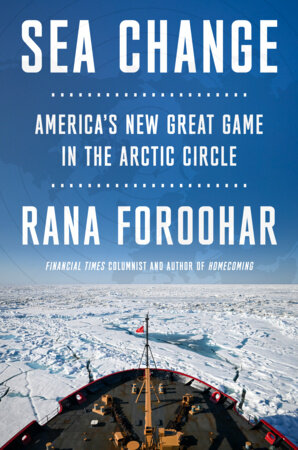
I first read The Purchase of the North just after reading From the Earth to the Moon and Around the Moon. I’ve been thinking about it a lot lately, especially while reading Rana Foroohar’s new book about recent geopolitical developments in the Arctic, Sea Change: America’s New Great Game in the Arctic Circle.
In light of Foroohar’s book, Verne’s novel reads like a satirical prophecy of anthropogenic climate change and international capitalism run amok. Now that Arctic ice is rapidly melting, making way for readier human access and travel, the issue of which nations or businesses control that region is timely indeed. So are the dangers cited by those who protested Barbicane’s project in Verne’s story.
The thawing Arctic permafrost is releasing “twice as much carbon as has been released by human sources since fossil fuels began to be burned,” according to Foroohar. As the polar ice cap and Greenland’s glaciers melt away, parts of the U.S. East Coast are liable to wind up underwater, and flooding will threaten the existence of entire nations.
Those consequences are only the tip, so to speak, of a rapidly melting iceberg. But Barbicane and his colleagues were correct to assume that there are vast riches in that region, readily accessible as the ice disappears. As Foroohar puts it,
“The Arctic seabed is filled with gas, oil, rare earth minerals, and metals such as lithium, cobalt, copper, silver, and gold.”
Not surprisingly, there is an ongoing feeding frenzy of countries and corporations eager to control those resources. Russia even dared to plant a titanium flag in a key contested location at the bottom of the Arctic Ocean.
Verne’s novels are famous for his technological prescience—the way he predicted long-range submarines, powered flight, space travel, and much else. But in Sans dessus dessous, he might be said to have outdone himself.
In a manner of speaking, Barbicane and Company’s massive cannon—or at least the man-made forces it symbolized—eventually succeeded in melting the Arctic and wreaking ecological havoc, all in the name of progress and profit. The gun and its makers are apt metaphors for the hubris and recklessness at the heart of the capitalistic spirit.
—Wim

