 The North Carolina Literary Map has put up pages for each of us, listing our mainstream novels, anthologized works, and many of the titles from our years of making a living writing for educational publishers. Since most of our work is co-authored, the lists are much alike except for Pat’s book about unicorns and Wim’s published plays. Our more recent income is from ghostwriting, so we can’t give you those titles, but they include 3 nonfiction books and 17 short mysteries—so far.
Category Archives: Thinking about story …
in translation…
This week I was delighted to receive a Polish translation of one of my stories. It was attached to a very nice email from Elżbieta Kalinowska of Wroclaw University asking to use my retelling of a West African myth in a book she’s working on. I promptly gave permission.
She has translated my story into Polish. She explains that in Poland the national curriculum includes teaching a foreign language — most often English — from the last year of kindergarten and then continuing with that language in school. I’m happy to contribute to that. There’s considerable research showing the benefits to the brain of being bilingual. (Sometimes I think that the bit of Spanish I learned in Mexico is all that’s keeping my own brain going.)
Dr. Kalinowska holds a PhD in pedagogy and has worked for 25 years as a university teacher. She says:
The book will have introduction about storytelling, then the Anansi story in Polish, and then 16 simplified stories in English with illustrations and some tips for teachers.

Illustration by Donata Golenia
Her friend, graphic artist Donata Golenia, is making terrific illustrations.
A shorter version of “Anansi and the Box of Stories” was originally published in READ magazine (English).
—Pat
Click here for the English version: anansi_stories
“The time is out of joint.” —Hamlet, 1.5
These days, any American with a functioning moral compass knows exactly how Hamlet felt when he said that. It’s a bit of a cliché that Shakespeare has something to say about virtually everything. So it’s hardly any wonder that we turn to Shakespeare’s eloquence and stories for insights concerning the catastrophe we now undergo.
But which play to choose, the selection being so rich?
Julius Caesar, the story of a tyrant brought low by his own ambition, has been a popular choice lately. Last year in New York, a production by the Public Theatre controversially (and unsubtly) portrayed the assassination of “a petulant, blondish Caesar in a blue suit, complete with gold bathtub and a pouty Slavic wife.” Richard III, with its Machiavellian antihero rising to power by nefarious means, is also much in vogue. And Professor Eliot A. Cohen recently likened Donald Trump to Macbeth, whose nearest allies turn against him as his criminal reign collapses.
Nobody ought to push any of these analogies too far. Donald Trump does not have the makings or the stature of a Shakespearean tragic hero. He has none of Julius Caesar’s nobility, Richard III’s articulate wit, or Macbeth’s introspective anguish.
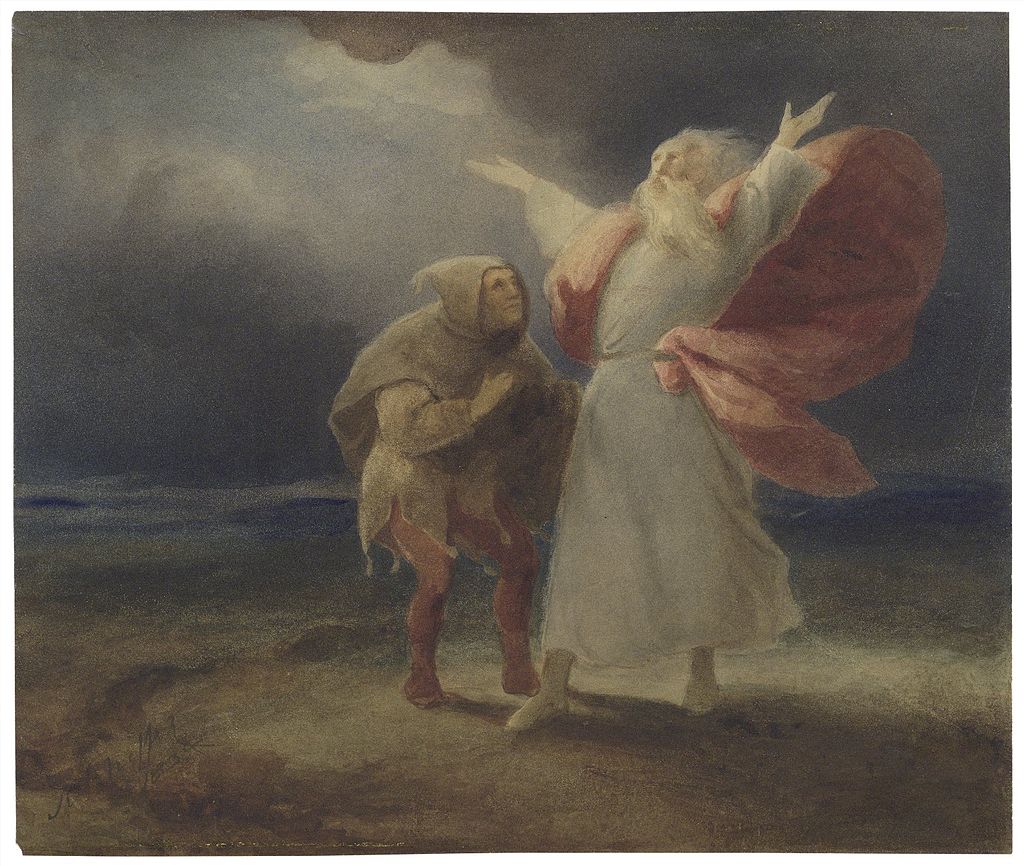
A watercolor of King Lear and the Fool in the storm from Act III, Scene ii.
Nor does our president much resemble King Lear, who learns humility and decency in the depths of suffering and madness. Even so, it seems to me that King Lear speaks more about the crisis of Trumpism than any other Shakespeare play. And that, I think, is because King Lear has less to say about Donald Trump himself than it does about the world that is crumbling around him—and around us.
The story is familiar and deceptively simple, almost like a fairy tale. An old king foolishly decides to abdicate his authority and divide his kingdom among his three daughters. To decide which daughter will receive the greatest share of his kingdom, he puts them to a famous test …
“Which of you shall we say doth love us most …”
Lear rewards two daughters, Goneril and Regan, for their elaborate flattery, but he furiously disowns and banishes his favorite daughter Cordelia for her honesty and bluntness. Chaos ensues as Goneril and Regan subdue their father into beggarly destitution; he spends much of the play wandering through his forfeited kingdom in a state of madness—a madness which sometimes graces him with paradoxical wisdom. For example, in a moment of crazed lucidity, Lear captures the very essence of Trumpism …
LEAR. Thou hast seen a farmer’s dog bark at a beggar?
GLOUCESTER. Ay, sir.
LEAR. And the creature run from the cur—there thou mightst behold the great image of authority: a dog’s obeyed in office.
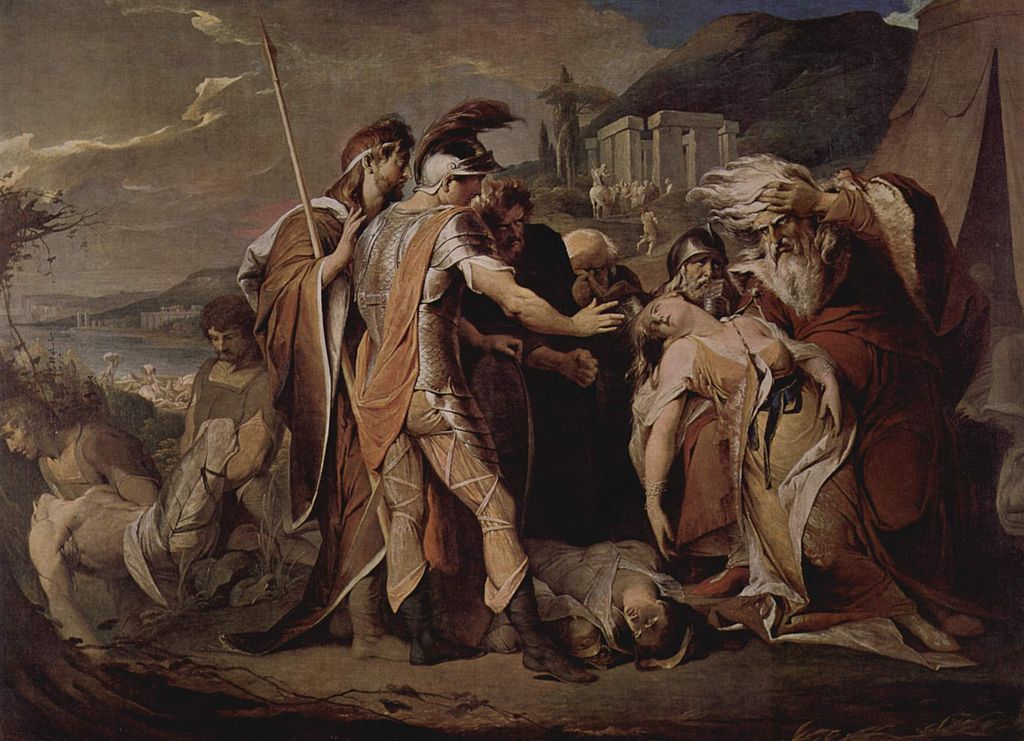
King Lear mourns Cordelia’s death, James Barry, 1786–1788
Lear’s abdication of authority creates a moral vacuum much like the one we inhabit right now—a vacuum in which norms of decency are threatened and largely destroyed. Catastrophe after catastrophe unfolds, tearing the kingdom to pieces and leading inexorably toward the play’s ultimate horrifying tableau—King Lear carrying his dead daughter Cordelia onto the stage, literally howling with animal grief before his own heart breaks forever.
During that last scene, the surviving characters are stricken with such despair that they wonder whether the world itself can endure …
KENT. Is this the promised end?
EDGAR. Or the image of that horror?
We might well wonder the same, for our situation is similarly dire. A manifestly egotistical and unstable man now has the power to unleash nuclear war. And faced with the possibility that the planet may soon become uninhabitable to humanity, Trump brazenly enacts policies that will hasten climate change.
Is there any hope at the end of Lear? Is there any hope for us now? Shakespeare’s nihilistic vision offers no easy reassurance. But there’s a strange idea lurking inside this savage play that merits parsing.
Three men are left standing at the end of King Lear—all of them capable of moral decency. King Lear’s exiled ally, the Earl of Kent, has spent the whole play loyally serving his master in disguise. The young Edgar, having survived his bastard brother’s machinations against him, has escorted his brutally blinded father to a peaceful death. Even Goneril’s husband, the once vacillating Duke of Albany, has at long last learned to follow the dictates of his conscience.
The task of rebuilding on the ruins of civilization finally falls to them.
Meanwhile—and I think this is terribly important—the evils that triggered and fueled the story’s chaos have been exhausted and destroyed. The Trump-like villains, duplicitous and opportunistic as they’ve been, have failed to stave off their own destruction. Obedient to their own vicious natures, they have inevitably turned their treachery against each other. Before they could quite destroy the frail, surviving goodness in the world, they have destroyed themselves.
The evil of Trumpism is already playing itself out in such a manner. Trump’s once-trusted allies—Michael Flynn, Michael Cohen, David Pecker, and Paul Manafort among them—are turning against him one by one. How could they do otherwise, given that their illusory loyalty was always founded upon self-interest, never on honor or decency?
So perhaps the grim denouement of Trumpism is already underway. Meanwhile, we who have witnessed this terrible spectacle with morally undeluded eyes must look to the future; it will be up to us to build upon the ruins.
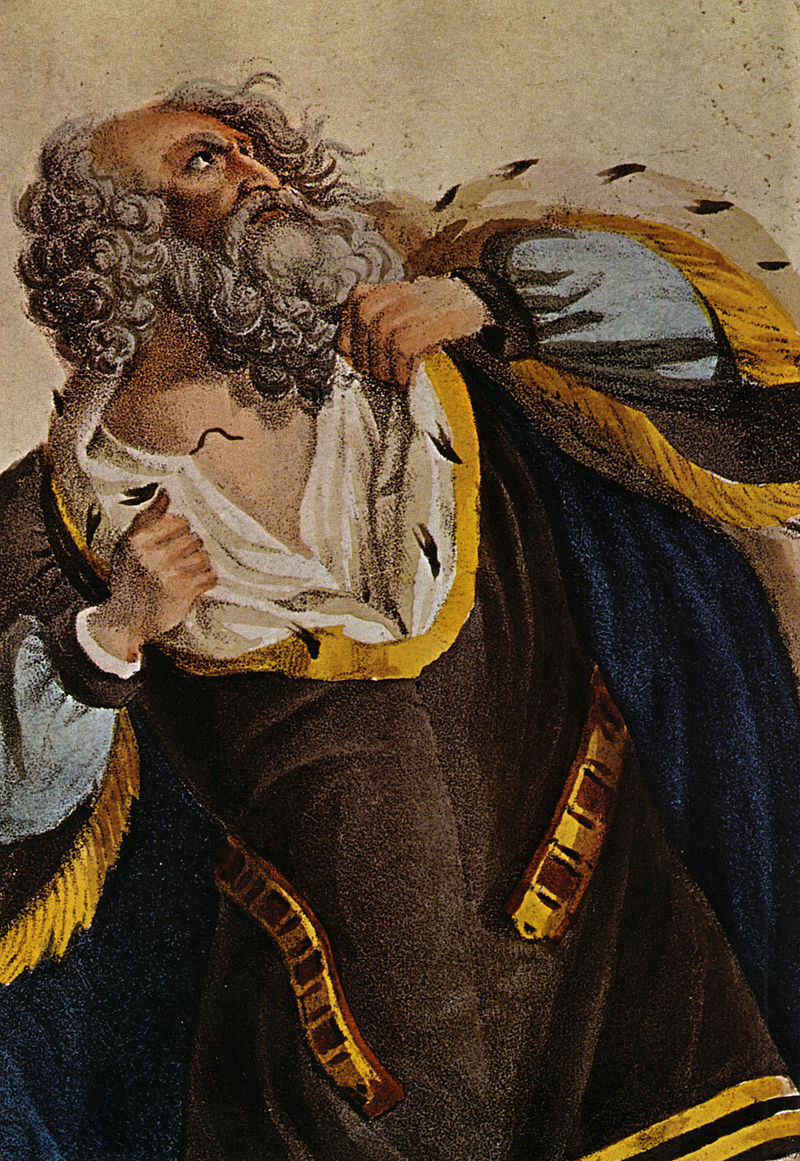
King Lear, by an unknown artist.
Lear, in the depths of his suffering, may have a lesson to offer in this effort. Shorn of power, authority, possessions, and dignity, thrust out onto a storm-blasted heath to make his way like a beggar, Lear at last learns to empathize with those who suffer in oblivion …
Poor naked wretches, whereso’er you are,
That bide the pelting of this pitiless storm,
How shall your houseless heads and unfed sides,
Your loop’d and window’d raggedness, defend you
From seasons such as these? O, I have ta’en
Too little care of this! Take physic, pomp;
Expose thyself to feel what wretches feel,
That thou mayst shake the superflux to them,
And show the heavens more just.
Like Lear, we have long “ta’en too little care of this,” leaving a moral vacuum in which Trumpism has arisen to run its ruthless course. To fill that vacuum, we must build a just and compassionate society.
It’s time to get started.
“… the Terrible Faces of Liberty”
When I wrote my award-winning play The Shackles of Liberty, Donald Trump had not yet risen to power. Even so, I can’t help thinking my play has some relevance to our situation today. What does it mean that America’s cherished ideals of democracy and liberty are under threat by people who profess those very ideals?
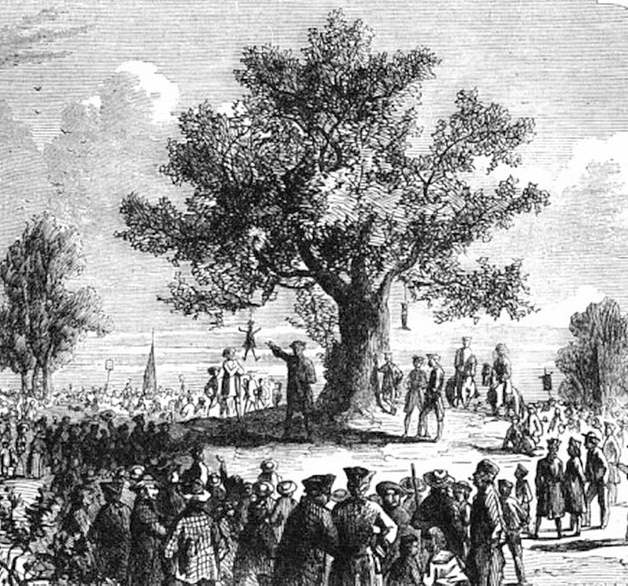
Colonists gathered around the Liberty Tree in Boston, Massachusetts.
Thomas Jefferson famously wrote of a “tree of liberty” that “must be refreshed from time to time with the blood of patriots & tyrants.” In The Shackles of Liberty, my fictional Jefferson elaborates on this image …
But the branches—how like a multi-headed monster, a vicious hydra with all of its faces at war, one against the other, the terrible faces of Liberty.
These words may sound incongruous coming from the lips of America’s most eloquent (if hypocritical) advocate of liberty. But my Jefferson is reflecting on the central contradiction of his own life—that his own liberty was built upon the enslavement of others. He’s also contemplating a lurking contradiction in the very idea of freedom …
“Freedom for the pike is death for the minnows.”
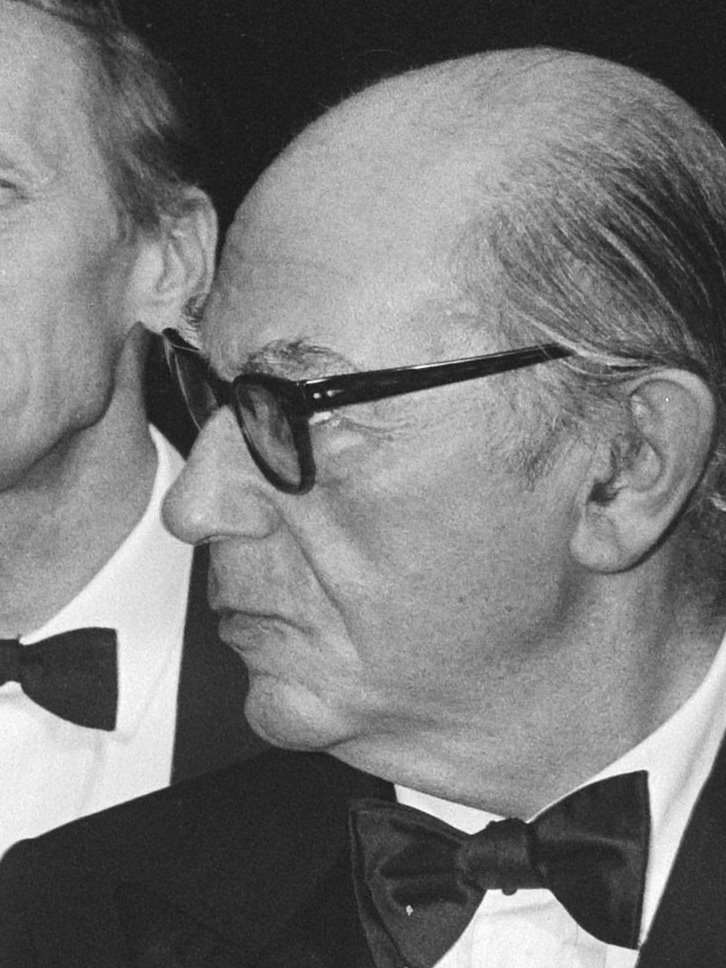
Isaiah Berlin (Rob C. Croes).
This old saying was a favorite of the late philosopher Isaiah Berlin. In his 1958 essay “Two Concepts of Liberty,” Berlin explores the distinction between negative and positive liberty. Negative liberty is essentially liberty from, the freedom to live one’s life without interference. Positive liberty is liberty to, the freedom of self-determination. As Berlin puts it …
The “positive” sense of the word “liberty” derives from the wish on the part of the individual to be his own master.
When Jefferson wrote of our “inalienable” right to “Life, Liberty and the pursuit of Happiness,” it seems to me that he was arguing for liberty in the positive sense. So was Patrick Henry when he demanded in 1775, “give me liberty or give me death!” I think that positive liberty lies at the very core of American aspiration and purpose. It has been a key to progress in America’s great moral struggles, including the abolition of slavery, women’s suffrage, and LGBTQ rights.
But like all noble ideals, positive liberty can be dangerous. In a society based on the assumption “that all men are created equal,” every individual expects to share an equal right to “the pursuit of Happiness,” and an equal participatory role in the political process that guarantees this right. And as Queen Elizabeth tells William Shakespeare in my short play The Throne and the Mirror …
The tyranny of the one is not worth fearing; the tyranny of the many, of the all—now that’s a tyranny to terrify any sane soul.
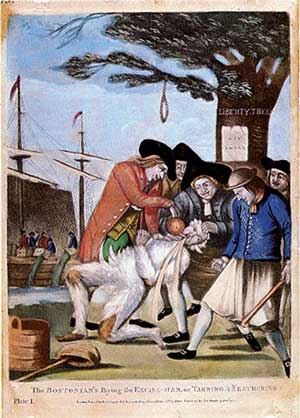
A customs commissioner is tarred and feathered by the Sons of Liberty under the Liberty Tree in Boston. Tea is being poured into his mouth; the Boston Tea Party is seen taking place in the background.
Our founders, including James Madison, John Adams, and Alexander Hamilton warned against this very danger—“the tyranny of the majority.” Majority rule is hardly a guarantee against injustice, especially when the majority chooses to serve its own pettiest interests and fails to consider what is just for all. American slavery and European fascism were both consequences of majority will turned to evil.
Such a perversion of democracy has given us Donald Trump, a manifestly narcissistic and incompetent would-be dictator. The majority of Americans are still not sufficiently horrified by the threat he poses to our republic to remove him from office by constitutional means. We are in a true crisis of democracy, in the grip of a doctrine that Trump and his followers regard as heroic and unassailable.
This doctrine holds that traditions surrounding the American flag and the national anthem should be enforced as mandatory expressions of patriotism; that most immigrants come to this country with malicious purpose; that the news media is a purveyor of “fake news,” an “enemy of the people” that ought to be muzzled; and many other specious and ugly ideas, all of them touted in the names of America’s highest ideals, including democracy and liberty.
Tragically, Trump’s followers fail to perceive the ruin this doctrine is bringing upon themselves. As Berlin puts it …
The triumph of despotism is to force the slaves to declare themselves free. It may need no force; the slaves may proclaim their freedom quite sincerely: but they are none the less slaves.
But what can be done to defeat Trumpism? The upcoming midterm elections are, of course, vitally important; but the problem won’t be solved even if Trump’s congressional sycophants are thrown out of office, or if Trump himself is deposed in 2020 or even before. The spirit of Trumpism will endure, at least for a time, impervious to truth, the rule of law, and the tears of frightened children locked in cages.
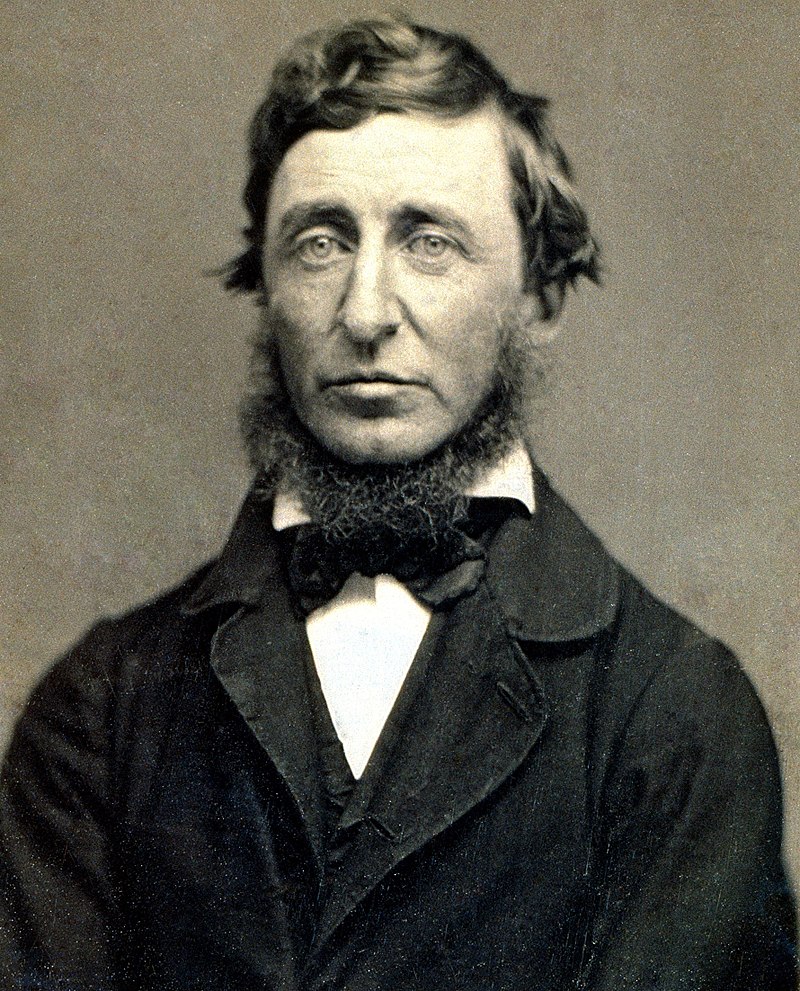
Henry David Thoreau, 1856.
Indeed, Henry David Thoreau argues in “Civil Disobedience” that voting is but a feeble weapon against injustice …
I cast my vote, perchance, as I think right; but I am not vitally concerned that that right should prevail. I am willing to leave it to the majority. Its obligation, therefore, never exceeds that of expediency. Even voting for the right is doing nothing for it. It is only expressing to men feebly your desire that it should prevail. A wise man will not leave the right to the mercy of chance, nor wish it to prevail through the power of the majority.
So what is to be done? I wish I knew. But I’m fairly sure that the abusers of positive liberty now in power can only be defeated by conscientious and decent people exercising their own positive liberty—and doing so with the fullest possible energy and goodwill.
In my play, Thomas Jefferson asks about those “terrible faces of liberty” …
Why can’t they see that the sky is filled with sunlight, that there is Freedom in infinite abundance, and Happiness bountiful enough for every creature that lives or ever shall—not merely to share but to give, one unto another, until the sun exhausts its perpetual light?
It’s an impossible ideal, of course—and Isaiah Berlin warns against the potential evil of impossible ideals. But if we keep striving toward greater and greater heights of acceptance, inclusion, generosity, equality, and love, I can’t help thinking our current evils will recede; our wounded republic may even begin its long healing.
The text of The Shackles of Liberty is available on the New Play Exchange or by contacting Wim personally.
Send No More Angels
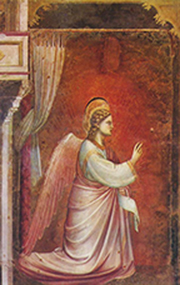
- Giotto—The Angel Gabriel Sent by God
Father god we pray to you
please send us no more angels.
Lend us neither son nor daughter.
We turn the words
of every avatar
into cause for murder.
For now our only holy path
is to suffer life without you
so we never speak your name again
to justify atrocity.
But please check back in a thousand years or so
to see if we’re ready
to learn to love.
Amen … amen … amen.
—Pat Perrin
 playsonideas