“The Rake’s Visit” — Wim’s new play …

I just finished writing a new two-character play: “The Rake’s Visit: A One-Act Capriccio on a Theme from Don Giovanni.” It is a revisionist take on Mozart’s opera, his wife Constanze, and especially the notorious adventurer Giacomo Casanova. You can download the entire play by clicking here.

Here’s a synopsis:

Prague, 1787: It is the night before the scheduled world premiere of Mozart’s opera Don Giovanni. The aging roué Giacomo Casanova has read the libretto by his libertine friend Lorenzo Da Ponte—and he hates it. He goes to Mozart’s lodgings hoping to rewrite it, only to find that Mozart wants nothing to do with him. But Mozart’s wife, Constanze, is intrigued by the legendary rake, and the two of them pass the night in the “alchemical brandy” of storytelling.

This exchange between Constanze and Giocamo takes place early in the play …

GIACOMO.
(thumbing through the libretto)
Would you help me … to fix this dreadful libretto?
Or just a little bit of it, at least?
Maybe just an aria or two?
If you don’t mind very much?
I’d hate to have squandered both my time and yours
with nothing to show for it.

CONSTANZE.
What’s wrong with it?

Portrait of Constanze Mozart by Joseph Lange c. 1782

GIACOMO.
Well, obviously it’s an abomination.
I knew it would be vile, but hadn’t expected—this,
not even from Lorenzo,
who is shameless as only a priest may be
(and, oh, I can assure you,
he was even worse before he was defrocked).
What he has done here with the Don Juan legend …
well, he has cast to the winds
the abundant moral lessons of Tirso and Molière
out of sheer infatuation with this scoundrel.
Giovanni is the lying looking-glass
that shows Lorenzo as he loves to see himself—
a rake of irresistible allure;
his very villainy flatters men’s dreams of debauchery,
of what they might do were their desires untethered
from decency or respect for womankind.
Oh, of course, in the end Giovanni does get swallowed up by hell and all—
the traditional perfunctory comeuppance
to lend an obligatory veneer of redeeming moral value.
But believe me, if you knew Lorenzo as I do—
well, he considers an eternity of hellfire
a paltry price to pay for a lifetime of glutting his earthly appetites
and ruining the lives of myriad ladies.

Drawing of Casanova by his brother Francesco

CONSTANZE.
Aren’t you a fine one to talk about ruining ladies’ lives?

GIACOMO.
My dear Frau Mozart,
of the thousands of women
who have conquered my heart and eyes and loins,
I challenge you to find one—
even one—
whose life I have ruined,
or one still living
with whom I do not remain on the most cordial terms
even after many years.
I am not a deceiver,
nor have I ever been deceived;
I have never been unfaithful,
nor have I ever been betrayed;
I have lived a happy life,
and I have generously shared my happiness.
Friendship is my categorical imperative—
I treat every woman I meet as an end in herself
and for herself,
not as a means toward an end.
For you see, the pleasures of flesh upon flesh are brief
and all the sweeter for it,
while friendship—
ah, friendship!—
is eternal—
but only when it really lasts!

—Wim

Don Giovanni confronting the stone guest; painting by Alexandre-Évariste Fragonard, c. 1830–35

Operation Ares — a short play

Characters:

Adolf Hitler
Wernher von Braun

The scene is Adolf Hitler’s vast office in the New Reich Chancellery in Berlin, December 1944. Downstage, an imaginary window in the “fourth wall” looks out into the night. Hitler is seated at his desk. Wearing an SS uniform, Wernher von Braun enters and salutes.

Peenemünde, Start einer V2

V-2 launch in 1943.

VON BRAUN. Sieg Heil, Mein Führer!

(HITLER rises from his chair and begins stalking around VON BRAUN, who stands at attention.)

HITLER. Major von Braun, where are my rockets?

VON BRAUN. Sir?

HITLER. My Vengeance Weapons. Where are they?

VON BRAUN. Mein Führer, I don’t understand.

HITLER. It is a simple question, Major von Braun.

VON BRAUN. You have your V-2 rockets, Mein Führer. Several thousands of them.

HITLER. Several thousands.

VON BRAUN. Yes, Mein Führer. They’re being launched daily from mobile sites in western Holland.

HITLER. Several thousands.

1024px-Damage_Caused_by_V2_Rocket_Attacks_in_Britain,_1945_HU88803

Damage caused by a V-2 rocket attack in Whitechapel, London.

VON BRAUN. Raining death upon London, sir.

HITLER. Why have you disobeyed my orders?

VON BRAUN. Mein Führer?

HITLER. Some three years ago, when you showed me plans for the V-2, I ordered the production of hundreds of thousands. Enough to turn all of London into a lake of flame, fire and fury like the world has never seen. You promised exactly that. Raining death, you say? Your rain is but a puny drizzle. Where are my rockets?

VON BRAUN. Sir, we couldn’t reckon on …

HITLER. On what?

VON BRAUN. Sir, the laborers can’t —

HITLER. You have all the forced labor you could possibly need from Mittelbau-Dora.

Hitler_portrait_cropVON BRAUN. Yes, but slave laborers have an unfortunate way of …

HITLER. Of what?

VON BRAUN. Dying.

HITLER. How?

VON BRAUN. Overwork. Starvation. Disease. What have you. Sir.

HITLER. So I hear. More laborers die making the rockets than Londoners die from their warheads! Take more slaves from Mittelbau-Dora. Empty the camp if need be. Then take more from Buchenwald. The supply will be endless, I promise you. You’ll have millions to choose from.

VON BRAUN. Yes, sir. But there is also the matter of raw materials, sir.

HITLER. Materials! Always materials! Are you telling me that hundreds of thousands of rockets are an impossible task?

VON BRAUN. So it would seem, sir.

HITLER. Why did you not reckon this three years ago?

VON BRAUN. A terrible miscalculation, sir.

(Pause)

HITLER. You may relax, Major von Braun.

(VON BRAUN stands at ease, but anything but relaxed; there is no place for him to sit.)

HITLER. You were jailed in Stettin last March, were you not?

VON BRAUN. Regretfully, yes, Mein Führer.

HITLER. Do you know why?

VON BRAUN. I was never entirely clear about that, Mein Führer.

HITLER. You were suspected of sabotaging your own rocket program. You were also suspected of planning an escape from the Reich. A truly astonishing escape. Not to England, or America, or Russia—but to the planet Mars!

VON BRAUN. Sir, I assure you that I never planned any such —

HITLER. Do you know why I’ve summoned you?

VON BRAUN. I received your memo, Mein Führer.

HITLER. And what did you glean from my memo?

VON BRAUN. You want to speak to me about Operation Ares.

HITLER. And what are your thoughts on Operation Ares?

VON BRAUN. Regretfully, I have no thoughts on Operation Ares.

HITLER. And why not?

VON BRAUN. Because, Mein Führer, I have never heard of Operation Ares.

(Pause)

HITLER. You’ve also been overheard making defeatist remarks about the war.

VON BRAUN. If so, my words have been terribly misunderstood.

HITLER. No? You haven’t been repeating vicious lies? That the Reich is crumbling? That the war effort is failing? That the Allies have taken back France? That the Russians are advancing upon us from the east?

VON BRAUN. I’ve said no such things, Mein Führer.

HITLER. But you’ve heard such lies?

VON BRAUN. I give them no credence, Mein Führer.

HITLER. Before you leave this office, I demand a list of every voice you’ve heard spreading such lies.

VON BRAUN. Yes, Mein Führer.

HITLER. I am about to launch an offensive in the forest of the Ardennes, crushing the Allied armies underfoot. The Russians, too, will live to regret their encroachment upon our realms. The Reich has never been so close to victory, believe me.

VON BRAUN. I have complete faith in the destiny of Reich, Mein Führer.

(Pause)

marsproject_0000-570x865HITLER. Do you deny that you want to go to Mars?

VON BRAUN. I never intended to escape —

HITLER. Do you want to go to Mars?

VON BRAUN. Yes, sir, I do. Very much, sir.

HITLER. Is it possible to go to Mars?

VON BRAUN. I believe it is entirely possible, sir.

HITLER. Explain.

VON BRAUN. I have in mind a fleet of ten spaceships carrying a total of seventy men. The voyage, if optimally timed, should take thirteen months and six days.

HITLER. Why aren’t we building such spaceships right now?

VON BRAUN. We will if you command it, Mein Führer.

HITLER. And how do you suppose we shall be greeted by the Martians?

VON BRAUN. Sir?

HITLER. The natives. The inhabitants. Will they greet us as friends, liberators, enemies?

VON BRAUN. Mein Führer, it is by no means certain that there is any life at all —

HITLER. There is intelligent life on Mars. My people tell me so.

VON BRAUN. There might be, sir, but —

HITLER. It is a certainty. I have it on good authority.

(HITLER goes to his desk and unrolls a large map.)

800px-Mars_Atlas_by_Giovanni_Schiaparelli_1888

1888 map of Mars by Giovanni Schiaparelli.

HITLER. I have here a detailed map of Mars and its canals—a vast and sophisticated network, a miracle of engineering that could only have been built by an extremely advanced civilization.

VON BRAUN. Sir, I am familiar with that theory, and I must regretfully say —

HITLER. That all this is impossible?

VON BRAUN. Not impossible at all, but —

HITLER. Surely you will not tell me that this map is in any way false or inaccurate.

VON BRAUN. It is a very old notion, sir, and more recent observations —

HITLER. I received it from the Reich’s most brilliant astronomers.

VON BRAUN. Very well, sir.

HITLER. So let me ask again—how will we be greeted by the Martians?

VON BRAUN. I haven’t the slightest idea, Mein Führer.

(HITLER rolls up the map.)

HITLER. Major von Braun, I can’t say I’m at all pleased by what I’m hearing. Surely the world’s other great powers have advanced space programs, while the Reich seems to have none at all. What about the Americans?

VON BRAUN. They’ve scarcely given it any thought, sir.

HITLER. The British?

VON BRAUN. Even less, sir.

HITLER. The Russians?

VON BRAUN. The Soviets have far-reaching hopes for space travel.

HITLER. How so?

VON BRAUN. It isn’t easy to … articulate, Mein Führer.

HITLER. What is its guiding spirit?

VON BRAUN. Sir?

HITLER. The fundamental principle, the single thought, the solitary word that sums up the aspirations and the philosophy of the Soviet space program. What is it, Major von Braun?

VON BRAUN. I cannot say.

HITLER. Cannot or will not? Come, come, Major. I’m not squeamish. I’m prepared to hear any notion, however vile or repugnant or obscene, any sort of sick and depraved Judeo-Bolshevist perversion —

VON BRAUN (interrupting fearfully). It’s love, Mein Führer.

(Pause; VON BRAUN clearly dreads HITLER’s reaction to this awful revelation.)

HITLER. Love?

VON BRAUN. Yes, Mein Führer. Love and …

HITLER. Well?

VON BRAUN (with mounting dread). Altruism.

HITLER. Explain.

VON BRAUN. The Russians’ greatest rocket engineer was also a philosopher.

HITLER. His name?

Tsiolkovsky

Konstantin Tsiolkovsky

VON BRAUN. Konstantin Tsiolkovsky.

HITLER. His beliefs?

VON BRAUN. That Earth is the cradle of humanity, but one cannot live in the cradle forever. That the Cosmos is perfect, and its cause and purpose is nothing else but love. That the universe is inhabited by untold billions of perfect races, and it is the destiny of humankind to join in their perfection; to resurrect the dead and grant them happiness and immortality; to selflessly spread love among the stars, throughout the infinite and the eternal.

HITLER. A loving Cosmos.

VON BRAUN. Yes, Mein Führer.

HITLER (shuddering). Yes, I have sensed this possibility myself.

VON BRAUN. Sir?

(HITLER holds out his hand to VON BRAUN.)

HITLER. Come. Let us look into the night together. Let us talk of Operation Ares.

(VON BRAUN takes his hand; they go downstage and gaze through the imaginary “fourth wall” window into the night.)

HITLER. With every passing night, I believe I see fewer and fewer stars. Some grow dim, some disappear altogether. (pointing) Look, right now, at that one, flickering with its last gasp of light. Last night it was large and blazing. Tomorrow I’ll look for it and it will be gone, just an empty pocket in the sable velvet void. The universe is dying, trudging in the funereal footsteps of its lame and senile God of Love, doomed to share in his wretched extinction. It’s pitiable! The sin of pity creeps up inside of me. But what need has the universe of my pity? It needs rather my fist, my rage, my volcanic cruelty. It begs for conquest, whimpers for a master to teach it strife and destruction, to breathe a fresh conflagration of hatred into its waning orbs. For struggle, not love, is the father of all things—and the more brutal the struggle and the more fierce the hatred, the greater life becomes, and the brighter the heavens. (clenching his fist) I’ll soon crush Russia with the Reich’s great hatred, and Britain, and America. I’ll teach hatred even to my enemies, those who most profess their love. I’ll make our planet great again. And then … Major von Braun, together we must conquer Mars.

VON BRAUN. Yes, Mein Führer.

(HITLER goes to his desk and spreads the map again; VON BRAUN joins him.)

HITLER. Let us prepare for Operation Ares.

END OF PLAY.

—Wim

800px-Walt_Disney_and_Dr._Wernher_von_Braun_-_GPN-2000-000060

Walt Disney and Wernher von Braun, 1954.

Voltaire and Catherine the Great discuss American democracy …

Wim’s new play Wiser than the Night is a witty and sweeping drama of ideas that asks a trenchant question about democracy: “What went wrong?”

Set in 1981 in the wake of Ronald Reagan’s election, Wiser than the Night brings together events of the Bolshevik Revolution, Stalinist tyranny, Russian folklore, and American history and politics. It includes the historical figures Catherine the Great, Peter III, Potemkin, and Voltaire. In one scene, Voltaire pays Catherine the Great a visit from the afterlife to discuss the future of American democracy. Their chat becomes more than a little prescient.

VOLTAIRE: What have I missed since I’ve been dead? How are those upstart American colonies doing, now that they’ve declared their independence? How fares their war against Britain?

CATHERINE: They might just win.

VOLTAIRE: Have they chosen a king yet?

CATHERINE: It doesn’t appear that they want one.

VOLTAIRE: Ha. Dr. Franklin said so when we met. I thought he was joking.

CATHERINE: They aim to become a republic of sorts. Don’t you approve?

VOLTAIRE: The question is, are they ready? I doubt it very much. An enlightened monarch is what they need.

CATHERINE: Where would they look to find one?

VOLTAIRE: To the noble houses of Europe, naturally. There are plenty of dynastic pretenders to choose from. What about your son? Might he be looking for something to keep him busy? A sort of—hobby, maybe?

CATHERINE: Aside from trying to murder his dear mother? I’m not that lucky. Anyway, I don’t think America would have him.

VOLTAIRE: Surely they don’t fancy choosing somebody from their own population—a common bourgeois merchant or planter or blacksmith or some backwoods trapper. What would they even call him? A chairman, a foreman, an overseer, a boss, a—president?

CATHERINE: Maybe they can do without one altogether.

VOLTAIRE: Oh, really—

CATHERINE: How can anybody know till it’s been tried? No more of this—this breeding of monarchs as livestock and pretending God picks and chooses. Surely the world has had enough of that. Perhaps the people of America can learn to govern themselves.

VOLTAIRE: Now you’re scaring me. A government must certainly be for the people—that’s what “consent of the governed” means. But a government by the people, and purely of the people? You’re talking about anarchy, my friend—no, something worse, democracy.

CATHERINE: Why not? It worked in ancient Athens.

VOLTAIRE: Yes, in a cozy little city state where everybody knew everybody else, but not in a bustling frontier teetering on the brink of savagery. Oh, this “all men are created equal” business is well and good, but just between you and me, there’s plenty of evidence against it. And anyway, it would take a powerful king to make this equality thing really work. A philosopher king isn’t out of the question—they do turn up now and again. Look at you, you’ve got an excellent head on your shoulders. But a whole nation of philosopher citizens? Don’t put money on it. Here’s a thought. What about pure democracy tempered by absolute despotism? No, don’t sneer at the idea. That sniveling sentimentalist Rousseau got one thing right. People must sometimes be forced to be free.

CATHERINE: But forced by whom? That seems to be the problem of America itself.

VOLTAIRE: Indeed, and it’s likely to continue so. They’ll have to get rid of slavery somehow, but what happens then? After a couple of centuries of strife and striving, lurching between the giddiness of progress and stomach-churning failure, I fear Americans will tire of the fight and surrender to their own basest instincts and become a nation of puppets. And the puppeteer they choose for their leader will be nothing but a puppet himself, a hollow automaton with neither mind nor will nor purpose, a demagogic fool ranting through his teeth and flailing his limbs and yanking his subjects’ strings in random idiotic fury.

*

A complete PDF of Wiser than the Night can be downloaded HERE.

Ruins for the Future

you-know-youre-a-history-fan-when-library-of-alexandria

I see this meme pop up from time to time. And yes, I too feel a certain pang about the Library of Alexandria. Even so, I can’t help but wonder if our grief might be a tad misplaced. For one thing, just which of the four fabled destructions of the Library of Alexandria is supposed to still upset us? When it was accidentally burned by Julius Caesar in 48 BCE, or destroyed—again accidentally—by the Emperor Aurelian in 272 CE? When it was vandalized and plundered at the orders of the Coptic Pope Theophilus in 391 CE? Or are we talking about an apparently apocryphal incident, its supposed destruction by Caliph Omar in 642 CE?

A single iconic “Burning of the Library of Alexandria” seems to linger in literate imaginations as a catch-all metaphor for the loss of any and all intellectual riches throughout the ages. But just what percentage of all the great ideas lost to time can really be blamed on those four purported catastrophes in that one place? A pretty small percentage is my not-so-humble guess.

A more pertinent if more unpalatable question might be — should we still be upset about it? In his book Nonzero: The Logic of Human Destiny, Robert Wright doesn’t specifically mention Alexandria, but he does mull over another catch-all metaphor for cultural waste, the so-called Dark Ages. Wright challenges Thomas Cahill’s assertion in How the Irish Saved Civilization that Irish monks singlehandedly rescued humanity’s most indispensable treasures from barbarian hoards after the fall of Rome. Wright quotes Cahill:

Had the destruction been complete — had every library been disassembled and every book burned — we might have lost Homer and Virgil and all of classical poetry, Herodotus and Tacitus and all of classical history, Demosthenes and Cicero and all of classical oratory, Plato and Aristotle and all of Greek philosophy, and Plotinus and Porphyry and all the subsequent commentary.

Wright’s response to Cahill:

Well, them’s the breaks. But what people of the early Middle Ages most needed wasn’t a good stiff dose of Demosthenes. They needed mundane things, such as a harness that wouldn’t press on a horse’s windpipe.

Wright isn’t being as callous as he might sound. His guiding optimistic idea in Nonzero is that human history is a halting but inexorable proliferation of “non-zero-sum” games — a sometimes wobbly but ever-forward march toward increasing intellect, sophistication, and cooperation. This perpetual advance will continue, Wright insists, with or without the all-too-perishable poems, plays, novels, and artworks that we so touchingly revere. The truer essentials of progress are the more prosaic but vastly more durable technological memes ranging from horseshoes to iPhones — and these have an uncanny way of turning up when we need them.

Another such argument is voiced in Tom Stoppard’s play Arcadia. In a scene set in early nineteenth-century England, a precocious fourteen-year-old pupil pines to her tutor about Julius Caesar’s destruction of the Library of Alexandria:

Oh, Septimus! — can you bear it? All the lost plays of the Athenians! Two hundred at least by Aeschylus, Sophocles, Euripides — thousands of poems — Aristotle’s own library … ! How can we sleep for grief?

Septimus replies:

By counting our stock. Seven plays from Aeschylus, seven from Sophocles, nineteen from Euripides, my lady! You should no more grieve for the rest than for a buckle lost from your first shoe, or for your lesson book which will be lost when you are old. We shed as we pick up, like travellers who must carry everything in their arms, and what we let fall will be picked up by those behind. The procession is very long and life is very short. We die on the march. But there is nothing outside the march so nothing can be lost to it.

Much more trenchant is a passage from Bernard Shaw’s play Caesar and Cleopatra. Here the elderly tutor Theodotus brings Julius Caesar desperate news:

THEODOTUS. The fire has spread from your ships. The first of the seven wonders of the world perishes. The library of Alexandria is in flames.

CAESAR. Is that all?

THEODOTUS (unable to believe his senses). All! Caesar: will you go down to posterity as a barbarous soldier too ignorant to know the value of books?

CAESAR. Theodotus: I am an author myself; and I tell you it is better that the Egyptians should live their lives than dream them away with the help of books.

THEODOTUS (kneeling, with genuine literary emotion: the passion of the pedant). Caesar: once in ten generations of men, the world gains an immortal book.

CAESAR (inflexible). If it did not flatter mankind, the common executioner would burn it.

THEODOTUS. Without history, death would lay you beside your meanest soldier.

CAESAR. Death will do that in any case. I ask no better grave.

THEODOTUS. What is burning there is the memory of mankind.

CAESAR. A shameful memory. Let it burn.

THEODOTUS (wildly). Will you destroy the past?

CAESAR. Ay, and build the future with its ruins.

1280px-The_Burning_of_the_Library_at_Alexandria_in_391_AD

My 90th Birthday

Reaching my 90th birthday seems to be important, but in another sense, this is just another day in a life full of a lot to think about and usually too much to do. There’s an unfinished fiber piece hanging on the wall that I haven’t gotten back to in months. There are art supplies ordered and so far unused. And there’s an unfinished novel lurking in my computer that’s a work of collaboration with Wim. (We’ve set a deadline for ourselves this fall and that’s where most of my creative effort goes right now.)

There are always freelance writing assignments to finish in order to pay the bills, and of course, there’s everyday life. (I do get help with those daily demands from both my daughter and husband.) The questions I get from random people are usually about how I am still on my feet. But there’s also that unspoken question: How is it I’m still here at all?

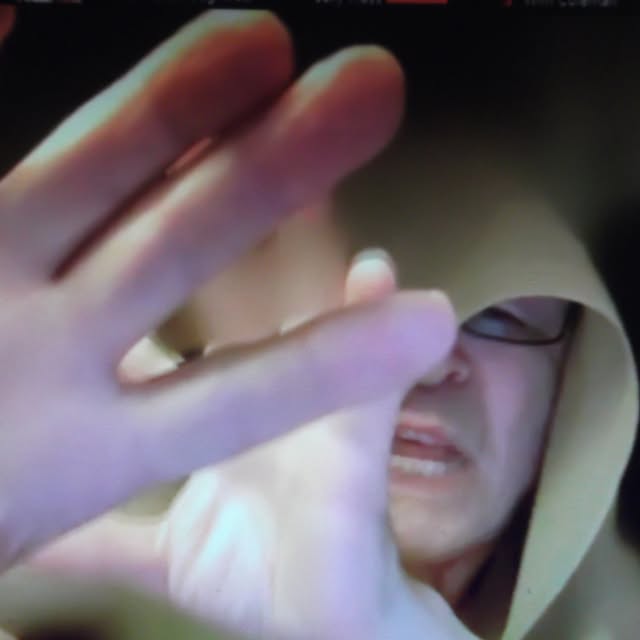
Photo from my computer camera yesterday.

Not that things are working perfectly. Of course there are lost words, dates, and specific memories — but the truth is, I was never good at knowing what happened when. A lot that took place between 1935-2025 doesn’t come into focus easily, but I’ve usually been centered on the present anyhow, or perhaps just outside of time. That has always had its disadvantages, of course, from long-ago history classes to present-day schedules.

The questions people ask about how deserve some thought. Some of the necessities seem to include a decent set of genes, physical activity, and mental and creative interests and efforts. Here are a few that make sense to me.  

Curiosity
What is the trick to aging successfully? If you’re curious about learning the answer, you might already be on the right track, according to an international team of psychologists, including several from UCLA. Click here to read an article by Holly Ober about curiosity and aging.

Optimism
This one gets difficult when the world seems to go askew. But an article in The MIT Press Reader relates optimism and longevity. Click here to read an article by Immaculata De Vivo on this topic.

Change
The flexibility to deal with change is an essential when this much time goes by. Neuroscientist Anne-Laure Le Cunff comments that, “We often think of change as something to endure. But change is how we grow.” Click here to read Le Cunff’s article about how curiosity transforms uncertainty from a threat into an invitation

Make Life an Artwork
An article in the online publication Philosophy Break quotes Nietzsche on finding our true selves and suggests that we “view our lives as an artistic project.” I’d add that you have to be able to think of such a project as open-ended, not something to ever be finished and framed. Click here to read Jack Maden’s article about what Nietzsche has to say about shaping our lives creatively.

Of course there’s no one answer. If we humans can be whoever, whatever, wherever we are — people just relating to other people — we can better enjoy whatever time we manage to have.

Pat