Cold-Blooded Kindness …

Did anybody need a reminder that we’re living through mean times? Whether we needed it or not, we’re getting one right now, as states enact anti-abortion laws that have virtually nothing to do with protecting human life and a everything to do with controlling women’s lives and bodies. What has gone so terribly wrong with our culture?

Aime-Morot-Le-bon-Samaritain

The Good Samaritan by Aimé Morot (1880).

Perhaps our collective empathy is failing us. I’ve certainly thought so for quite some time. So did then-Senator Barack Obama back when he gave a 2006 commencement speech at Northwestern University in which he warned graduates of America’s “empathy deficit” …

[W]e live in a culture that discourages empathy.  A culture that too often tells us our principal goal in life is to be rich, thin, young, famous, safe, and entertained. A culture where those in power too often encourage these selfish impulses.

It’s gotten worse since 2006, as I’m sure Obama would agree. Incivility rears its head all over the place, from hate-filled Trump rallies to petty name-calling and ad hominem attacks on social media. Sometimes it feels like the whole world is descending into what the Indian writer Pankaj Mishra calls the “Age of Anger.”

But is “cultivating empathy,” as Obama proposed, some sort of magic bullet? Maybe—but maybe not. Lately some writers have been suggesting that empathy has its limitations—and also its dangers.

Hanna Rosin recently wrote about the ideas of Fritz Breithaupt, the author of the book The Dark Side of Empathy. Breithaupt turns some of our conventional notions of empathy upside down. For example, while we routinely think of terrorists as lacking in basic human empathy, Breithaupt suggests that they are instead afflicted with an “excess of empathy. They feel the suffering of their people.” Their empathy drives them to commit vicious acts against those whom they suppose to be responsible for inflicting that suffering.

I almost balk at this idea. Still, I’m afraid there’s something to it. Even those of us who are not terrorists can fall into narrow tribalism. It is easy to empathize with people who are like us, and near and dear to us; it is harder to empathize with people who are different and farther away. And this is dangerous. By giving ourselves over to divisive and selective empathy—the kind of empathy that excludes and persecutes the other—Breithaupt suggests that “basically you give up on civil society at that point. You give up on democracy.”

Paul_Bloom_no_Fronteiras_do_Pensamento_Florianópolis_2014_(15062511061)

Paul Bloom
photo by José Luis Somensi

Also, because empathy focuses on individuals, it is just about impossible to exercise in the abstract—which is to say, on any truly large human scale. Empathy is like a spotlight that blinds us to widespread suffering. In his controversial and provocatively-titled book Against Empathy, Psychologist Paul Bloom comments on this “spotlight” problem …

[S]potlights have a narrow focus, and this is one problem with empathy. It does poorly in a world where there are many people in need and where the effects of one’s actions are diffuse, often delayed, and difficult to compute, a world in which an act that helps one person in the here and now can lead to greater suffering in the future.

Bloom is fond of citing a question posed by the Chinese philosopher Mencius: If you are out walking and see a child drowning, what would prompt you to rescue her? Would it be empathy? I can certainly imagine feeling empathy for the child’s pain and terror, and also for her parents’ grief and sorrow should their daughter drown. But when it comes to actually rescuing her, I suspect that Bloom is right in suggesting that I’d rescue the girl because it is simply the right thing to do.

According to Bloom, this may not be an empathetic decision, but it is definitely a compassionate one. We’re not used to making a distinction between empathy and compassion, but they’re really not the same. Bloom quotes a paper by Tania Singer and Olga Klimecki

In contrast to empathy, compassion does not mean sharing the suffering of the other: rather, it is characterized by feelings of warmth, concern and care for the other, as well as a strong motivation to improve the other’s well-being. Compassion is feeling for and not feeling with the other.

Bloom describes this sort of “non-empathetic compassion” as “a more distanced love and kindness and concern for others.” Such compassion involves a level of caring that empathy doesn’t necessarily engage. And because it isn’t easily exhausted, compassion also facilitates sustained, positive action to remedy human suffering.

I can remember my own outrage when the crisis of family separations began at the U.S./Mexico border. Like many Americans, I was devastated by images, videos, and audio recordings of terrified children. But I’ve also experienced a feeling of gnawing helplessness at the sheer number of children who remain separated from their families. My tears did those children no good—but perhaps my modest contributions to the ACLU did. That organization’s tireless effort to reunite children with their families is a task for which empathy seems ill-suited, but for which the more distanced, diffuse, and nuanced emotions of compassion and kindness are essential.

Such thoughts about empathy vs. compassion aren’t exactly new. Zambian writer Namwali Serpell compares Bloom’s notion of non-empathetic compassion with Hannah Arendt’s theory of “representative thinking”

Hannah_Arendt_1924

Hannah Arendt

I find that the best way to grasp the distinction between “representative thinking” and emotional empathy is Arendt’s lovely phrase, “one trains one’s imagination to go visiting.”

I’ve noticed that new developments in neuroscience seem to bear out these ideas. The hormone oxytocin has lately gained what I’m tempted to call “celebrity status.” Because it facilitates empathy, trust, and social bonding, and is released during sex and childbirth, it is popularly known as a “love drug” or “cuddle chemical.” But as sociologist Christopher Badcock points out, oxytocin has a dark side. The empathy that it generates seems to be limited to one’s own group and can actually stir up hostility toward outsiders.

Nevertheless, recent experiments with oxytocin suggest some intriguing possibilities—and maybe even potential therapies. When administered as a nasal spray to human subjects, oxytocin alone does not change preexisting attitudes toward, say, refugees and foreigners. But if a dosage is accompanied by “peer influence” promoting the value of tolerance, subjects show increasing generosity even toward outsiders.

In other words, when administered with a spoonful of advocacy for positive social behavior, oxytocin might help transform “mere” empathy into robust and inclusive compassion. According to researcher Rene Hurlemann, “Given the right circumstances, oxytocin may help promote the acceptance and integration of migrants into Western cultures.”

That’s a tall order. I find it hard to imagine Americans lining up at clinics to get inoculated against xenophobia. Also, the mystique of empathy is so strong that people probably won’t easily give up their unquestioning faith in it. Even when it is painful, empathy makes us feel good about ourselves, promotes a desirable self-image. But there’s a difference between feeling good and doing good, and even between righteousness and doing what’s right.
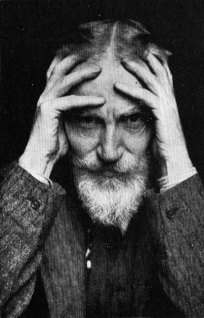
bernard-shaw-on-self-effacement

Bernard Shaw

I’m reminded of the words of playwright Bernard Shaw, who could be notoriously unemotional—even chilly—in both his life and his writings …

The only aim that is at all peculiar to me is my disregard of warm feelings. They are quite well able to take care of themselves. What I want is a race of men who can be kind in cold blood.

—Wim

Beach Scene

—excerpted from Thing of Darkness,
a novel-in-progress by Wim Coleman and Pat Perrin

The tide was coming in. The wide beach where people and dogs had been playing earlier in the day was rapidly growing narrow, and no one was in sight. My timing was excellent—not just the hour but the season. While I especially love the coast during the gray and stormy winter, the Pacific is plenty mysterious and daunting in the fall.

I spotted a familiar rock, the largest in a decrepit old breakwater of scattered and piled-up boulders reaching out into the sea. I took off my shoes and socks and dropped them on the sand, then rolled up my pants legs. I waded a little way through icy water that rose partly up my calves, climbed up on the rock, and sat down on it—a perch I’d enjoyed since I was a little girl. The wind was cold and sharp, and waves rolled in on both sides of the line of stones.

I’ve been to other beaches, some in tepid humid parts of the Atlantic, all full of things that sting, pinch, or slide out from under your feet. But the sea life out east is prosaic and familiar, and in most places the ocean isn’t particularly treacherous. Even on the West Coast, some of the more southern shores are docile enough if you don’t go out too far.

But northwestern waters are not for lubberly humans to enter casually. Just to wade in the shallows is to invite getting sucked out to sea by a powerful undertow or swept away by a giant sneaker wave appearing out of nowhere. No, the coast in those parts is the domain of cunning things living beneath that gray surface—and you never really get to know those creatures.

Staring off into that ambiguous stretch of sea lying between the shore and the true deeps, I glimpsed some of them—three hulking shadows of unidentifiable beasts drifting by, not distant enough to be whales, but too big to be anything a swimmer would want to run into.

Beyond those parts, out in the depths far, far beyond the horizon, were live creatures to stagger and puzzle the mind—great blue whales, undulating manta rays, seldom-seen and semi-legendary giant squids, to say nothing of primordial dwellers of unspeakably deep subaquatic canyons near scalding hydrothermal vents, those scale-armored snails, eyeless shrimp, red-plumed tube worms, and heat-thriving eels, all so weird and alien that they’d be just as much at home in the watery abyss of Jupiter’s planet Europa as here on Earth.

Even so, I’m not one to ponder the depths all that much. The deceptively intimate shoreline shallows are plenty inscrutable for my reckoning. Right down below my dangling feet, what had recently been damp sand now lay beneath a foot of water, a foamy world populated by tiny creatures that had emerged now that the tide sequestered them and invited them forth. But even the afternoon daylight was powerless to fully reveal those frolicking sprites. What were those wet shadows flitting by? I couldn’t tell. Some serpenty shape writhed before me, then slipped away before I could detect whether it was plant or animal.

Here, right here, I thought. Here lies the answer to every mystery that will ever trouble me.

If only my eyes could lucidly penetrate the chaotic rippling refraction of the water, if only I could reach down and pick up the right rock and look under it, if only I could cup my hands and capture an ounce of salt-saturated truth like a fluttering butterfly …

If only.

I’d understand it all.

No demon could mystify or frighten me.

But it wasn’t to be, not while my skull was young and thick.

Maybe when I was old and soft and supple like Monty and Beth, this place would tell me all.

But not now, not yet.

I’d have to wait to achieve that kind of ripeness.

And I could wait. I’d be patient.

I lifted my face to gaze at the sea. At that moment, a breaker swept along the breakwater before me and blew sharp spray into my face. The clouds suddenly split, and the late afternoon sunlight set the waves ablaze.

Laughter rose up in me—a kind of laughter I’d experienced before, but only in this very spot. It’s an extraordinary laughter that both affirms and denies, delights and grieves, embracing all that is joyful and tragic in life, true and ambivalent, the kind of laughter that makes the heartiest common workaday laughter seem weak and puny. I knew the laughter would be gone in an inkling, so I gave it free reign, letting it rumble ferociously out of my belly to fill up the sparkling sky, as mighty as the surf itself.

The clouds closed, the sun vanished, and my laughter ended. A sadness settled deep in my chest—a strange, good, healing sadness that always comes in the wake of such spells of cosmic laughter.

My communion with the sea had reached its lovely consummation.

It was time to go back to the house.

On the Literary Map

safe_imageThe North Carolina Literary Map has put up pages for each of us, listing our mainstream novels, anthologized works, and many of the titles from our years of making a living writing for educational publishers. Since most of our work is co-authored, the lists are much alike except for Pat’s book about unicorns and Wim’s published plays. Our more recent income is from ghostwriting, so we can’t give you those titles, but they include 3 nonfiction books and 17 short mysteries—so far.

Pat’s page

Wim’s page

in translation…


This week I was delighted to receive a Polish translation of one of my stories. It was attached to a very nice email from Elżbieta Kalinowska of Wroclaw University asking to use my retelling of a West African myth in a book she’s working on. I promptly gave permission.

She has translated my story into Polish. She explains that in Poland the national curriculum includes teaching a foreign language — most often English — from the last year of kindergarten and then continuing with that language in school. I’m happy to contribute to that. There’s considerable research showing the benefits to the brain of being bilingual. (Sometimes I think that the bit of Spanish I learned in Mexico is all that’s keeping my own brain going.)

Dr. Kalinowska holds a PhD in pedagogy and has worked for 25 years as a university teacher. She says:

The book will have introduction about storytelling, then the Anansi story in Polish, and then 16 simplified stories in English with illustrations and some tips for teachers. 

tiger illust

Illustration by Donata Golenia

Her friend, graphic artist Donata Golenia, is making terrific illustrations.

A shorter version of “Anansi and the Box of Stories” was originally published in READ magazine (English).

—Pat

Click here for the English version: anansi_stories

“The time is out of joint.” —Hamlet, 1.5

These days, any American with a functioning moral compass knows exactly how Hamlet felt when he said that. It’s a bit of a cliché that Shakespeare has something to say about virtually everything. So it’s hardly any wonder that we turn to Shakespeare’s eloquence and stories for insights concerning the catastrophe we now undergo.

But which play to choose, the selection being so rich?

Julius Caesar, the story of a tyrant brought low by his own ambition, has been a popular choice lately. Last year in New York, a production by the Public Theatre controversially (and unsubtly) portrayed the assassination of “a petulant, blondish Caesar in a blue suit, complete with gold bathtub and a pouty Slavic wife.” Richard III, with its Machiavellian antihero rising to power by nefarious means, is also much in vogue. And Professor Eliot A. Cohen recently likened Donald Trump to Macbeth, whose nearest allies turn against him as his criminal reign collapses.

Nobody ought to push any of these analogies too far. Donald Trump does not have the makings or the stature of a Shakespearean tragic hero. He has none of Julius Caesar’s nobility, Richard III’s articulate wit, or Macbeth’s introspective anguish.

1024px-Lear_and_the_Fool_III.ii.jpg

A watercolor of King Lear and the Fool in the storm from Act III, Scene ii.

Nor does our president much resemble King Lear, who learns humility and decency in the depths of suffering and madness. Even so, it seems to me that King Lear speaks more about the crisis of Trumpism than any other Shakespeare play. And that, I think, is because King Lear has less to say about Donald Trump himself than it does about the world that is crumbling around him—and around us.

The story is familiar and deceptively simple, almost like a fairy tale. An old king foolishly decides to abdicate his authority and divide his kingdom among his three daughters. To decide which daughter will receive the greatest share of his kingdom, he puts them to a famous test …

“Which of you shall we say doth love us most …”

Lear rewards two daughters, Goneril and Regan, for their elaborate flattery, but he furiously disowns and banishes his favorite daughter Cordelia for her honesty and bluntness. Chaos ensues as Goneril and Regan subdue their father into beggarly destitution; he spends much of the play wandering through his forfeited kingdom in a state of madness—a madness which sometimes graces him with paradoxical wisdom. For example, in a moment of crazed lucidity, Lear captures the very essence of Trumpism …

LEAR. Thou hast seen a farmer’s dog bark at a beggar?
GLOUCESTER. Ay, sir.
LEAR. And the creature run from the cur—there thou mightst behold the great image of authority: a dog’s obeyed in office.

1024px-James_Barry_002.jpg

King Lear mourns Cordelia’s death, James Barry, 1786–1788

Lear’s abdication of authority creates a moral vacuum much like the one we inhabit right now—a vacuum in which norms of decency are threatened and largely destroyed. Catastrophe after catastrophe unfolds, tearing the kingdom to pieces and leading inexorably toward the play’s ultimate horrifying tableau—King Lear carrying his dead daughter Cordelia onto the stage, literally howling with animal grief before his own heart breaks forever.

During that last scene, the surviving characters are stricken with such despair that they wonder whether the world itself can endure …

KENT. Is this the promised end?
EDGAR. Or the image of that horror?

We might well wonder the same, for our situation is similarly dire. A manifestly egotistical and unstable man now has the power to unleash nuclear war. And faced with the possibility that the planet may soon become uninhabitable to humanity, Trump brazenly enacts policies that will hasten climate change.

Is there any hope at the end of Lear? Is there any hope for us now? Shakespeare’s nihilistic vision offers no easy reassurance. But there’s a strange idea lurking inside this savage play that merits parsing.

Three men are left standing at the end of King Lear—all of them capable of moral decency. King Lear’s exiled ally, the Earl of Kent, has spent the whole play loyally serving his master in disguise. The young Edgar, having survived his bastard brother’s machinations against him, has escorted his brutally blinded father to a peaceful death. Even Goneril’s husband, the once vacillating Duke of Albany, has at long last learned to follow the dictates of his conscience.

The task of rebuilding on the ruins of civilization finally falls to them.

Meanwhile—and I think this is terribly important—the evils that triggered and fueled the story’s chaos have been exhausted and destroyed. The Trump-like villains, duplicitous and opportunistic as they’ve been, have failed to stave off their own destruction. Obedient to their own vicious natures, they have inevitably turned their treachery against each other. Before they could quite destroy the frail, surviving goodness in the world, they have destroyed themselves.

The evil of Trumpism is already playing itself out in such a manner. Trump’s once-trusted allies—Michael Flynn, Michael Cohen, David Pecker, and Paul Manafort among them—are turning against him one by one. How could they do otherwise, given that their illusory loyalty was always founded upon self-interest, never on honor or decency?

So perhaps the grim denouement of Trumpism is already underway. Meanwhile, we who have witnessed this terrible spectacle with morally undeluded eyes must look to the future; it will be up to us to build upon the ruins.

800px-King_Lear.jpg

King Lear, by an unknown artist.

Lear, in the depths of his suffering, may have a lesson to offer in this effort. Shorn of power, authority, possessions, and dignity, thrust out onto a storm-blasted heath to make his way like a beggar, Lear at last learns to empathize with those who suffer in oblivion …

Poor naked wretches, whereso’er you are,
That bide the pelting of this pitiless storm,
How shall your houseless heads and unfed sides,
Your loop’d and window’d raggedness, defend you
From seasons such as these? O, I have ta’en
Too little care of this! Take physic, pomp;
Expose thyself to feel what wretches feel,
That thou mayst shake the superflux to them,
And show the heavens more just.

Like Lear, we have long “ta’en too little care of this,” leaving a moral vacuum in which Trumpism has arisen to run its ruthless course. To fill that vacuum, we must build a just and compassionate society.

It’s time to get started.