Concerning Wisdom—Old and New

“There is no such thing as ancient wisdom; it is always new.”
Thus Spake Aforista

Count on the Postfuturist Sage Aforista to say something strident, hyperbolic, and even untrue. Of course there is such a thing as ancient wisdom, and of course we all need to be mindful of it in this speed-of-light age of rampant newness—what Douglas Rushkoff has dubbed Present Shock. As the authors of a recently published novel exploring Mayan culture of a millennium ago, Pat and I would seem to be active proponents of ancient wisdom.

And yet …

Mayan-72Is Mayan Interface really about ancient wisdom at all? There are certainly aspects of indigenous culture that Pat and I extol. In my post of February 13, I wrote about our fascination with Mayan storytelling techniques. A related excerpt written in authentic Mayan fashion may be found in the current issue of SOL: English Writing in Mexico.

But readers looking for a quick and easy fixes based Mayan ancient wisdom will surely be disappointed by our book. Pakabtun’s fictional king Bohol Caan has no more of a grasp on certainty ca. 900 CE than epigrapher Lydia Rosenstrom does in 2012 CE. In our novels, Pat and I just don’t do certainty.

Just yesterday, Pat asked me if any of our novels even had “endings” to speak of. Could I think of just one that culminated in some final resolution, realization, or insight? No, I couldn’t. While I hope that all of our stories have satisfactory and satisfying denouements, Pat and I always leave our protagonists on the brink of fresh discoveries, as if another turn of the page will lead into an entirely new adventure. “And that’s essential,” Pat remarked.

One of my favorite twentieth-century plays is Bernard Shaw’s little-known The Simpleton of the Unexpected Isles. In this 1934 extravaganza, an angel arrives, announcing that the Day of Judgment has come. This is not to be the noisy apocalypse of the Book of Revelation, the angel explains:

The Day of Judgment is not the end of the world, but the end of its childhood and the beginning of its responsibility.

According to the angel, there will be no reward or punishment, no heaven or hell—only the quiet vaporization of almost all of humanity:

The lives which have no use, no meaning, no purpose, will fade out. You will have to justify your existence or perish.

The play’s characters are understandably unsettled by this proclamation. How can anyone ever “justify” one’s existence? Whose life can assuredly be said to have use, meaning, and purpose? None of the characters can answer these questions, and one by one they vanish—accompanied, presumably, by most if not all of the human race.

Finally, only two people remain onstage: the priestess Prola and her husband, the priest Pra. Fully aware that their lives have been engaged in folly and futility, Prola and Pra expect to evaporate at any moment. But that moment never comes.

Flawed, failed, and seemingly useless as they are, Prola and Pra share the redemptive belief in the doctrine, “Let Life Come.” And this doctrine is, after all, merely a denial of all doctrines, of all beliefs.

Prola and Pra prevail through the Judgment, for together they grasp that “the future is to those who prefer surprise and wonder to security.” As Prola puts it,

Remember: we are in the Unexpected Isles; and in the Unexpected Isles all plans fail. So much the better: plans are only jigsaw puzzles: one gets tired of them long before one can piece them together. There are still a million lives beyond all the Utopias and the Millenniums and the rest of the jigsaw puzzles.… We are not here to fulfill prophecies and fit ourselves into puzzles, but to wrestle with life as it comes. And it never comes as we expect it to come.

So I suppose Aforista may be onto something after all. There are no endings in the world of Story. There is only wisdom’s perpetually unfolding newness.

Jaynesiana

9k=I must admit that I’m fairly obsessed with the ideas of the late psychologist Julian Jaynes. If you’ve been following these posts, I’m sure you’ve noticed. Just about everything that Pat and I write has been influenced by his mind-blowing classic, The Origin of Consciousness in the Breakdown of the Bicameral Mind. Our latest visionary novel Mayan Interface is steeped in his thinking.

I recently finished reading The Julian Jaynes Collection, a splendid new anthology of Jaynesiana edited by Marcel Kuijsten. I found the last half of the book to be a special treat. Consisting of interviews and discussions, it brings me closer to the man himself than I ever hoped to get.

Here’s an exchange that I particularly like. In an interview with Sam Keen, Jaynes says this about the ongoing evolution of human consciousness:

We are still in transition, entering into the gateways of a different kind of mentality.

At the end of the interview, Keen comes back to this point:

It would seem that we are becoming freer. Is history pushing us toward enlightenment, toward waking up from the illusion that we must be blindly obedient to external authorities?

I love Jaynes’s reply:

What interests me is the metaphors you use: freedom, awakening, the passage from darkness to light. You are creating or changing consciousness by metaphors. In my value system, the effect of those metaphors is to strengthen the individual, to change consciousness for the better. But I am mostly aware of what the metaphors are doing. When you ask me what we are becoming, it is like asking me to choose one of a thousand roads. It’s like asking how history is going to end up. To ask for an end or a purpose is to ask for a single path. And consciousness is always open to many possibilities. It is always an adventure.

Pat and I put it this way in an interview with each other:

Our protagonists learn to abdicate certainty and safety. Life is risk. Transformation means never knowing what will happen next—or even what or who you will become. Nothing that’s evolving ever knows exactly where it’s going.

Mayan Storytelling

Mayan-72“Happens all the time,” says Coyote. “That’s what myths do. They happen all the time.”
Ursula K. Le Guin, Dancing at the Edge of the World

Pat and I like this quote so much that we put it at the beginning of our new novel, Mayan Interface. It sums up a lot of our thinking about Story (with a capital S).

Mayan Interface is set in two different times. One is during the fall of the (fictional) Mayan kingdom of Pakabtun during the Terminal Classic period, around A.D. 900. The other is the present day—or last year, to be precise—when a breach between past and present occurs in cyberspace, and primal shamanism and today’s information technology become pretty much one and the same thing.

As we researched the book, Pat and I studied Mayan storytelling. We were especially fascinated by Allan F. Burns’s 1983 collection, An Epoch of Miracles: Oral Literature of the Yucatec Maya. The stories that Burns brings together are a crazy quilt collage of old and new, traditional and contemporary, fictional and true. Incongruity reigns as Christianity collides with Mayan myth and religion, and as worldly personae mingle with the mythic and the holy—for example, Jesucristo, “Beautiful Woman Honored María,” and “Wonderful True God” turn up in the same story as Richard Nixon.

Regarding the oral performances he took part in while gathering his tales, Burns writes,

In Yucatec Mayan, it is not possible to say “tell me a story.” Instead, the only way to bring a story into verbal expression is to ask someone to “converse” a story with you.

Or as our protagonist, Lydia Rosenstrom, puts it,

All speech is dialogue to the Maya.

We incorporated this idea into our novel, modeling whole chapters on the Mayan oral tradition. Here we set the scene for a Yucatec storytelling session:

The three people all understood their parts perfectly. As the principal storyteller, Nacho would do most of the talking. As his designated respondent, César knew the story, too, and would prod the narrative along with questions and comments. As for Julio, he knew better than to commit the unspeakable rudeness of keeping utterly silent during Nacho’s tale. He, too, would make his voice heard in small but crucial ways as the story unfolded …

Pat and I hope that we put this philosophy to use in our novel as a whole, and that Mayan Interface is as much a conversation with the reader as it is a fixed narrative. And we hope the conversation continues after the book has been read, passing on to other people. In all of our stories, we’re not interested in imparting truths so much as we are in prompting questions, getting dialogues going, and generally stirring the hot, tasty, and variegated stew of evolutionary possibilities.

That sort of open-endedness is a part of the Mayan tradition. In Burns’s book, we noticed that a Yucatec tale never seems to take place in time at all. One notably haunting story tells of a Mayan hunter who slays a magical deer belonging to the Master of the Deer. The hunter perishes because of his hubris, and at the end of the tale the storyteller emphatically says,

“WHEN I PASSED BY, HIS FUNERAL WAS IN PROGRESS.”

When I read that story, I felt almost as though I glimpsed his funeral as well.

Maybe all of us did …

… or do …

… or shall.

Like all myths, it happens all the time.

And everywhere.

__________

We also visited specific sites, see Researching the Maya

Shared Story

How much are we shaped by stories told by others?

I left that question hanging at the end of my last post. As it happens, the ever-popular neurologist Oliver Sacks touched on it in a recent article. In his 2001 memoir, Uncle Tungsten: Memories of a Chemical Boyhood, Sacks recalled a childhood incident that took place during the London Blitz of 1940-41. Here’s how he described it in his book:

[A]n incendiary bomb, a thermite bomb, fell behind our house and burned with a terrible, white-hot heat. My father had a stirrup pump, and my brothers carried pails of water to him, but water seemed useless against this infernal fire—indeed, made it burn even more furiously. There was a vicious hissing and sputtering when the water hit the white-hot metal, and meanwhile the bomb was melting its own casing and throwing blobs and jets of molten metal in all directions.

Not surprisingly, the incident was seared on Sacks’s memory in fearsome detail. But after his memoir was published, Sacks found out something alarming. He hadn’t been at home during the time of the firebombing. He had learned about it via a letter from his brother—a letter so vivid that the incident eventually became, for him, indistinguishable from a true memory.

Sacks’s error prompted him to consider how our memories can be altered by written accounts, photographs, verbal narratives, and countless other sources. He realized that “source confusion” leads not only to “fallibilities, frailties, and imperfections” of memory, but to “great flexibility and creativity”:

It allows us to see and hear with other eyes and ears, to enter into other minds, to assimilate the art and science and religion of the whole culture, to enter into and contribute to the common mind, the general commonwealth of knowledge. This sort of sharing and participation, this communion, would not be possible if all our knowledge, our memories, were tagged and identified, seen as private, exclusively ours. Memory is dialogic and arises not only from direct experience but from the intercourse of many minds.

Devoted as we are to the topic of Story (with a capital S), and also to collaboration, Pat and I might put it this way:

Consciousness itself is an act of collaborative storytelling.

So to return to my question, “How much are we shaped by stories told by others?” The answer would seem to be, “Enormously.” And all of our lives are richer for it. As the late psychologist Julian Jaynes pithily put it,

We are all subjects, one of another.

Concerning Bones and Thrones and Parking Lot Stones

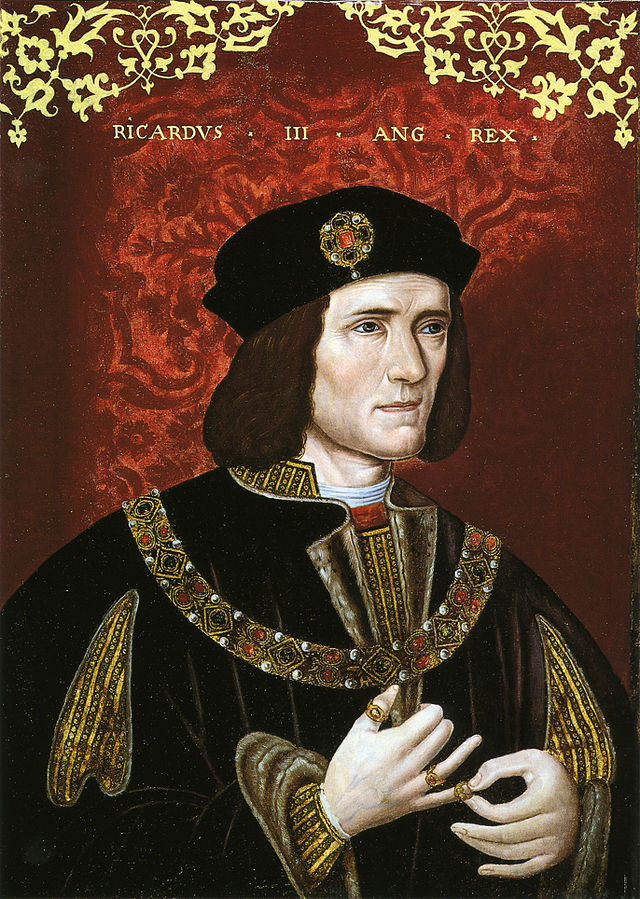
640px-King_Richard_IIIIt’s a story perfectly suited for a blog entitled “Story.”

I mean the recent unearthing of the bones of King Richard III under a parking lot in Leicester—a discovery so fresh that the bones are still cold, so to speak. The find has me thinking about another king, a currently reigning queen, and the power of Story to shape their lives and ours.

Not surprisingly, the find has rekindled that hoary debate about the character of the Plantagenet monarch, who reigned between 1461 and 1483. His popular image comes from Shakespeare’s tragedy Richard III, in which he is portrayed as murderous and conniving, both physically and morally deformed. The real Richard, who reigned from 1483 until his death in 1485, seems to have been a well-meaning reformer whose good works were thwarted by the brevity of his reign.

All that’s unfair, of course. But I can’t help fretting about a monarch even more unjustly reviled than Richard III, and that’s King Macbeth of Scotland. Once again, the Bard is the chief culprit in his defamation.

As Garry Wills shows in his book Witches and Jesuits, Shakespeare’s Macbeth is as much a propaganda piece as it is a literary masterpiece. Written in the wake of the notorious, failed “Gunpowder Plot” of 1605 to blow up the British Parliament, the play is filled to the brim with scarcely veiled flattery to the reigning King James I, who claimed descent from the play’s King Duncan and quasi-mythical Banquo. If Shakespeare’s earlier Richard III was a paean to Tudor rule under Elizabeth, Macbeth was a paean to the ascendency of the Stuarts under James.

Shakespeare’s story has precious little to do with facts. King Duncan, whom Shakespeare portrays as blameless, kindly, and fatally naïve, was actually a cruel, aggressive, war-mongering, and rather incompetent tyrant whose six-year reign was bloody and oppressive. Macbeth had good reason to get rid of him, and he did so in open combat, not while he lay asleep as a guest in his castle.

As for Macbeth himself, Scotland greeted him as a welcome change and prospered under his reign of nearly two decades. He ended long wars, generously supported monasteries, preserved the Celtic language and traditions, and made a holy pilgrimage to Rome. Macbeth’s defeat by Malcolm in 1057 with English aid was nothing for the Scots to cheer about.

As Marc Antony said of the title character in Julius Caesar,

The evil that men do lives after them:
The good is oft interred with their bones.
So let it be with Caesar.

And so let it be with both Richard III and Macbeth. But let’s pause to consider the power of Story to transform a person’s life. Is the Richard III whose bones lay under that parking lot fundamentally more real than Shakespeare’s “subtle, false, and treacherous” Machiavellian fiend? And is the historically benign Macbeth more real than Shakespeare’s murderous necromancer?

The cognitive philosopher Daniel C. Dennett once chatted with the fictional Hector Glasco about the supremacy of public image over private reality:

I remember some years ago seeing on the BBC in England a series of interviews with young schoolchildren … about Queen Elizabeth II. And they were asked, “Well, what does she do? Tell us about her day.” And it was fascinating. These children were very sure they knew exactly what the queen did. For instance, she vacuumed Buckingham Palace while wearing her crown. And she sat on her throne while she watched television, things like that. It was wonderful. And it struck me then that [the children’s beliefs about] Elizabeth II … had a much more important role to play in British social history than the actual living woman … and also had a certain power over her.jvpold-new

So let it be with Queen Elizabeth II.

And as for the rest of us …
… how much are we shaped by stories told by others?