The Lullaby Tree

Image

My new play, The Lullaby Tree, is now available in paperback. It is inspired by the shortest verse in the King James Bible:

Jesus wept. —John 11:35

Here’s a bit of PR copy:

A no-holds-barred literary and theatrical extravaganza of ideas, The Lullaby Tree reels riotously between prose and verse, vulgarity and beauty, farce and heartbreak, earthiness and mysticism.

Of course I pay my publicist good money to write this kind of hype. Even so, I hope it’s not completely undeserved. Unlike my other plays, I’d say that this one is aimed more at readers than theatrical audiences, making it what theater history books call a “closet drama.” It begins with a deus ex machina and ends with (SPOILER ALERT) the annihilation and rebirth of the universe. And since this is the first installment in a tetralogy, the remaining three plays will have bigger fish to fry.

Although trying to stage it might prove to be downright quixotic, I won’t object if a sufficiently brash director decides to tilt at this particular windmill.

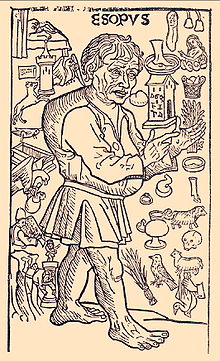
Here’s an excerpt from early in Act II. The scene is a grove on the island of Samos. At this point in the story, the legendary Aesop has not yet received his divine gift of storytelling. He is still a mute slave—and an amazingly ugly one. His job is to dig holes for no particular reason. His overseer, the Steward, is giving him orders.
Image

STEWARD. But—hold it now.

(AESOP stops digging.)

STEWARD.  Take note of this tree—Ficus carica, the common fig, though of most uncommon stature. Observe the breadth of its trunk, the robustness of its limbs. Odd, I’ve never stopped to look at it before. A reverend specimen. Though dormant for the winter, it’s clearly alive—observe its scattering of leaves. Be careful of its roots as you dig. Don’t want to do it harm.

(AESOP starts digging again. The STEWARD moves toward the tree.)

STEWARD.  Hold it now.

(AESOP stops digging. The STEWARD stares at the tree in silence for a moment.)

STEWARD.  I happen to know a story about a tree such as this. There once was a prophet. A prophet of love. Went around preaching that there was nothing but love. Even the gods were nothing but love. In fact, there were no gods, since love was the only real thing there was. Inhuman teaching it was, just awful, terrifying to think about.

Well, naturally, the authorities put a death sentence upon the wretch for saying such a thing. He right well knew they would all along—knew they had no choice, what else could they do? He went to the big city to turn himself in.

On his way there, along the road, he and his followers came across a fig tree—just like this one. And just like now, it wasn’t the season for figs, too early for them. A perfectly healthy fig tree with a few leaves on it, but no figs. The prophet was hungry, and on his way to his own execution—but no figs.

He got angry. He said to the tree, “Let no man eat your fruit, from this time forever.” And the tree withered at once, and all its leaves fell.

And the prophet’s followers stared on with horror. They murmured to each other, “How quickly the fig tree withered away!”

And the prophet overheard them and said, “Love with all belief, believe in nothing but love. For whoever loves completely, with all his heart, may say to a mountain, ‘Go away from this place and throw yourself into the sea,’ and that very thing will happen. If you love completely, with all your heart, whatever you command will come to pass.”

Odd sort of story.

A prophet of love, but so full of rage that he murdered a tree.

Can’t get my head around it, somehow.

(The STEWARD and AESOP stare at the tree in silence for a moment.)

STEWARD.  But you know, I almost half believe it. The whole world, the whole universe—nothing but love everywhere, as far as the eye can see, as far as the ear can hear, as far as thought can reach. Gnaws at my guts to consider it, but it seems true somehow. Wish it weren’t, but there doesn’t seem to be any way around something that’s true, once it gets stuck inside you.

Which is why I’d never tell this story to anyone but a mute idiot like you.

There’d be real hell to pay if such a truth got out.

Think of what would happen.

No one would take thought for anything in life—not what they ate, nor what they drank, nor what clothes they wore. For behold the birds of the air: they don’t sow, nor do they reap, nor do they gather into barns, yet they stay well-fed. And consider the lilies of the field: they don’t work, nor do they spin, and yet they go more handsomely clothed than the richest princes of the earth.

But we’re not birds, and we’re not lilies.

How could we bear such a life?

Happier digging holes, we are.

Small Talk in the Worlds of WEIRD and un-WEIRD

“Save oxygen: stamp out small talk.”
Thus Spake Aforista

jpegI seldom agree wholeheartedly with the Postfuturist Sage Aforista, but I’m right on board with this saying. Whenever small talk starts, Pat and I both glaze over and remain in a quasi-catatonic state until the conversation returns to something real. As someone who loves language and works with it every day, I find small talk downright offensive. I once had an English teacher who loathed slang, calling it an “abuse of language.” I actually like slang, and agree with Steven Pinker that it enriches and enlarges language. But small talk is another matter. It does use up precious oxygen, and it clutters up the brain.

Call me a snob if you like. I don’t see it that way. Here’s what I’ve always thought: When human beings lived closer to nature and to each other, surely nobody wasted time on pointless blather. Surely small talk is a sign of language in its decadence; we “civilized” people talk in inanities because we don’t give our brains enough meaningful stuff to think about. We’re mentally just plain lazy.

But Jared Diamond’s new book, The World Until Yesterday, has given me cause to reconsider. Subtitled “What Can We Learn from Traditional Societies?”, Diamond’s book reflects upon years of fieldwork among people living traditional lifestyles. It is an unsentimental assessment of what we in the world of WEIRD (Western, Educated, Industrialized, Rich, and Democratic) have to learn from traditional peoples. Diamond points out that small talk was hardly invented by us WEIRD people:

I have been impressed by how much more time New Guineans spend talking with each other than do we Americans and Europeans. They keep up a running commentary on what is happening now, what happened this morning and yesterday, who ate what and when, who urinated when and where, and minute details of who said what about whom or did what to whom. They don’t merely fill the day with talk: from time to time through the night they wake up and resume talking. That makes it difficult for a Westerner like me, accustomed to nights spent in uninterrupted sleep and not punctuated with conversations, to get a good night’s rest in a hut shared with many New Guineans.

So these uncorrupted children of nature are not communicating gems of ancient wisdom; they’re engaged in the idlest possible chat about food and bodily functions and what have you. (Diamond calls it “gossip” because it consists of people talking about other people; I call it “small talk” because it is about trivialities. Let’s just treat the two terms as interchangeable.) What’s more, explains Diamond, small talk serves perfectly valid functions in the non-WEIRD world. In a society lacking in mass media, it is a justly valued form of entertainment; in a community where interdependence is crucial, it is a way to create and sustain social relationships; in a habitat where danger is everywhere, it is a source of precious information about every possible contingency.

But in his review of Diamond’s book, Steven Mithin goes further …

The value of gossip provides one of the best theories for the evolution of language among our hominin ancestors …

I can’t say I much like this possibility. I prefer Julian Jaynes’s idea that the first words were warnings: not nouns or even verbs, but modifiers like “far,” “near,” “slow,” or “fast”—utterances to communicate the proximity of danger and the urgency to do something about it. That idea appeals to me, because it suggests that language has its origins in matters of life and death importance.

But maybe it’s just not so. Maybe primordial language was all about bowel movements, embarrassing physical mishaps, and spur-of-the-moment sexual encounters—a cultural step lower even than People magazine.

Surely none of this justifies the continued use of small talk by our species. As Diamond also points out, we crave salt and carbohydrates because they were once so hard to come by; now that we’ve got them in abundance, such cravings have become hazardous to our health. It seems to me that our craving for small talk is likewise toxic—an adaptation that has long since turned maladaptive, causing the mental equivalents of hypertension and diabetes. If we can cut down on unhealthy substances at the dinner table, can’t we do the same on Facebook and Twitter?

P.S. to “That Other Darwin”

In my previous post, I certainly didn’t mean to “diss” Charles Darwin by calling him the “consummate hedgehog.” The world of ideas must have its hedgehogs as well as its foxes. It is true that Charles’s überfox grandfather Erasmus anticipated a lot of evolutionary theory, including Natural Selection, many years before Charles got around to it. Charles’s contemporary, Alfred Russel Wallace, also figured out the basics. But neither Erasmus nor Wallace gathered the sheer weight of evidence needed to make their ideas stick. It took the world’s greatest hedgehog to do that.

And Charles came by his ideas the hard way, with no noticeable influence from his grandfather. True, he read a book by Erasmus when he was seventeen “in which similar views are maintained, but without producing any effect on me.”

Charles’s way was longer and more tortuous. To begin with, he had to let himself be amazed and puzzled by the sheer diversity of life he observed during his youthful, legendary, worldwide journey aboard HMS Beagle.

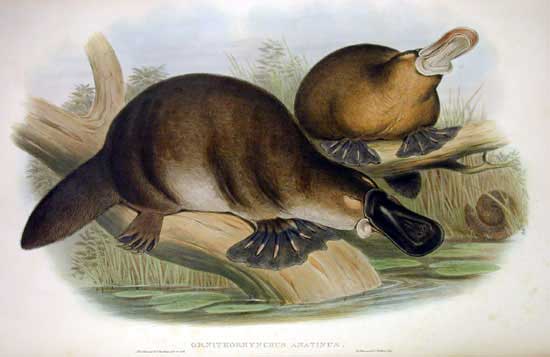
In an age in which the first two chapters of Genesis were almost unanimously accepted as the final authority on natural history, what was young Charles to suppose upon seeing his first platypus in Australia? Why would an all-creating God scatter such anomalous creatures in entirely different parts of the world? His earliest speculation was about as far from evolution as you can get:

An unbeliever in every thing beyond his own reason might exclaim, “Two distinct Creators must have been at work; their object, however, has been the same, and certainly the end in each case is complete.”

“Two distinct Creators”! It was as heretical an idea as Natural Selection would later prove to be. But young Darwin was not an “unbeliever”—not yet, anyway. Soon after his encounter with the freakishly odd platypus, he took comfort in noticing that the Australian antlion larva was very similar to a European species. Such a resemblance, he thought, could be no cosmic coincidence:

Now what would the sceptic say to this? Would any two workmen ever have hit upon so beautiful, so simple, and yet so artificial a contrivance? It cannot be thought so: one Hand has surely worked throughout the universe.

“One hand” creating, of course, in a manner consistent with Genesis. But Charles Darwin’s Story was just getting started.

Platypus-sketch


That Other Darwin

Here are a few lines to celebrate National Poetry Month

Organic life beneath the shoreless waves
Was born and nurs’d in ocean’s pearly caves;
First forms minute, unseen by spheric glass,
Move on the mud, or pierce the watery mass;
These, as successive generations bloom,
New powers acquire, and larger limbs assume;
Whence countless groups of vegetation spring,
And breathing realms of fin, and feet, and wing.

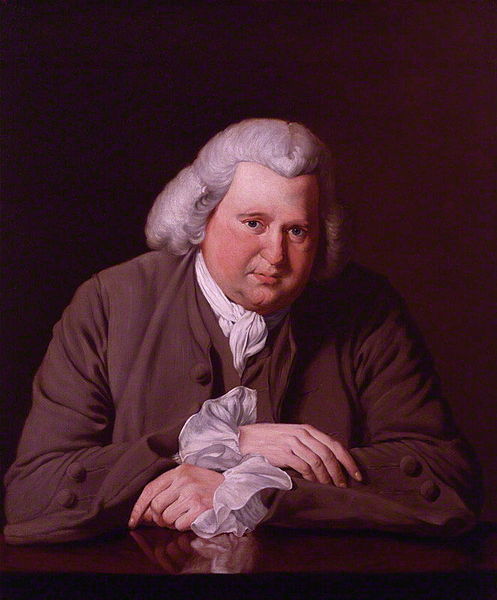
This poetic description of biological evolution was written by Darwin—not Charles Darwin, but his grandfather, Erasmus. And they appear in his poetic masterpiece, The Temple of Nature, posthumously published in 1803.

Erasmus Darwin formulated ideas about evolution (including Natural Selection) during the late eighteenth century, and proposed that all earthly life was descended from a “single living filament”—pretty much the orthodox view of today’s science. His grandson wouldn’t get around to publishing On the Origin of Species, now considered the founding text of evolutionary theory, until 1859.

I just finished re-reading Desmond King-Hele’s inspiring biography, Erasmus Darwin: A Life of Unequalled Achievement. It brought to mind my post of last year about proverbial foxes and hedgehogs. Remember the words of the ancient Greek poet Archilochus?

“The fox knows many things, but the hedgehog knows one big thing.”

If Charles Darwin was the consummate hedgehog, devoting decades at a crack to the single idea of Natural Selection, then Erasmus Darwin was the ultimate fox—a veritable überfox whose accomplishments ranged across all disciplines, all areas of knowledge. Consider just a smattering of facts about him:

He was longtime friends of Joseph Priestley, James Watt, Josiah Wedgewood, and most of the other the intellectual giants of his time. While he maintained a thirty-year friendship with Benjamin Franklin, the great Samuel Johnson was too daunted by Darwin’s genius to have much to do with him.

Erasmus was a philosopher-scientist of the first order, and a member of Britain’s Royal Society. He invented a copying machine and a voice synthesizer. He understood the electrical nature of nerve impulses before Luigi Galvani and Alessandro Volta performed their experiments with frogs’ legs and muscle contractions. He explained the formation of clouds, cold and warm fronts, and the basics of photosynthesis. He was a pioneer in understanding oxygen; he described how the heart and lungs oxygenize blood, and proposed that water was made up of oxygen and hydrogen.

He was a humanitarian who opposed slavery. As a physician, he gave free medical service to the poor. He was an early feminist who advocated education for girls and women, and he insisted on referring to our species as “humankind” instead of “mankind.” Although an Englishman, he was courageously pro-American during the Revolutionary War and supported the French Revolution. A committed freethinker, he advocated a secular morality based on compassion, and he felt touched and honored when the Pope condemned one of his books.

He was also more than a bit of a prophet. He proposed rockets powered by liquid fuel, a goal unrealized until the twentieth century. He dreamed up an internal combustion engine (one which would not pollute!) and designed a steering mechanism that would eventually be used in early automobiles. Some of his speculations are prescient of black holes, the Big Bang, and the DNA molecule.

All this is just the tip of the iceberg—and by the way, he had fascinating ideas about icebergs!

But here’s what I find most interesting. During much of the 1790s, Erasmus Darwin was considered the greatest living poet in the English language. His poetry and ideas were central to founding the Romantic movement, influencing Coleridge, WordsworthShelley, KeatsGoethe, and Sir Walter Scott. William Blake admired Darwin and designed engravings for his poetry. “Dr. Darwin” is cited (albeit erroneously) in the very first sentence of the preface to Mary Shelley’s Frankenstein. And unlike too many poets from his own age until today, he saw nothing incongruous or philistine about putting forth scientific ideas in verse.

What I like most about Erasmus Darwin is his kindness, good cheer, and optimism. Although, like his grandson, he understood that evolution was spurred by a ruthless struggle for survival, he believed that this struggle was ultimately aimed at “organic happiness” or “the Bliss of Being.” And so I’ll close with these joy-affirming lines from The Temple of Nature:

Shout round the globe, how Reproduction strives
With vanquish’d Death—and Happiness survives;
How Life increasing peoples every clime,
And young renascent Nature conquers Time.

497px-Erasmus_Darwin_-_Joseph_Wright_-_1770

Of Fish, Women, and Bicycles

When my teenage daughter broke up with her boyfriend recently, her Awesome Grandma sent her a t-shirt with this slogan:

 A WOMAN NEEDS A MAN LIKE A FISH NEEDS A BICYCLE

It’s an old maxim, one that I can remember seeing on t-shirts back when I was in high school. I hadn’t seen or heard it for a long time. I’m glad it’s still current, and even more glad that it has become part of my daughter’s phraseology. It also got me thinking about women and bicycles, and how the Story of gender roles reached a turning point courtesy of a two-wheeled vehicle.

In a previous post, I considered innovations and inventions that had spelt the end of culture itself, ranging from slam poetry (according to Harold Bloom) all the way back to writing itself (according to Plato). I just now remembered that bicycles also played their role in the destruction of civilization.

In 1896, Charlotte Odlum Smith claimed that the bicycle

brings on the most appalling diseases among young women; it swells the ranks of reckless girls and outcast women; it will prevent motherhood; and it’s the devil’s advance agent, morally and physically, in thousands of instances.

Now Charlotte Smith was not by any means an antifeminist. To the contrary, she fought for safe conditions for female laborers, sought recognition for women inventors, and was a pioneering proponent of equal pay for equal work. But even she was alarmed by the freedom that the bicycle unleashed upon womankind.

After its origin in 1817 as a wooden vehicle powered by feet on the ground, the bicycle suffered from many decades of irredeemable clunkiness. But the 1880s introduced the diamond frame, the rear-wheel chain, and pneumatic tires. The “safety bicycle” of the 1890s was recognizably the two-wheeled vehicle that we ride today.

Women were attracted to the hugely popular new mode of transportation. But radical fashion change was needed before women could ride bicycles. Although bustles were mercifully approaching extinction, those were still the days of corsets, voluminous skirts, and ponderous undergarments. If a woman’s home was a domestic prison, her clothes amounted to a ball and chain.

The bicycle changed all that. To partake of the freedom of bicycle travel, women donned unheard-of new garments—lightweight, loose, comfortable, and liberating. Instead of dresses, women began to wear bloomers—or “rationals,” as they were fittingly called.

Suddenly, women were unshackled and set loose to explore a hitherto inaccessible world. The protest, of course, was enormous. If even a feminist like Charlotte Odlum Smith was alarmed by the bicycle, one can well imagine the horror of gender norm advocates, especially husbands. Medical experts fretted about the consequences of so much outdoor exercise to the “delicate” female frame, and moralists stewed over the mischief that women, so notoriously unreliable in powers of judgment, might get themselves into if unchaperoned.

But the backlash didn’t stand a chance. Memoirist Flora Thompson recalled how “men’s shocked criticism petered out before the fait accompli, and they contented themselves with such mild thrusts”:

Mother’s out upon her bike, enjoying of the fun,
Sister and her beau have gone to take a little run.
The housemaid and the cook are both a-riding on their wheels;
And Daddy’s in the kitchen a-cooking of the meals.

And another anonymous verse captured the changing cultural story with images of wheels:

The maiden with her wheel of old
Sat by the fire to spin,
While lightly through her careful hold
The flax slid out and in.
Today her distaff, rock and reel
Far out of sight are hurled
And now the maiden with her wheel
Goes spinning round the world.

Charlotte Oldum Smith notwithstanding, most feminists rejoiced. As Elizabeth Cady Stanton put it in 1895,

The bicycle will inspire women with more courage, self-respect and self-reliance and make the next generation more vigorous of mind and of body; for feeble mothers do not produce great statesmen, scientists, and scholars.

And the following year, Susan B. Anthony declared that bicycling

has done more to emancipate women than anything else in the world. It gives women a feeling of freedom and self-reliance. I stand and rejoice every time I see a woman ride by on a wheel … the picture of free, untrammeled womanhood.

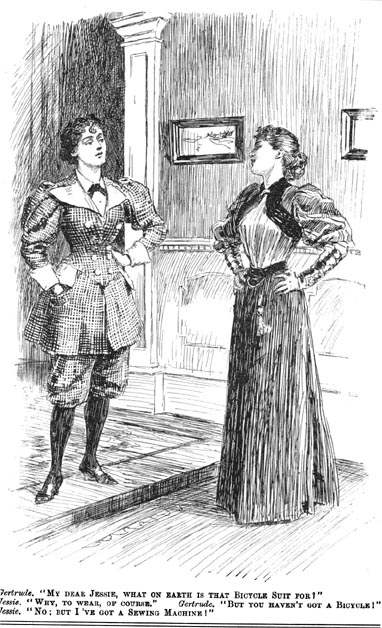
So while fish have scant need for bicycles, never let it be said that women haven’t found them vitally useful, perhaps especially for the commonsense fashion innovations they provoked. A Punch cartoon of 1895 portrays two women, Gertrude and Jessie. Gertrude’s full dress reaches the ground, and she appears to be paralyzed from the waist up by a corset. Jessie looks much more at ease in “rational dress,” including bloomers. The women speak the following lines:

GERTRUDE: “My dear Jessie, what on earth is that bicycle suit for!”

JESSIE: “Why, to wear, of course.”

GERTRUDE: “But you haven’t a bicycle!”

JESSIE: “No, but I’ve got a sewing machine!”

Bicycle_suit_punch_1895