The Maiden and the Nation: Joan of Arc at Orléans — a short play

Image

Characters:

Joan of Arc
An English Soldier
St. Margaret
St. Catherine

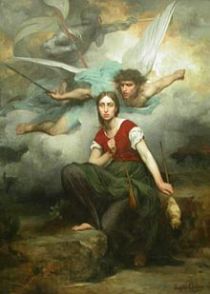
The scene is the English fortress of the Augustinians, near Orléans in France, May 6, 1429. A battle has just ended. Joan tends to a dying English soldier. Behind her hover two saints, Margaret and Catherine. (The entire play is staged as a tableau—a sort of pietà.)

SOLDIER.  I’m thirsty.

JOAN.  You’re dying.

ST. MARGARET.  Give him a sip of water.

ST.  CATHERINE.  Sprinkle some on his forehead.

JOAN  (to SAINTS as she sprinkles water from a flask).  Don’t tell me how to help him. Save your wisdom for when I need it.

SOLDIER.  Who are you talking to?

JOAN.  My Council—St. Catherine and St. Margaret. They talk to me. Sometimes they talk too much.

SOLDIER.  Oh—you are La Pucelle.

JOAN. You know my name?

SOLDIER. We all do. Every English soldier. The witch of the French. The whore of the dauphin. Your banner, your amulets—laden with black spells. Hot wax—you pour upon the faces of children. You opened your veins—offered your blood—for fiends to drink. Your body—you gave it to Satan for his pleasure.

ST. MARGARET.  Such lies!

ST. CATHERINE.  Tell him that none of it is true.

ST. MARGARET.  Tell him what you really are.

JOAN  (to SAINTS).  Let the English think I’m evil. For now, anyway. They dread me and that’s good. We won this battle and we’ll drive them from France. They’ll soon know God righteously condemned them. They’ll know Jesus fought for us. (to SOLDIER) But poor boy—you must confess! And all the priests, busy with dying Frenchmen!

SOLDIER.  Take my confession.

JOAN.  You’d trust a witch with your eternal soul?

SOLDIER.  You’ve been close to God. You spat in his face. That’s closer than a priest.

ST. MARGARET.  A sensible lad!

ST. CATHERINE.  A practical lad!

SOLDIER. My last confession—it’s not been long. I’ve only one sin—just one—it troubles me. Marching through France, I saw a shepherd girl. All alone with her flock she was. Her sheep were scared—our troops’ trudging—it scattered them. But the girl didn’t move. My eyes met hers. Her eyes were frightened. She feared me. Her fear filled me with lust. I gazed at her with lust.

JOAN.  You did not act upon that lust?

SOLDIER.  No.

JOAN.  The Lord forgives you. But you came to a land that wasn’t yours. You gazed on it with lust. You acted upon that lust. You troubled people who never troubled you. That is the greater sin.

SOLDIER.  I obeyed my king. He rules by God’s grace. How can that be a sin? Is it a sin to be English?

JOAN.  Many things we do not choose are sins. Our greatest sin was being born. I beg forgiveness every day. I repent that I weigh down my soul with flesh and bone. But ridding myself of flesh and bone would also be a sin. Freedom is scarce in this world.

SOLDIER.  And so—it is holy for you to kill.

JOAN.  God keeps me chaste, and he keeps me from killing. God preserves my innocence. (Showing him her sword) This sword—it has a secret. At Tours, before I joined the fighting, I needed a weapon. I asked my saints, where could I find one? St. Catherine told me to look in her church. My followers found it hidden there, a miracle.

SOLDIER.  The devil can work a miracle.

JOAN.  But that’s not the secret. I wouldn’t tell it to you if you weren’t dying. It’s dull as sandstone. It’s no good for fighting. The Good Lord gave me a weapon that can’t draw blood. It’s fit only for a schoolmaster’s paddle. And that’s how I use it. To smack knuckles and backsides. To send you Englishmen crying home to your mothers like naughty schoolboys.

SOLDIER.  And so—the men who follow you—you leave killing to them. You march at their head—face English ranks—they have no choice but to kill—kill to save your life. You deliver them into temptation—into evil—yet keep your innocence—your chastity of blood. (With a groan) Oh, I hear a voice! High and clear it rings—like a trumpet!

JOAN.  Surely it’s a demon.

ST. MARGARET.  And how would you know?

ST. CATHERINE.  Who are you to judge?

ST. MARGARET.  You of all people!

ST. CATHERINE.  Hear the boy out.

SOLDIER.  “You French!” it cries out to you. “We’ve struck your cheek—now offer the other. We’ve stolen your coat, now give us your cloak. Love us, your enemies—bless us who curse you—do good to us who hate you—pray for us who despise you—and persecute you!”

ST. MARGARET.  Tell him.

ST. CATHERINE.  Tell him that war is holy, just as peace is holy.

ST. MARGARET.  Tell him that the Prince of Peace Himself brought the Sword of War into this world, setting man against father and daughter against mother.

ST. CATHERINE.  Tell him that war must have its saints, the same as peace.

ST. MARGARET.  Tell him that the King of Heaven has chosen you as France’s Saint of War.

ST. CATHERINE.  Tell him.

ST. MARGARET.  Tell him now.

JOAN.  It is too late.

ST. CATHERINE.  He is gone, indeed.

ST. MARGARET.  I see his soul fluttering from his breast, darting across the fields like a butterfly.

ST. CATHERINE.  Where is it bound, I wonder?

ST. MARGARET.  But look—though his heart is stilled, it glows.

ST. CATHERINE.  Some other soul has lighted there, taking the departed one’s place.

ST. MARGARET.  Who might it be—an angel or a demon?

SOLDIER  (in a strange and powerful voice).  I am he who slew the dragon.

ST. MARGARET.  Oh, wonderful!

ST. CATHERINE.  Oh, splendid!

JOAN  (to SOLDIER).  Who are you?

ST. MARGARET.  Didn’t you hear?

ST. CATHERINE.  It is St. George, our brother in Christ!

ST. MARGARET  (to SOLDIER).  So it was you who spoke through the boy just now.

SOLDIER  (as before).  And ’twas I who brought him to Orléans; I who whispered to him all the evils of La Pucelle; I who filled his loins with lust for a maiden and a nation; I who thrust him in the path of a crossbow dart, so he might know an English hero’s blissful death. His mother shall rejoice that the sacrificial offering of her womb was deemed worthy of God. His father shall weep glad tears that his boy followed his footsteps into wayward France. For ’twas I who summoned that father to the field of Agincourt, where the English won a mighty victory. ’Twas I who guided that father’s ax to hack a score of Frenchman.

JOAN.  You speak for hell!

ST. MARGARET.  Silence, girl!

ST. CATHERINE.  How dare you blaspheme!

SOLDIER  (as before).  But this dead tongue grows stiff. I can speak no more. I must hasten myself to other English breasts, fill up their hearts and lungs with the eternal cry, “God for Harry, England, and St. George!”

ST. CATHERINE.  Farewell, our brother!

ST. MARGARET.  Godspeed in all you do!

JOAN  (to SOLDIER).  No! Don’t pass, you devil! Listen to me! Listen to my Council! (to SAINTS) Tell him, wise friends! Tell him the truth you told me! Tell him that the English are marked for disgrace! The King of Heaven wills it!

ST. CATHERINE.  That is your truth.

ST. MARGARET.  That is France’s truth.

ST. CATHERINE.  The English have their truth also.

ST. MARGARET.  They read your Bible.

ST. CATHERINE.  They pray to your God.

ST. MARGARET.  They invoke His aid against you.

JOAN.  How can God answer both their prayers and mine?

ST. CATHERINE.  Would you deny them the truth of their saints?

JOAN.  Two truths from one God?

ST. MARGARET.  With God all things are possible.

ST. CATHERINE.  You do not understand but you shall.

ST. MARGARET.  In betrayal you shall be blessed.

ST. CATHERINE.  In persecution you shall find wisdom.

ST. MARGARET.  In death you shall find peace.

ST. CATHERINE.  In paradise you shall grasp all mysteries.

ST. MARGARET.  But now your soul is weighted down by flesh and bone.

ST. CATHERINE.  You have earthly work to do.

ST. MARGARET.  Therefore, arise and win glory!

ST. CATHERINE.  Defeat the English and fulfill your sainthood!

ST. MARGARET.  Be God’s instrument, the archer by His side!

ST. MARGARET and ST. CATHERINE  (together).  Your foes are already killed by Him!

END OF PLAY
Image

play © 2008, Wim Coleman

Llixgrijb Again … and Again

Coyote3in“I was just thinking,” said Coyote/Llixgrijb, “that maybe I’ve chosen the wrong realm to live in altogether. I created this physical, temporal realm, and put Brillig in it to experience it for me. But, really, all this physicality spells nothing but trouble. It seems that suffering, ignorance, and mortality are the only things that hold the temporal realm together. It leads to more grief than gratis.”

“Indeed,” said Wolf. “Buddha taught us that suffering and sacrifice are key ingredients in this realm.”

“Then why stick around? I believe I’ll scrap the whole thing and move on to the mythic realm—the world of flow, of determinacy. A world without surprises. I like the sound of that.”

“So are you contemplating destroying our world altogether?”

“What do you think?”

“Be careful, my friend,” said Wolf. “If you try to scrap this world, you may find the mythic world extremely boring. There will be no meaning or purpose to it, without information from our temporal realm leaking into it. The mythic world is only important because of the physical world, and the physical world is only important because of the mythic world. Here, at least, you get to experience the heroic myth of the mystic experience, because death is real here.”

Coyote/Llixgrijb grinned at him. “You’re trying to scare me out of it, aren’t you?”

“Besides,” continued Wolf, “getting rid of either realm would prove rather difficult. Dividing the mythic from the physical or the temporal is like cutting a magnet in two; the pieces will divide into physical or mythic wherever you make the cut. It’s either both realms, or nothing. It’s a cosmic/mythic complementarity. You must have both to have your dream.”

“I think you’re bluffing,” said Coyote/Llixgrijb.

—physicist Fred Alan Wolf in conversation with Llixgrijb, from The Jamais Vu Papers newsletter and book by Wim Coleman and Pat Perrin. Reprinted in Jamais Vu Views along with additional material.

We thought that Llixgrijb was a fictional character, but if you Google that name today, you’ll get about 12,000 results. Some are quotes, usually (but not always) attributed to The Jamais Vu Papers, and sometimes translated into various other languages. Many are said to be posts by Llixgrijb, who apparently speaks Russian and a bevy of other languages as well as English and lives in various parts of the world. Here are just a few Llixgrijb links:

offering to be a pen pal

playing music

playing chess

discussing software

tweeting

lurking

You can read how that came about in our blog of 2012/10/05

CLICK for prints of Coyote/Llixgrijb and other illustrations from The Jamais Vu Papers.

Avoid Mere Self-expression!

Avoid mere4inThat’s a line that I once scrawled inside a paper sculpture—one of a series of artworks called “messages.”

Google “self-expression.” Today I got 2,480,000 results in less than a second. At a glance, it’s obvious that a lot of our cultural dialogue is dedicated to self-expression. A Wikipedia article connects it with a “creative class” of people who get to express themselves in their work. Centers, classes, and various kinds of gurus offer to teach people how to express themselves. And self-expression is highly recommended in discussions on leadership, spirituality, democracy, self-esteem—to say nothing of selling pitches for cars and clothes (which, of course, look just like a lot of other cars and clothes).

OK, so that could go on and on. Clearly, self-expression has many advocates.

First have a self. Wim reminds me of the observation—probably originally from Julia Cameron in The Artist’s Way—that one must have a self to express. But that self must be an evolving thing. So we sort of dance around in circles—find self … express … find … express … Maybe that’s not a bad way to go about a creative life. (Though I must note that art galleries and publishers can resist the finding and expressing of a new self—they often prefer the repetition of whatever has already proved commercially successful.) Why should anyone avoid expressing the self?

Let’s get back to that word mere.

In essays, articles, books, academic research, and artworks, I’ve tried to understand, identify, and explain the creative experience. In my definition, “self-expression” is not nearly enough. Those very words seem to imply the expression of something you already know, and that’s what a lot of self-expression seems to be about. But as the expression of a self in a state of discovery it can become part of the whole creative experience. At that point, it’s no longer “mere.”

The creative experience is more like hanging off the edge of a cliff … or jumping off … or falling off. It’s risky. You’re writing about something you almost know, or barely know, but that you’re in the process of finding out more about.

Comments from other cliffhangers are welcome. —Pat

Which Came First — The Tool or Its Name?

Here’s some news that amazed me recently, and also got me to asking myself a lot of troublesome questions. Working gears have been discovered in an insect. Scientific American’s video of these gears in action is pretty breathtaking to watch. The story broke just a couple of months ago

The juvenile Issus—a plant-hopping insect found in gardens across Europe—has hind-leg joints with curved cog-like strips of opposing “teeth” that intermesh, rotating like mechanical gears to synchronize the animal’s legs when it launches into a jump.

And so human hubris suffers another body blow from the inventiveness of Natural Selection. Until now, mechanical gears were believed to have a distinctly anthropocentric pedigree. They first appeared (or so it was said) in the “south-pointing chariot,” invented by the Chinese engineer Ma Jun back in the third century CE. But no, the juvenile Issus has been using gears for millions of years. In what seems almost a cosmic practical joke, nature invented gears millions of years before it bothered to invent their human “inventors.”

The Jamais Vu PapersAll this reminds me of the fictional psychiatrist Hector Glasco’s ill-fated and ill-advised meeting with the real-life New York superagent John Brockman in 1989. The oracular Mr. Brockman held forth about hearts and pumps and such …

We talk about the heart as a pump. It isn’t like a pump. It is one.

Now this is a long-familiar example of nature beating human engineers to the punch. Artificial pumps date back to Ctesibius (no, I can’t pronounce it either), a Greek inventor of the third century BCE. But nature has been manufacturing pumps for as long as there have been hearts with two or more chambers, and hearts have been around for at least as long as there have been fish.

Similar cases abound. During World War II, for instance, around the time when the Allies were secretly developing sonar, scientists happened to discover that bats had been using sonar all along. Talk about security leaks!

It should no longer surprise us that the beautifully intricate mechanisms created by Natural Selection should … well, surprise us. But further paradoxes lurk in the realm of language. Regarding hearts as pumps, Brockman went on to tell Hector …

That metaphor is a human invention.

Indeed, nobody knew that hearts were pumps until William Harvey figured it out in the 17th century. So which came first, the tool or its name?

I suppose, if Hector had thought to ask Brockman this question, he would have answered that words like “sonar” and “pump” and “gear” weren’t around when nature first toyed with echolocation, primordial jumping devices, and throbbing two-chambered movers of blood. Neither were any other words. There wasn’t anything we would call “language” at all. And as Brockman put it …

If it’s not in the language, it isn’t. If you can’t say it, it isn’t.

And so, although little gears appeared in bugs untold millions of years ago, they didn’t actually become gears until we noticed them and called them “gears.” The same goes for pumps and sonar. Hector Glasco might take heart from this. “If it’s not really invented until there’s a word for it,” he might say, “then surely human beings actually did invent gears, pumps, and sonar! After all, aren’t we, and not nature, the makers of words?”

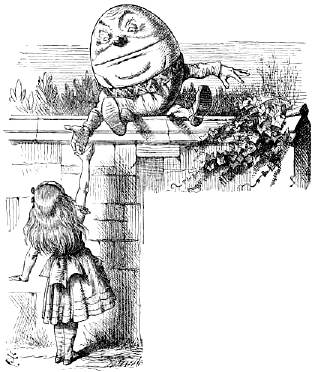
The words of another oracular figure come to mind—Humpty Dumpty in Lewis Carroll’s Through the Looking Glass

Humpty_Dumpty_Tenniel-1

“When I use a word,” Humpty Dumpty said, in rather a scornful tone, “it means just what I choose it to mean—neither more nor less.”

“The question is,” said Alice, “whether you can make words mean so many different things.”

“The question is,” said Humpty Dumpty, “which is to be master—that’s all.”

But according to Brockman, even so lofty a linguistic authority as Humpty Dumpty is wrong, for words are the makers of us—and of everything else:

[T]he words of the world are the life of the world, and nature is not created, nature is said…. I’m talking about the idea that we are our words. We create technologies and tools, and we become the technologies and tools. So, too, with language. All we have is language. All we have is ideas.

jvV ebook 180

“Astride Occam’s Razor,” the story of Hector Glasco’s encounter with John Brockman, appears in both The Jamais Vu Papers and Jamais Vu VIEWS.

Invasions of Privacy … the Kind We Like

Mayan-72A couple of posts ago, I mentioned the allegedly late Timothy Leary’s disdain for privacy—“the evil of monotheism,” he called it. Personally, I’m as alarmed as anyone else about threats to personal privacy from both government and corporations. But some invasions of privacy seem downright benign—or at least they do to me.

For example, Pat and I just now discovered that Amazon.com keeps track of people’s highlights in Kindle copies. Pat and I were delighted to see what readers marked in our award-winning novel Mayan Interface. You can find these quotes at the bottom of its Kindle page. (It is also available in paperback.) Here are a few that we especially like:

Change is always dangerous. And to become a new person, first you must die. It’s an absolute requirement. Now getting resurrected—that’s the tricky part.

You may have heard that Eve was the first woman, but that’s not quite true. Eve was actually a small, dark-eyed, long-tailed monkey—well, not quite a monkey, more like a lemur. And she lived, oh, some fifty million years ago—back during the Epoch of Miracles, let’s say.

What’s required is the courage to risk change without knowing what it will bring about. What’s needed are adventurers willing to go into whatever is ahead without even knowing what they, themselves, will become—because no one transformation will suffice for all.

The Maya understand that their people were shaped by both history and myth. We think of history as “what really happened” and of a myth as a story made up to account for whatever people didn’t understand—and unnecessary once science and logic have explained everything. But if a myth has influenced anyone’s life, then in some sense it “happened”—and is therefore history.4 mystery gllyphs