In the Belly of the Fish: Bryan and Darrow After the Scopes Trial — a short play

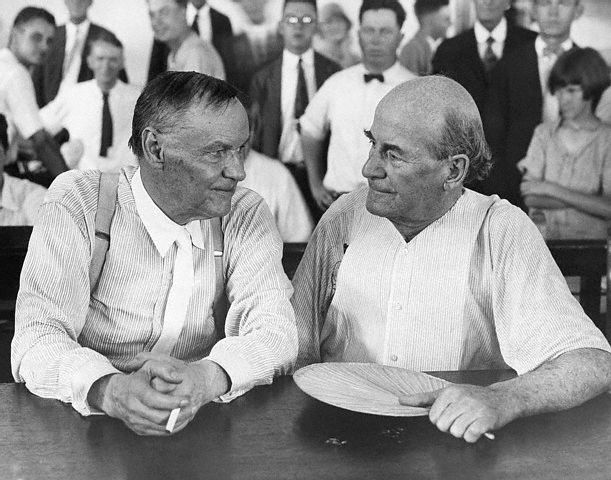
Clarence Darrow and William Jennings Bryan, 1925Characters:

Clarence Darrow
William Jennings Bryan

The scene is the railway station in Dayton, Tennessee, July 22, 1925—the day after the end of the Scopes trial. Darrow is alone on a platform, waiting for a train. Bryan quietly enters, walks toward Darrow, and speaks.

BRYAN.  “Now the Lord had prepared a great fish to swallow up Jonah. And Jonah was in the belly of the fish three days and three nights.” Oh, my! The fuss you made about that fish! The questions you asked me! “Do you really think God made that fish especially to swallow Jonah?” “Just how big was that fish?” Well, it’s a real fish, sure enough. And here we are, the two of us, smack dab in its belly, compelled by the Almighty to face our failures until we repent our hearts out.

DARROW.  I’m not repenting. And I’m not in a fish’s belly. I’m waiting for a train on a murderous hot day. I’m standing beside a man I thought I knew, and thought I liked, but I was wrong on both counts. I’ve spent a lousy week in a godforsaken Podunk which got stuffed to the gills with a thousand more stinking, sweating bodies than it was meant to hold, and all their skulls together don’t hold a fraction of our brains. And we set a fine example, didn’t we? Yelling insults at each other like a pair of banshees. I’m anxious as hell to get out of here. That’s the reality, my friend. Skip the poetry and metaphors.

BRYAN.  “Stuffed to the gills”—that’s not a metaphor?

DARROW.  Why not admit your precious Bible’s a just a sampler of metaphors? Why the hell does Jonah’s fish have to be a real fish?

BRYAN.  It’s real, all right. Stinks bad down here in its guts. (Pause) I had a dandy closing speech all ready for the jury. Too bad I never got to give it. “Science is a magnificent force,” I was going to say, “but it is not a teacher of morals.”

DARROW.  That is too bad. I agree with you.

BRYAN.  Do you, now? I thought evolution was your moral crusade.

DARROW.  Free speech is my moral crusade. Science is about knowledge, not morality.

BRYAN.  So much the worse for science. Where does Darwin teach brotherly love? Where does he say, as our Savior did, Whatsoever ye would that men should do to you, do ye also to them”?

DARROW.  Shallow stuff. Notice the ulterior motive. Treat people right, and maybe they’ll treat you right. No altruism there. Same with “Judge not, that ye be not judged.” Jesus and Machiavelli aren’t so far apart. Kant got to the heart of morality a whole lot better.

BRYAN.  Oh, yes. The categorical imperative. Something to do with following a certain kind of maxim. A real mouthful, as I remember.

DARROW. “Act only according to that maxim by which you can at the same time will that it should become a universal law.”

BRYAN.  Sheer poetry. Give me King James.

DARROW.  Poetry crawled into Whitman’s coffin and died.

BRYAN.  Well, the Good Lord’s presence has been scarce these last few days. Wonder what he’s up to? (Pause) Darwin may turn out to be right, after all. Read a bit of him once. Didn’t win me over, mind you, not by a long shot. But he seemed a decent sort of fellow with some worthwhile notions. Nice writing style too. I didn’t let him bother me much for a while. Then something happened.

DARROW.  What?

BRYAN.  There was a war, remember? The whole world went mad. Millions of good boys died. And all because the Germans read their Darwin, studied up about the survival of the fittest. Oh, the “fittest”—the Germans figured that just had to mean them and their Kultur. So they replaced the Christian doctrine of love and renunciation with the Darwinian doctrine of hatred and force. Allmacht, they called it—the idea that war was a positive virtue, since the world was full of unfit folks who needed clearing out. Pretty soon, all civilization caught the Darwin bug and came pretty near committing suicide. When Wilson got ready to drag America into the mayhem, I skedaddled straight out of his cabinet.

DARROW.  A Secretary of State quitting in protest. I remember. I was impressed.

BRYAN.  There’s nothing Christian about a war.

DARROW. I didn’t like it either. (Pause) What was it you said? “Science is a magnificent force …”?

BRYAN.  “… but it is not a teacher of morals.”

DARROW.  So you’ve got no intellectual objections to Darwinism?

BRYAN.  Well, according to you, I’ve got no intellect at all. But I’ve got moral objections as a compassionate man. For the life of me, I can’t see why you don’t too. When have we ever been at odds until these last few days? I was right with you on that Eugene Debs case; I always support the working man against the captains of industry. And I thought you were right as rain defending those Loeb and Leopold boys; I can’t abide executions even for bona fide monsters. And you’ve been on my side pushing for women’s suffrage and equality. It all makes good Christian sense to me. Jesus put no stock in big money, or legalized lynching, or keeping women in their place, or any other such thing. But my land, you’ve called me all kinds of names since this whole business got started! A bigot, a fanatic, and—what was it? Oh, yeah—“the idol of all morondom.” Odd things to say about a man who agrees with you straight down the line.

DARROW.  You want to snatch independent reason away from the common man, leave him with nothing but blind belief in some poor dumb slob nailed to a Roman gibbet. Now that’ll make the millionaire fat cats happy, won’t it? Lording it over a herd of meek, brainless cattle?

BRYAN.  You’ve got it backwards. The fat cats caught the Darwin disease. They think they’ve won their booty fair and square in the struggle for existence.  They think might makes right, it’s virtuous to poison our food, work our children to death, hoard our wealth.

DARROW.  You don’t have the first idea what you’re talking about. Why, you probably think evolution and Darwinian theory are one and the same thing.

BRYAN.  Aren’t they?

DARROW.  No.

BRYAN.  That’s way too subtle for me.

DARROW.  Yeah, I’m sure it is.
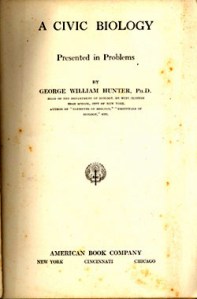
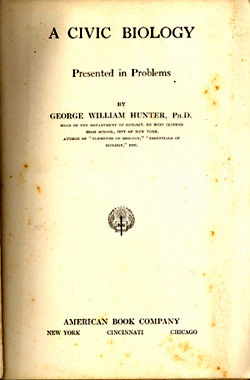
Hunter cover pageBRYAN.  Well, here’s your train. Oh, and here’s a little gift. A copy of that textbook Scopes taught from, Hunter’s Civic BiologyBut I reckon you’ve already read it.

DARROW.  Only the parts about evolution. Have you?

BRYAN.  Bits of it. As the Lord would have it, it fell open for me on an interesting page. I marked it for you, I think you’d find it interesting. This Hunter fellow seems to think we humans can be improved with some good old-fashioned selective breeding, like livestock. Says society’s “parasites”—criminals, the mentally slow, infirm, weak—ought to be locked in asylums, men and women kept apart so they can’t breed, can’t contaminate the race of the fit and able. I get the impression he thinks a better solution would be out-and-out extermination, but people are too bigoted for that, they lack the proper enlightenment.

            (Pause as DARROW peruses the page)

BRYAN.  Sounds like something you and I might want to tackle together one of these days.

DARROW.  Possibly.

BRYAN.  I’ll make you a deal. I’ll let you have your Darwin—in the classroom or anywhere else—if you can give me some kind of moral compass to save our nation and our world. But I don’t think you can do it. You soul’s all hollowed out.

DARROW.  The sooner humanity accepts the tragedy of God’s death, the sooner people’ll be decent to each other.

BRYAN.  That makes no sense.

DARROW.  How would you know? You’re not a sensible man.

BRYAN.  True.

            (Pause)

DARROW.  I don’t have any hope, William.

BRYAN.  Search in your heart for faith, my friend.

DARROW. There’s no faith there.

BRYAN.  Well. We shall see what comes of all this.

DARROW.  No, we won’t. We’ll be dead.

BRYAN.  Have a good trip.

DARROW.  You’re not going?

BRYAN.  I just stopped by to see you off. I’m staying in Tennessee a few more days.

DARROW.  This place will kill you.

 END OF PLAY

A Play and an Idea

“… and did you know that William Jennings Bryan died on the last day of the trial, right there in the courtroom?”

I was sitting in a café listening to two customers at another table holding forth about the Scopes “Monkey” Trial of 1925. They seemed to be valiantly trying to outdo each other for ignorance. For absolutely nothing they said was historically true.

WilliamJBryan1902

William Jennings Bryan

No, William Jennings Bryan didn’t die that day in the courtroom. He died in his sleep five days after the trial ended. And no, John Scopes was not a biology teacher but a high school football coach. And no, the text Scopes got into trouble for teaching was not Darwin, but a chapter in George William Hunter’s textbook A Civic Biology. And so on, and so on, and so on …

None of this misinformation surprised me. All of it comes from Inherit the Wind, that perennially popular 1955 drama by Jerome Lawrence and Robert E. Lee. Neither Lawrence nor Lee ever claimed that their play had much to do with history. In a 1996 interview, Lawrence explained that it was really intended as a parable attacking the McCarthyism of its era …

It’s not about science versus religion. It’s about the right to think.

Nevertheless, Inherit the Wind is all-too-widely accepted as a factual account of the trial.

Now why should this bother me? It’s not that I object to the play’s status as a rousing polemic against Creationism. Pat and I are passionately devoted to evolutionary thought, and we’re constantly exchanging and discussing the latest news stories about discoveries in natural history. To us, the simple fact of evolution is wonderfully and endlessly pertinent to our ongoing fascination with Story.

But as a storyteller, I think that a cultural milestone as momentous as the Scopes Trial merits a more reliable account than you’ll find in Inherit the Wind. And the politically progressive William Jennings Bryan deserves fairer treatment than the character assassination he has suffered from being equated with his fictional proxy, the laughable but dangerous buffoon Matthew Harrison Brady.

Clarence Darrow

Clarence Darrow

The actual Scopes Trial and the media circus surrounding it were quite melodramatic enough without recourse to Lawrence and Lee’s extravagant distortions. And the trial did not bring out the best in either Bryan or his nemesis Clarence Darrow, especially during Darrow’s climactic cross-examination of Bryan. Bryan managed to fit perfectly the image that Darrow had drawn of him as a Bible-thumping bigot. And by embarking upon an obsessive (if also eloquent and effective) defense of science against religion, Darrow succeeded in botching what ought to have been a fairly straightforward legal defense of free speech. Despite all this, a deeper historical and intellectual subtext lies beneath all the melodrama.

The late paleontologist Stephen Jay Gould offered a remarkably nuanced view of both Bryan and the trial itself in his essay “William Jennings Bryan’s Last Campaign,” which appeared in his 1991 collection Bully for Brontosaurus. And now I’d like to do likewise.

In our next post, I’ll offer a sort of 10-minute thumbnail revision of Inherit the Wind. In it I hope to portray both Bryan and Darrow somewhat more favorably than they did themselves in 1925.

Spencer Tracy and Frederick March in the 1960 movie

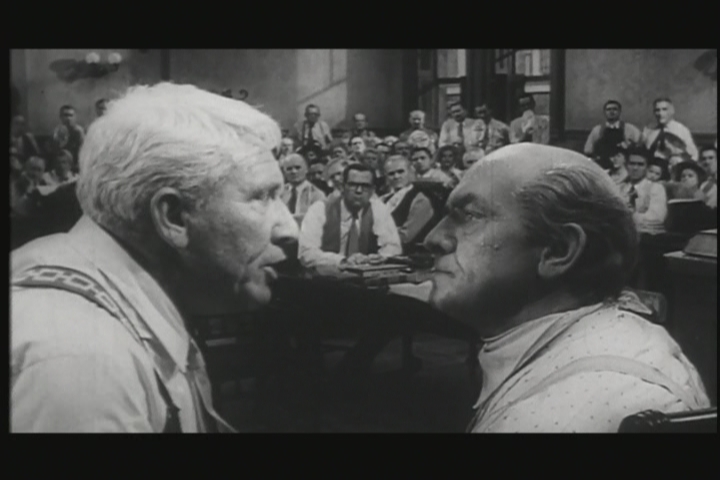
Spencer Tracy and Frederick March in the 1960 movie “Inherit the Wind”

A Noble Kind of Thievery

“Immature poets imitate; mature poets steal.”  —T.S. Eliot, The Sacred Wood

I think this famous dictum is correct as far as it goes. But poets of truly outlandish genius go way beyond petty thievery. They think themselves licensed to pillage nothing less than all of the world’s literature.

The dying Robert Greene attacking Shakespeare with his pen

The dying Robert Greene attacking Shakespeare with his pen

Consider William Shakespeare, whose thefts are legion. We’ve all heard about how he stole most of his stories. For example, he brazenly snatched the plot of Pericles from a novel by Robert Greene, who on his deathbed some years earlier had fulminated against a certain conceited young upstart crow” who fancied himself “the only Shake-scene in a country.”

But Shakespeare didn’t stop at stealing overall plots. He grabbed up specific passages by others seemingly pell-mell and did whatever he liked with them. Let’s look this speech from Antony and Cleopatra, in which Enobarbus describes Antony’s first glimpse of Cleopatra upon the river Cydnus …

The barge she sat in, like a burnished throne,
Burned on the water; the poop was beaten gold;
Purple the sails, and so perfumed that
The winds were love-sick with them; the oars were silver,
Which to the tune of flutes kept stroke, and made
The water which they beat to follow faster,
As amorous of their strokes.

Compare this to a description of Cleopatra’s barge in Sir Thomas North’s 1579 translation of Plutarch’s Parallel Lives …

… the poope whereof was of gold, the sailes of purple, and the owers of silver, which kept stroke in rowing after the sounde of the musicke of flutes …

Resemblances sharpen as Enobarbus starts describing Cleopatra herself …

For her own person,
It beggared all description: she did lie
In her pavilion, cloth-of-gold of tissue,
O’erpicturing that Venus where we see
The fancy outwork nature.

"Cléopâtre et Antoine sur le Cydnus" by Henri-Pierre Pico

“Cléopâtre et Antoine sur le Cydnus” by Henri-Pierre Pico

… again echoing Plutarch …

And now for the person of her selfe: she was layed under a pavilion of cloth of gold of tissue, apparelled and attired like the goddess Venus, commonly drawen in picture …

And so Enobarbus continues for some seventeen lines, matching North’s Plutarch pretty much image after image.

Similar thievery can be found in Prospero’s climactic speech in The Tempest

Ye elves of hills, brooks, standing lakes, and groves …

Compare these words to those of the sorceress Medea in Arthur Golding’s 1567 translation of Ovid’s Metamorphoses

Ye Ayres and windes: ye Elves of Hilles, of Brookes, of Woods alone,
Of standing Lakes …

Again, the parallels continue for some seventeen lines.

“Prospero and Miranda” by William Maw Egley

“Prospero and Miranda” by William Maw Egley

I’m not griping. None of us should. Indeed, we really must rejoice. Shakespeare’s was more than the “honorable kind of thievery” mentioned in Two Gentlemen of Verona; it was truly noble thievery — Promethean, even. He stole liberally from the vast stores of human letters, transformed cold brass plunder into fiery gold, then handed this augmented treasure down to the poor in spirit — namely us.

Shakespeare also knew when to jettison his sources and let fly with his own preternatural eloquence. Prospero’s speech culminates in a poignant farewell to magic, which according to legend was Shakespeare’s own farewell to his art. You won’t find anything like it in Ovid …

But this rough magic
I here abjure; and when I have required
Some heavenly music (which even now I do)
To work mine end upon their senses that
This airy charm is for, I’ll break my staff,
Bury it certain fathoms in the earth,
And deeper than did ever plummet sound
I’ll drown my book.

The Gateway of the Soul: Queen Christina and the Death of Descartes — a short play

Characters:

René Descartes
Queen Christina

The scene is the royal library in Stockholm, Sweden, on February 1, 1650, at about 5:00 a.m. Queen Christina is dressed in male attire. René Descartes enters, bows to the queen, and begins to speak. He shivers almost convulsively, despite being warmly clothed. He is extremely ill and coughs frequently.

Queen Christina (left) and René Descartes (right)

Queen Christina (left) and René Descartes (right)

DESCARTES. Your Majesty, I have a regrettable announcement to make. I’m not long for this world. Your royal physicians have told me so. These morning lessons of ours are to blame. I’m 54 years old and have never been in robust health. As you know, it was long my custom to stay abed mornings till nearly noon, meditating upon my work. But you insist that I meet you here at 5:00 in the morning. Before that ungodly hour, I must rise, bathe, and dress. And while I am still damp from bathing, I must walk here to your library, out-of-doors in this northern cold that freezes men’s very thoughts. I am burning up with fever. I cannot stop shivering. My lungs are inflamed. Your doctors tell me that my only hope of survival is your royal mercy. Please, please, Your Majesty, allow me a few more hours of sleep. Allow me to tutor you in the afternoon. And may we not light the fireplace? And may we not close some of these windows?

CHRISTINA. I learn best in the cold.

DESCARTES. But Your Majesty—

CHRISTINA. Stop calling me that, Monsieur Descartes. It infuriates me. I am the only woman alive who knows your analytic geometry. You dedicated a book to me. We’ve discussed the mysteries of the universe. We’ve probed each other’s intellects in their full nakedness. That makes us lovers. I am your mistress, not your queen. So call me your beloved darling—no, your precious little squirrel. I command it.

DESCARTES. Your Majesty, that would be—unthinkable.

CHRISTINA. Do it.

DESCARTES. Yes, my … precious little squirrel.

CHRISTINA. Now stop whining about your paltry little ailments. Something terrible has happened. I’ve committed a frightful deed. I don’t know how to live with myself. Sit down.

(DESCARTES does so. CHRISTINA hands him a saucer and a magnifying glass.)

CHRISTINA. Tell me what this is.

DESCARTES (looking in the saucer through the glass). It looks like a tiny pink pinecone.

CHRISTINA. You should know what it is.

DESCARTES. A pineal gland?

CHRISTINA. It came from my dear tomcat, Loki.

220px-Descartes3

René Descartes

DESCARTES. You killed your cat?

CHRISTINA. He was terribly sick. His eyes were sunken and had lost their luster. He couldn’t lift his backside off the floor, not even to relieve himself. He was suffering terribly, and I knew he would never get better. So I held him close, and said goodbye to him, and broke his neck with a twist of my hand. Then my curiosity got the better of me, and I opened his skull with a paring knife to see what was inside. And there I found this between the lobes of his brain. I thought I was putting him out of his misery. But it turns out that I murdered him.

DESCARTES. You did not murder Loki.

CHRISTINA. Why not?

DESCARTES. One cannot murder a brute beast.

CHRISTINA. Why not?

DESCARTES. Because a brute beast does not have a soul.

CHRISTINA. This brute beast had a pineal gland. The pineal gland is the seat of the soul. You’ve said so yourself.

DESCARTES. Not the seat of the soul precisely. More like a gateway. It connects the sensory realm of matter, space, and extension with the spaceless dimension of spirit, soul, and thought.

CHRISTINA. The dimension of God.

DESCARTES. Indeed.

CHRISTINA. Loki had a pineal gland. Therefore, Loki had a soul. Therefore, Loki had access to that spaceless dimension. Therefore, Loki was connected with God. Therefore, I murdered him.

DESCARTES. Not so, lady, not so. Didn’t you read that book I wrote for you? An animal is nothing more than a wonderful machine of nature. It cannot think or feel. You could have cut open Loki’s skull and poked about his brain while he was fully alive without causing him the slightest distress. I practice this sort of thing myself. Would I ever sanction murder? So put your mind at ease. And please, please, call a servant to start a fire and shut these windows.

CHRISTINA. You haven’t explained why a soulless creature’s brain should contain a gateway of the soul.

DESCARTES. And I shall explain, my precious little squirrel. But not now, not while I am so sick. I beg you, if you love me with a true mistress’s love, if you don’t want me to die—

CHRISTINA. Oh, stop fretting about death.

DESCARTES. Then you do want me to die. That’s exactly it. You are stalking me. You are awaiting the moment for the kill. When I weaken enough, you’ll snap my neck, just like your cat’s. And then you’ll dissect me to compare the insides of our skulls, won’t you?

(Pause)

CHRISTINA. It hadn’t occurred to me.

DESCARTES. Dear God!

Cover Descartes' Meditations on First Philosophy

Cover of Descartes’ Meditations on First Philosophy

CHRISTINA. I’m starting to understand. It’s all coming clear. This whole pineal body-mind duality business, this separation between the material and the mental, you made it all up.

DESCARTES. Why would I do such a thing?

CHRISTINA. Naturally, as a materialist and a mechanist, you’re afraid the churchmen will discover that your learning leads directly to atheism. You are afraid of being burned at the stake like Galileo.

DESCARTES. You mean Giordano Bruno.

CHRISTINA. No, I mean Galileo. Something bad happened to him too, didn’t it?

DESCARTES. He was forced to keep quiet.

CHRISTINA.  Even worse. I warn you, don’t try to deceive me. I did not bring the most brilliant scholar in Christendom to my court so he might hoodwink me along with everybody else. I mean to learn the truth. About everything. At all costs. Now if you value your life, tell me what you know!

DESCARTES. The gland—it is exactly what I’ve said.

CHRISTINA. It makes no sense.

DESCARTES. Then what other purpose might it serve?

CHRISTINA. Perhaps it is vestigial of some long-defunct use. Let us suppose that Loki and I had a common ancestor—

DESCARTES. Cousins? You and your cat?

CHRISTINA. And you. And a dog. And a mouse. And a precious little squirrel. Every creature that has a pineal gland.

DESCARTES. But, oh, noble lady—!

CHRISTINA. I know, I know. “And God said, Let the earth bring forth the living creature after his kind.” And here I am, proposing that God’s eternal kinds are mutable, that they evolve. But let’s be just a wee bit heretical, shall we? Just between ourselves. This is neither Catholic France nor Calvinist Holland, but simple, backward, rustic, Lutheran Sweden, where scarcely anybody has brains enough to be bigoted. Whatever we say won’t leave this room. And if it does, and if the Inquisition catches you—well, I promise to be burned at the very same stake right along with you, and won’t that be fine? Again, let’s suppose that you and I and Loki had a common ancestor. Whatever such a creature was, it had some use for the gland. Perhaps it was a sort of eye, just like the mystics say. That use disappeared, but the gland did not. And now it just sits there wedged in our brains, doing nothing in particular. There is no gateway to the soul.

DESCARTES. Blasphemy.

CHRISTINA. How so?

DESCARTES. You are on the brink of saying—

CHRISTINA. What? That there is no soul? That there is no God? Nay, perhaps simply everything—this entire exquisitely manifold and sundry material world of ours—is nothing but soul, is nothing but God.

DESCARTES. It is atheism either way.

Queen Christina

Queen Christina

CHRISTINA. Nonsense. It is piety multiplied. We must worship the body, because it creates mind. We must worship mind, because it is capable of worship. We must worship all immanence, because it is God. When we go into a church, we must sing hymns of praise to its very stones, for they too are the stuff of divinity, restlessly striving for mind and for life. If I am wrong, you must explain to me why.

DESCARTES. I haven’t the strength.

CHRISTINA. Then you’ve proved my point. Your body and your mind are one. Otherwise your mind would be impervious to the sickness of your body. Your body is about to die; therefore your soul is about to die. Or might your soul instead assume some other material shape?

DESCARTES. I shall lose consciousness.

CHRISTINA. Oh, do! Please! I must observe that! (Pause) Could you teach me how to lose consciousness too? I want to know what it’s like.

END OF PLAY

Tolstoy and the Shaker

AnnasWorldcoversmallThe work Pat and I do together leads us on some fascinating detours. While we were researching the Shakers for our multiple-award-winning novel Anna’s World, we ran across a startling letter from the great Russian novelist Leo Tolstoy himself …

I received the tracts that you sent me, and read them, not only with interest, but with profit; and cannot criticise them, because I agree with everything that is said in them …

Tolstoy was writing to Frederick W. Evans, a Shaker elder based in New Lebanon, New York. The date was February 15, 1891. By then Tolstoy was a thoroughgoing Christian anarchist-pacifist, cantankerous and iconoclastic enough to look back upon his own masterpieces War and Peace and Anna Karenina with utter disgust. And the communistic, celibate Shakers were right up his alley. He and Evans kept on writing back and forth, exchanging ideas about religion, society, and justice.

shakers-dancingFrederick Evans had been a socialist since his youth. In 1830, when he was about 22 years old and every inch a materialist and secularist, he went out scouting New York state for a place to found his own utopian community. He stopped in New Lebanon to visit the Shakers there, expecting to find “the most ignorant and fanatical people in existence.” Instead he was promptly converted, convinced that he had found just the ideal society he had envisioned.

Evans’s life as a Shaker was anything but cloistered. He served the Shakers as an ambassador to what they called simply “the World.” At the height of the Civil War, Evans and another elder visited the White House, petitioning President Lincoln for exemption from the draft. Although deeply opposed to slavery and actively supportive of the Union, the Shakers were steadfast and devoted pacifists for whom fighting was morally unthinkable.

Lincoln was impressed by the elders. After they finished making their case, he asked …

“Well, what am I to do?”

“It is not for me,” Elder Frederick replied, “to advise the President of the United States.”

“You ought to be made to fight,” Lincoln said. “We need regiments of such men as you.”

Even so, Lincoln granted the petition.

10606140_910718692290831_759700197982803500_nIn their correspondence, Evans and Tolstoy hit it off famously. When Evans died, Tolstoy wrote a letter of sympathy to another Shaker elder …

I can not tell you how sorry I am, not for the death of our dear and honored friend Evans, but for you and for all those who loved him and were fortified by his spirit. I am one of them.… I loved him very much.

In Anna’s World, I hope that Pat and I wrote a novel that both Frederick Evans and Leo Tolstoy might enjoy. I expect that our chances might have been better with Evans. Shaker intellectuals weren’t too otherworldly to disdain all fiction, and they much admired Tolstoy’s then quite scandalous story “The Kreutzer Sonata.”

But I suspect it would have been tougher to please Tolstoy, whose literary standards eventually got to be downright quirky. In his old age, he had this to say to poor Anton Chekhov

You know, I hate your plays. Shakespeare was a bad writer, and I consider your plays even worse than his.