Timothy Leary in Cyberland

chaos_cyberculture

I think about Timothy Leary a lot these days. He is widely believed to have died on May 31, 1996. If so, it’s really too bad. A pioneering technopagan and an elder statesman of Cyberpunk, he would revel in Google, Twitter, Facebook, and all the rest of our digital paraphernalia. What Douglas Rushkoff has called “Present Shock” (we are way beyond Alvin Toffler’s “Future Shock”) wouldn’t faze him one little bit.

Leary wouldn’t even be bothered by encroachments on personal privacy. As I remember, he rather liked having his phone tapped—because whoever was listening might actually learn something. “Privacy is the evil of monotheism,” he once said to me—or rather, he will say it to J. X. Brillig in the year 2040.

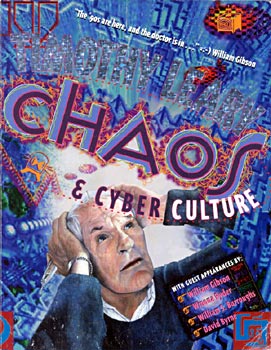
Pat’s and my jamais inter-vu with Leary, entitled “Brillig in Cyberland,” was first published in our jamais vu newsletter in December 1988. In it, Leary plays a garrulous tour guide to a futuristic, William Gibsonesque wonderworld. Leary himself included “Brillig and Cyberland” as the epilog to his last non-posthumous book, Chaos & Cyber Culture (1994).

But why am I somewhat skeptical that he actually died in 1996? Well, talk of Timothy Leary’s demise dates all the way back to 1968 and the lyrics to “Legend of the Mind” by the Moody Blues. “Timothy Leary’s dead,” the song announced. It wasn’t true then, and I’m not so sure it is now.

Leary was obsessed with life extension, and he considered death (or “irreversible involuntary coma”) an inexcusable waste of time and resources. So he didn’t plan on dying if he could possibly help it. It’s well known that Leary arranged to have his head cryonically preserved, only to change his mind shortly before his final “coma.” He grumbled,

I was worried I would wake up in fifty years surrounded by people with clipboards.

He opted for cremation—which would seem to put an end to the matter.

But in an increasingly informational world, immortality isn’t necessarily about the survival of the physical body. In “Brillig in Cyberland,” Leary explained (or will explain in 2040),

Basically, immortality is about digitizing. The more of yourself you digitize, the more of yourself is going to be immortal. The more of your actions and memories you get digitized, the more immortal you’re going to be. I was one of the first people to discover this. My claim to fame today is that there is more of me in digital form than almost any other person from the twentieth century.

There is, indeed, a lot of information about Timothy Leary kicking around, so I wouldn’t write him off just yet. While it’s true that the Moody Blues said that he was dead, they went right on to say otherwise:

The Jamais Vu Papers

No, no, no, no, he’s outside looking in.

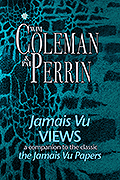
“Brillig in Cyberland” is now available in both The Jamais Vu Papers and its brand new companion volume Jamais Vu VIEWS. I hope you’ll check them out.

jvV ebook 180

Metaphor and Tom Robbins

jvV ebook 180In yesterday’s post, we announced the publication of Jamais Vu Views, the long-awaited companion to our underground classic The Jamais Vu PapersIt is available in paperback and Kindle. Both books include jamais inter-views with real people participating in a fictional story. Our first-ever inter-view was with author Tom Robbins in 1987.

At the time, we were fascinated by the role of metaphor in Story (with a capital S). We felt that metaphor was more that just figurative speech, more than just analogy. What was the power of metaphor? We decided to play around with a fictive and admittedly silly idea: that metaphors are literally true, and that you could conceivably make a drug out of a metaphor.

The Jamais Vu Papers began as a newsletter that told the story an addled Los Angeles psychiatrist named Hector Glasco. He was treating a jaded celebrity patient named Hilary, who was suffering from a chronic and potentially fatal case of déjà vu—that condition, of course, in which one has the weirdest feeling that one has been here before. The cure, it seemed, was to instill a sense of jamais vu, a mysterious feeling that one has never been here before—not in this world, this life, or the most familiar circumstances.

So Hector Glasco tried to cure his patient with a dose of a mystery drug called “M”—the chemical equivalent of a metaphor. Disaster ensued, and Hilary escaped from his office on a flying carpet and disappeared. The newsletter itself was Hector’s desperate plea for help; he needed insights into the nature of metaphor. We hoped that this premise would shake loose some interesting thoughts. We were right.

Tom Robbins was our newsletter’s first subscriber/participant. He wrote to us, agreeing to send us 8 answers if we’d send him 7 questions. Naturally, Hector asked him:

As a master of figurative language, what do you think are the transformative and evolutionary properties of metaphors?

Robbins gave this lovely answer:

When we say that “Johnny runs fast,” what have we said that anyone except Johnny’s mother is apt to recall? When we say that “Johnny runs like a deer,” we have provided a memorable totemic image to which our notion of Johnny’s speed might conveniently be stapled. Should we say, however, that “Johnny is a deer,” we have eternalized Johnny, fitting him with antlers and hooves from the unyielding deep forest of primal unconsciousness.

Glasco pushed on, concerned about the use of such a powerful tool:

What will happen if chemical metaphors hit the streets?

Robbins replied:

My suspicion is that chemical metaphors may not belong on the streets. In ancient Greece, the fungoid metaphors dispensed at Eleusis were restricted to those who were deemed spiritually and intellectually evolved enough to benefit from them. Public discussion of the M(ysteries) by initiates was forbidden under penalty of death. That’s probably a sound idea. The problem is, who decides who is or who isn’t qualified for the experience? Certainly, it’s a bit elitist, but as Hermann Hesse pointed out, “The M(agic) Theatre is not for everyone.”

Our Storied discussion was off to a flying start.

Jamais Vu Views

It’s finally out in both paperback and KindleJamais Vu Views, the companion to our underground classic The Jamais Vu Papers.

Image

Some of you have been waiting for this book for two decades or more.

Others of you have no idea what we’re talking about.

So let’s go back to Los Angeles in 1987, for the birth of a crypto-legend …

The two us lived in a little house at the base of Mount Washington; at the top was perched the Self-Realization Fellowship. Its gardens are lovely, tranquil, and open to all. We loved to walk up there to retreat from that intense city, rest, and meditate. One afternoon, we were walking down Mount Washington after some especially stimulating meditation. As we headed home, ideas started flowing, and we talked and talked and talked. And so we started our own newsletter—the jamais vu papers, a monthly publication with a fictional storyline that included far-flung, far-fetched, and far-sighted ideas. (BTW, we got married the month the first issue appeared.)

Publishing a newsletter wasn’t easy back in those days. Does anyone remember waxers and paste-ups? We put the pages together in our little house and took them to a copy shop for printing. We sent free copies to as many people as we could get addresses for. We started asking other people to participate.

Real-life thinkers eagerly pitched into our fictional world, changing the story itself as it galloped waywardly forward, sideways, upward, downward, across parallel realities, and every which way. We interviewed Tom Robbins (our first-ever subscriber), and also María De Céspedes, Fred Chappell, Daniel C. Dennett, Jamake Highwater, Paul Krassner, Timothy Leary, and Fred Alan Wolf. Because these interviews took place in a peculiar no man’s land somewhere between fiction and reality, they became known as jamais inter-vus.

When the New York superagent John Brockman got wind of what we were up to, he signed us up with Harmony Books to rework our material into a novel—and he took part in a jamais inter-vu as well. The novel came out in 1991. Even after it went out of print, copies kept circulating until The Jamais Vu Papers became a bona fide underground classic. As copies grew scarce and zanily expensive, we published a new edition in 2010.

But alas, the novel could not contain nearly everything we’d put in the newsletter. A lot of great material had to be left behind, including jamais inter-vus with Stewart Brand, Jean Houston, Russell Jacoby, Charles Johnston, Russell Targ, and Robert Theobald.

Now, at long last, we’ve compiled Jamais Vu Views, which includes all of the original interviews—those that appeared in the book, and those that haven’t been seen since our newsletter was discontinued in 1991. If you are already a fan of The Jamais Vu Papers, you’ll be delighted by what you have jamais (never) seen before. And if you have jamais (never) experienced the reality-bending phenomenon known as The Jamais Vu Papers, this new collection is a great place to start.

Check it out at Amazon.com—in paperback or Kindle.

The Lullaby Tree — in paperback

ImageMy last post announced that my new play, The Lullaby Tree, was available in paperback. I hope you’ll have a look at it. As I mentioned before, it’s aimed more at readers than theatrical audiences—a “closet drama,” as it were. —Wim

Today I’m sharing Aesop’s not-so-famous Third Act Soliloquy …

I am alone—or so I say
Because I am supposed to;
You know the truth is not a thing
I’m really quite disposed to.
And flights of verse treat facts much worse
Than statements spoke in prose do.

“I am alone”: Let it be known,
I find those words most queer.
For I am standing on a stage,
Addressing you loud and clear,
While you are sitting in your chairs
Pretending you’re not here.

I am alone, I am alone,
Standing at stage center,
Awaiting someone who may be
My savior or tormentor—
Waiting, waiting, nothing more,
For someone else to enter.

I am alone; watch closely now—
Yes, you and all your chums—
This tap-tap-tapping of my toes,
This twiddling of my thumbs.
My tongue I’ll click, my nose I’ll pick,
Till something this way comes.

I am alone; so seize this time
(It really would be wise)
To hold each other by the hand,
To stroke each others’ thighs,
Or gaze and gaze, entranced, amazed,
Into each others’ eyes.

I am alone; now aren’t I
A fascinating sight?
For you can’t look away from me;
Tell me if I’m not right.
For you can’t look away from me;
Try it with all your might.

I am alone and wear a mask,
Just as all actors should.
And yet—I touch my face and feel
That it is flesh and blood.
Now touch your frozen face—you’ll find
It’s linen, cork, or wood.

“I am alone”: These words have spun
A gripping spell, it’s true;
Moments are passing, lost and gone—
Moments that you shall rue;
For when you peep in a play too deep,
The play peeps into you.

The Lullaby Tree

Image

My new play, The Lullaby Tree, is now available in paperback. It is inspired by the shortest verse in the King James Bible:

Jesus wept. —John 11:35

Here’s a bit of PR copy:

A no-holds-barred literary and theatrical extravaganza of ideas, The Lullaby Tree reels riotously between prose and verse, vulgarity and beauty, farce and heartbreak, earthiness and mysticism.

Of course I pay my publicist good money to write this kind of hype. Even so, I hope it’s not completely undeserved. Unlike my other plays, I’d say that this one is aimed more at readers than theatrical audiences, making it what theater history books call a “closet drama.” It begins with a deus ex machina and ends with (SPOILER ALERT) the annihilation and rebirth of the universe. And since this is the first installment in a tetralogy, the remaining three plays will have bigger fish to fry.

Although trying to stage it might prove to be downright quixotic, I won’t object if a sufficiently brash director decides to tilt at this particular windmill.

Here’s an excerpt from early in Act II. The scene is a grove on the island of Samos. At this point in the story, the legendary Aesop has not yet received his divine gift of storytelling. He is still a mute slave—and an amazingly ugly one. His job is to dig holes for no particular reason. His overseer, the Steward, is giving him orders.

Image

STEWARD. But—hold it now.

(AESOP stops digging.)

STEWARD.  Take note of this tree—Ficus carica, the common fig, though of most uncommon stature. Observe the breadth of its trunk, the robustness of its limbs. Odd, I’ve never stopped to look at it before. A reverend specimen. Though dormant for the winter, it’s clearly alive—observe its scattering of leaves. Be careful of its roots as you dig. Don’t want to do it harm.

(AESOP starts digging again. The STEWARD moves toward the tree.)

STEWARD.  Hold it now.

(AESOP stops digging. The STEWARD stares at the tree in silence for a moment.)

STEWARD.  I happen to know a story about a tree such as this. There once was a prophet. A prophet of love. Went around preaching that there was nothing but love. Even the gods were nothing but love. In fact, there were no gods, since love was the only real thing there was. Inhuman teaching it was, just awful, terrifying to think about.

Well, naturally, the authorities put a death sentence upon the wretch for saying such a thing. He right well knew they would all along—knew they had no choice, what else could they do? He went to the big city to turn himself in.

On his way there, along the road, he and his followers came across a fig tree—just like this one. And just like now, it wasn’t the season for figs, too early for them. A perfectly healthy fig tree with a few leaves on it, but no figs. The prophet was hungry, and on his way to his own execution—but no figs.

He got angry. He said to the tree, “Let no man eat your fruit, from this time forever.” And the tree withered at once, and all its leaves fell.

And the prophet’s followers stared on with horror. They murmured to each other, “How quickly the fig tree withered away!”

And the prophet overheard them and said, “Love with all belief, believe in nothing but love. For whoever loves completely, with all his heart, may say to a mountain, ‘Go away from this place and throw yourself into the sea,’ and that very thing will happen. If you love completely, with all your heart, whatever you command will come to pass.”

Odd sort of story.

A prophet of love, but so full of rage that he murdered a tree.

Can’t get my head around it, somehow.

(The STEWARD and AESOP stare at the tree in silence for a moment.)

STEWARD.  But you know, I almost half believe it. The whole world, the whole universe—nothing but love everywhere, as far as the eye can see, as far as the ear can hear, as far as thought can reach. Gnaws at my guts to consider it, but it seems true somehow. Wish it weren’t, but there doesn’t seem to be any way around something that’s true, once it gets stuck inside you.

Which is why I’d never tell this story to anyone but a mute idiot like you.

There’d be real hell to pay if such a truth got out.

Think of what would happen.

No one would take thought for anything in life—not what they ate, nor what they drank, nor what clothes they wore. For behold the birds of the air: they don’t sow, nor do they reap, nor do they gather into barns, yet they stay well-fed. And consider the lilies of the field: they don’t work, nor do they spin, and yet they go more handsomely clothed than the richest princes of the earth.

But we’re not birds, and we’re not lilies.

How could we bear such a life?

Happier digging holes, we are.