Back to Lamarck?

“Did you know that acquired characteristics can be inherited?”

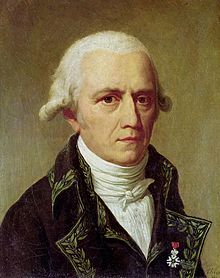
220px-Jean-Baptiste_de_Lamarck

Jean-Baptiste Lamarck

My daughter dropped that little bombshell on me one day after she came home from school.

“What kind of crap are they teaching you in that biology class of yours?” I grumbled.

“It’s called epigenetics,” she replied. “Look it up.”

I did. It blew my mind.

In previous posts, I wrote about Bernard Shaw’s attempt to found an evolution-based religion called Life Force Worship. Shaw’s ideas were based on the pre-Darwinian theories of Jean-Baptiste Lamarck. Here’s an admittedly crude and cartoonish rendition of the Lamarckian Story:

Once upon an extremely long-ago time, a certain hoofed animal ate all the leaves within easy reach. It then got into the habit of stretching its neck in order to eat leaves higher up. It passed along both the habit and an ever-so-slightly more elongated neck to its offspring. And lo, after untold generations of habit and inheritance, we now have giraffes in our midst.

Lamarckism eventually gave way to Charles Giraffe23Darwin’s theory of Natural Selection. Alas, according to this new idea, giraffes did not develop long necks solely through exercise and effort—by willing it, so to speak. Instead, giraffes lucky enough to be longer-necked managed to survive and procreate in the life-or-death struggle to reach higher leaves.

The process seemed (at least to thinkers like Shaw) to be intolerably random and mindless. Nevertheless, Lamarckism was relegated to the dustbin of defunct ideas—or so it was long thought.

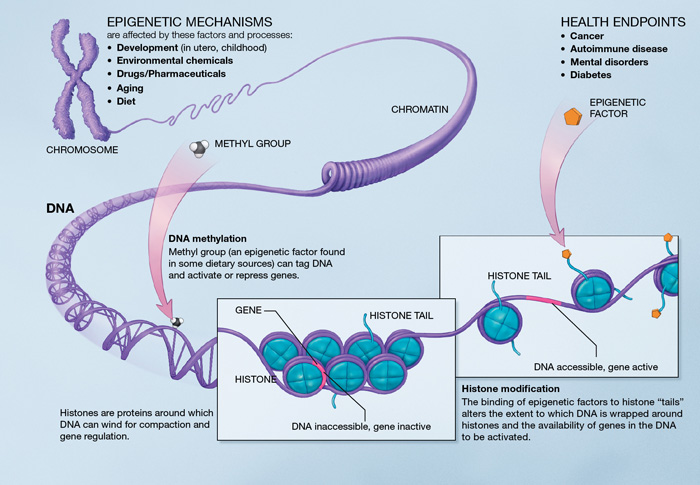
Epigenetic_mechanismsI won’t try to explain how epigenetics works. I doubt that I’ll ever be able to wrap my own brain around it. The gist of it seems to be that, while our genes are pretty much inalterable, the expression of those genes is not. Moreover, acquired characteristics sometimes can be inherited. As Kara Rogers writes in Scientific American,

the implications so far suggest that our lifestyles and what we eat, drink, and breathe may directly affect the genetic health of our progeny.

What’s more, epigenetics may well offer possibilities for treating obesity, cancer, diabetes, addiction, aging, mental disorders, and all sorts of other bugbears of the human condition.

So has this new science given Lamarckism a new lease on life? There’s a lot of healthy skepticism out there. And I doubt that any serious epigeneticist is ready to claim that giraffes willed themselves into having longer necks. But epigenetics certainly looks like an inspiring plot point in the ever-evolving Story of life.

Stitches, Stones, Spaces & Paper

10402515_943882342307799_8786174904186307091_n

I’m drawn to the creative experience—that act of discovery that can change everything …

For some years, Pat lived on an old farm in Virginia’s Shenandoah Valley—an “art farm” where she raised horses, chickens, and other animals, grew a garden, cooked on a wood-burning stove, and held art workshops, all with the help of other artists and several energetic teenagers.

It was a creatively transforming environment, she recalls …

My eyes simply filled up, and my brain overflowed with the world around me. I used photography, painting, stained glass, metals, fibers, handmade paper, and natural objects to try to comprehend what I was seeing. Those works were my way of looking at things, looking between things, and finally looking into the energy and connectedness within things.

Although Pat has worked in many visual media, in recent years she has turned to the warm, organic qualities of natural fibers, paper, and stones. She often uses a technique called needlelace, which incorporates some stitches from traditional lace making.

Pat has had one-woman shows in Virginia and Mexico, and her awards include a prize from MacWorld magazine for computer art. This little video is about a show she presented in San Miguel de Allende in 2010 …

https://www.youtube.com/watch?v=K7XJ0c0rGig

The Life Force Speaks to G.B.S. Out of the Evolutionary Whirlwind

bernard-shaw-on-self-effacement
In our last post, we touched on Bernard Shaw’s all but single-handed creation of a “religion of the future”: Life Force Worship. Not surprisingly, a faith in which God does not exist (yet) was not widely welcomed by the conventionally religious. Perhaps more surprising is the animus Shaw got from the scientifically literate—an animus that still persists today.

Shaw’s friend H. G. Wells, himself a former pupil of T. H. (“Darwin’s Bulldog”) Huxley, told Shaw that his religion embodied “an almost encyclopedic philosophical and biological ignorance.” And Richard Dawkins remembers with shame that “my own appreciation of Darwinism as a teenager was held back for at least a year by Shaw’s bewitching rhetoric in Back to Methuselah.”

Why such hostility? In the spirit of Story, let’s play with this question in a free-verse fable — with an accompanying video …

He was sitting there minding his own business and trying his best to write a potboiler replete with adulterous affairs and a couple of good sword fights when it had him round the throat again demanding:

“How dare you disobey me thus?
I who made the fish to thirst for the air and create nostrils for itself and feet so it could walk upon the earth:
I who made the giraffe to stretch its neck to attain the green beauty of the leaves:
and the mouse to insist on wings and arrange them out of its own flaccid flesh so it might fly in the dark like a bird:
and apes like you to seek more mind out of muddled mute sludge over eons of hit-and-miss attempts:
a mind to be my pilot and my guide and you use it to feed your own greedy face.”

“There you go spewing Lamarckian nonsense again,” said he.
“And if that isn’t bad enough you make me talk it too:
mystical gobbledygook that flummoxes science and slurs divinity and goads all sentient clusters of cells subscribing to fact or faith to shout ‘Blasphemy!’ from the bowels of billion-year-old lungs:
and who can blame them?
And to make matters worse you make me believe it myself:
you make me a cursed genetic freak and a puncture on the face of life and a damned mutation with no like organism to breed more of my kind with:
you make me to speak with such infernal roundabout wit that my fellow creatures are too delighted by how I say things to pay the first shred of attention to what I have to say:
just as you did with Jesus Christ damn you:
and now I demand to know if I’m to be crucified like he was.”

“Certainly not,” it replied. “You’ll live to be ninety-four.”

“Too old to be martyred and too young to learn,” he moaned.

“Remember the giraffe,” said the Life Force out of the Chaos.

The Evangelist and the Evolutionist

From William Jennings Bryan to George Bernard Shaw

GBShaw1900It might seem like a rather big leap from our previous two blog posts to this one — from the Bible-thumping Bryan to the vitalist Shaw. But consider what Shaw had to say about the theory of Natural Selection:

[W]hen its whole significance dawns on you, your heart sinks into a heap of sand within you. There is a hideous fatalism about it, a ghastly and damnable reduction of beauty and intelligence, of strength and purpose, of honor and aspiration…. To call this Natural Selection is a blasphemy, possible to many for whom Nature is nothing but a casual aggregation of inert and dead matter, but eternally impossible to the spirits and souls of the righteous.

jpegThis is from the preface to Shaw’s monumental five-play cycle Back to Methuselah, written some six years before Bryan took the witness stand in Dayton, Ohio. Of course, he and Bryan had both fallen for a gross caricature of what Daniel Dennett calls “Darwin’s Dangerous Idea.” But that’s hardly a surprise. Theirs was the heyday of “Social Darwinism,” the idea that “might makes right” in human society as well as in nature.

Also, as William Jennings Bryan says in the play I recently posted, “There was a war, remember?” Bryan believed that neo-Darwinism had done nothing less than bring civilization to the brink of suicide during the years 1914 – 18. Shaw said precisely the same thing in Back to Methuselah

Neo-Darwinism in politics had produced a European catastrophe of a magnitude so appalling, and a scope so unpredictable, that as I write these lines in 1920, it is still far from certain whether our civilization will survive it.

140px-William-Jennings-Bryan-speaking-c1896Bryan and Shaw were of sharply opposing mentalities, to put it mildly. Even so, they were both men of faith for whom the idea of a universe devoid of meaning was intolerable. But Shaw’s faith, unlike Bryan’s, was by no means conventional. As he wrote to Leo Tolstoy,

To me God does not yet exist; but there is a creative force constantly struggling to evolve an executive organ of godlike knowledge and power; that is, to achieve omnipotence and omniscience; and every man and woman born is a fresh attempt to achieve this object.

Shaw was seeking a new religion that would harmonize with scientific thought. At the same time, he yearned like Bryan for a creed that the materialistic science of his age seemed actively to deny. But did “faith” mean the same thing for Shaw as it did for Bryan? I think they would at least have understood each other’s meaning.

Both Shaw and Bryan studied and admired the Christian anarchist writings of Leo Tolstoy, who rejected St. Paul’s definition of faith as “the substance of things hoped for, and the evidence of things not seen.” His was a definition of faith that Bryan and Shaw could have agreed upon:

Faith is the force of life. If a man lives, then he must believe in something. If he did not believe that there was something he must live for he would not live. If he does not see and comprehend the illusion of the finite he will believe in the finite. If he does understand the illusion of the finite, he is bound to believe in the infinite. Without faith it is impossible to live.

A Play and an Idea

“… and did you know that William Jennings Bryan died on the last day of the trial, right there in the courtroom?”

I was sitting in a café listening to two customers at another table holding forth about the Scopes “Monkey” Trial of 1925. They seemed to be valiantly trying to outdo each other for ignorance. For absolutely nothing they said was historically true.

WilliamJBryan1902

William Jennings Bryan

No, William Jennings Bryan didn’t die that day in the courtroom. He died in his sleep five days after the trial ended. And no, John Scopes was not a biology teacher but a high school football coach. And no, the text Scopes got into trouble for teaching was not Darwin, but a chapter in George William Hunter’s textbook A Civic Biology. And so on, and so on, and so on …

None of this misinformation surprised me. All of it comes from Inherit the Wind, that perennially popular 1955 drama by Jerome Lawrence and Robert E. Lee. Neither Lawrence nor Lee ever claimed that their play had much to do with history. In a 1996 interview, Lawrence explained that it was really intended as a parable attacking the McCarthyism of its era …

It’s not about science versus religion. It’s about the right to think.

Nevertheless, Inherit the Wind is all-too-widely accepted as a factual account of the trial.

Now why should this bother me? It’s not that I object to the play’s status as a rousing polemic against Creationism. Pat and I are passionately devoted to evolutionary thought, and we’re constantly exchanging and discussing the latest news stories about discoveries in natural history. To us, the simple fact of evolution is wonderfully and endlessly pertinent to our ongoing fascination with Story.

But as a storyteller, I think that a cultural milestone as momentous as the Scopes Trial merits a more reliable account than you’ll find in Inherit the Wind. And the politically progressive William Jennings Bryan deserves fairer treatment than the character assassination he has suffered from being equated with his fictional proxy, the laughable but dangerous buffoon Matthew Harrison Brady.

Clarence Darrow

Clarence Darrow

The actual Scopes Trial and the media circus surrounding it were quite melodramatic enough without recourse to Lawrence and Lee’s extravagant distortions. And the trial did not bring out the best in either Bryan or his nemesis Clarence Darrow, especially during Darrow’s climactic cross-examination of Bryan. Bryan managed to fit perfectly the image that Darrow had drawn of him as a Bible-thumping bigot. And by embarking upon an obsessive (if also eloquent and effective) defense of science against religion, Darrow succeeded in botching what ought to have been a fairly straightforward legal defense of free speech. Despite all this, a deeper historical and intellectual subtext lies beneath all the melodrama.

The late paleontologist Stephen Jay Gould offered a remarkably nuanced view of both Bryan and the trial itself in his essay “William Jennings Bryan’s Last Campaign,” which appeared in his 1991 collection Bully for Brontosaurus. And now I’d like to do likewise.

In our next post, I’ll offer a sort of 10-minute thumbnail revision of Inherit the Wind. In it I hope to portray both Bryan and Darrow somewhat more favorably than they did themselves in 1925.

Spencer Tracy and Frederick March in the 1960 movie

Spencer Tracy and Frederick March in the 1960 movie “Inherit the Wind”