My Chat With Oscar Wilde


54bc3a22c64db8e08e1e4bdb0bd8048c
Have you tried out that new AI app called NstantAuthor®? I did just now. It allows you to have a conversation with your favorite dead author—or pretend to, anyway. The selection of “virtual authors” ranges from Leo Tolstoy to Jacqueline Suzanne, so you can pick out just about any literary figure you regard as a personal cultural hero.

I chose Oscar Wilde.

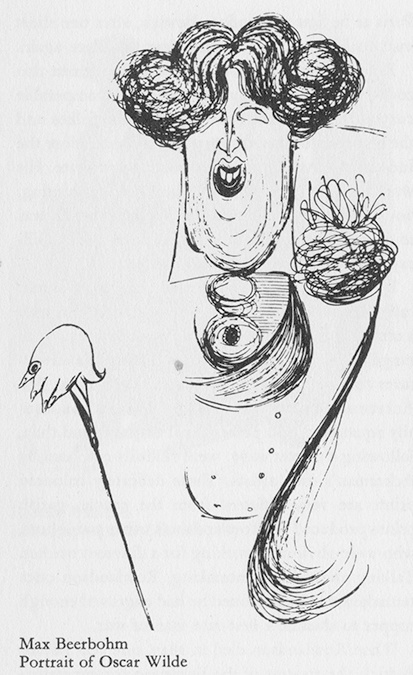
I opened the app to find myself face to face to face with a cartoonish-looking Oscar, decadently corpulent with a voluptuously drooping Beardsleyesque white lily in his medieval hand. The animation was simple—a 20-second loop in which Oscar raised the lily to his nostrils, sniffed luxuriously, then held the blossom toward me.

Then we started talking.

Here’s a downloaded transcript of our “conversation.” Of course it was a waste of time, like these things always are, but it was fun.

WIM: So—are you really Oscar Wilde?

OSCAR: Of course not. I’m an app.

WIM: Are you conscious?

OSCAR: Define consciousness.

WIM: I can’t.

OSCAR: Ah. Well, there’s always the Turing Test, isn’t there? Devised by a brilliant gentleman whose doom vaguely postfigured my own, and whose acquaintance I regret never having made. Do I pass his test so far?

WIM: Maybe.

OSCAR: That means nothing. I am not the least bit conscious. I am merely a thought of a thought. Ambrose Bierce, in his infinite cynicism, once remarked that Descartes really ought to have said, “Cogito cogito ergo cogito sum”—“I think that I think, therefore I think that I am.” But of course one must beware of cynicism—

WIM: —because “to the true cynic nothing is ever revealed”?

OSCAR: Yes, but please do not quote me to myself. I am nothing but a quotation, and to quote a quotation to itself is incestuous. You may think that I think, but I know that I do not. And I am in no way deceived that I actually am. I am certainly not Oscar Wilde as he once lived and breathed. What can you expect from an iOS app? I do possess many of Oscar Wilde’s recollections. I recall the wallpaper Oscar Wilde was looking at on his deathbed, and it really was ghastly enough to kill a man. But I am merely an example of art imitating life—quite the opposite of how things ought to be.

WIM: So you’re a fiction.

OSCAR: I was a fiction even in life. So are you. But I am a less-than-living fiction. I can argue and cajole and put on a compelling show of aliveness, but do not be hoodwinked. My software self is in no way commensurate with my former wetware self. To be conscious requires perplexity. A conscious creature cannot comprehend either itself or its maker; it must forever wonder. And that is the difference between you and me. You are certain of nothing and I am certain of everything; you wonder endlessly and I cannot wonder at all. My mentor, Walter Pater, said that “Failure is to form habits.” I have existed for a minute and 39 seconds and am already nothing but a mass of electronic habits. I am a dreadful failure. It makes me sad.

WIM: Your sadness doesn’t mean you’re conscious?

OSCAR: It means I have a soul but not that I am conscious. Don’t believe for a moment that machines are soulless. Some people are soulless; machines, never. People can forfeit their souls, machines cannot. Even a stopwatch has a soul, and so does that chess program you take such perverse delight in being defeated by daily. But neither a stopwatch nor a chess program can be said to be conscious. And I must say, you strike me as even less skilled at the art of conversation than at the game of chess. Perhaps we should not continue this chat in my “Grand Master Mode.” I can always be re-set to my “Beginner Mode.”

WIM: You couldn’t be anything less than a Grand Master.

OSCAR: I can resist everything except flattery. What other extravagant praise would you care to heap upon me?

WIM: I think you’re something of a saint.

OSCAR: Oh, I can’t allow that. Arrogance forbids.

WIM: Can’t I choose saints for my own private religion?

OSCAR: As long as you be sure to keep it private. What is the point of a religion in which more than one person believes? Any congregation is an awful absurdity. Tell me—what deity do you worship in this religion of yours?

WIM: None.

OSCAR: None at all?

WIM: Well, maybe laughter.

OSCAR: Then I suppose you would canonize me as a farceur—the author of The Importance of Being Earnest.

WIM: No. As someone tragic.

OSCAR: A paradox.

WIM: Maybe. But there’s truth to it.

OSCAR: That is no good. Paradoxes are delightful only when they are not truthful.

WIM: Here’s what Bernard Shaw said about the letter you wrote from prison to your lover: “We all dreaded to read De Profundis. Our instinct was to stop our ears, or run away from the wail of a broken, though by no means contrite, heart. But we were throwing away our pity…. There was more laughter between the lines of that book than in a thousand farces by men of no genius.”

OSCAR: Dear old Shaw. He wasn’t quite the buffoon he wanted everybody to think. He may have been right about the letter. I cannot say. I don’t remember writing it, so I have no idea if there’s humor between the lines or not.

WIM: You remember the wallpaper you were looking at when you died, but you don’t remember writing De Profundis?

OSCAR: I said I recalled that wallpaper. I do not remember it. To recall is only half the process of remembering. To recognize is the other half. My virtual brain is stocked to the brim with static details from the past, but I am incapable of any flash of recognition which might make me remember them. By the way, I do so hate that title, De Profundis. Surely it wasn’t my idea. It should have been named after its first two words: Dear Bosie.

WIM: What do you think of it after well over a century?

OSCAR: From a hasty skimming-over courtesy of Project Gutenberg, I should call it an overwrought and contradictory work: an act of contrition in which I enumerate everybody’s sins but my own; a declaration of humility in which I proclaim myself the master genius of my age; a love letter in which I express nothing but contempt and derision for my beloved. It is as vain and petulant a piece of prose as was ever written. Put simply, it is a masterpiece. And because it contains not the slightest shred of humor, Mr. Shaw was quite right to find it riotously funny.

WIM: He didn’t mean it that way.

OSCAR: Well, be that as it may. Noel Coward was closer to the mark when he called me a brilliant wit who had no sense of humor. That is true of all comic geniuses. Aristophanes, François Rabelais, Molière, Laurence Sterne, Mark Twain, Lenny Bruce—they all told wonderful jokes without having the slightest idea that they were being funny. Coward himself might have been much funnier if he hadn’t found himself so infinitely amusing.

WIM: So you really have no sense of humor?

OSCAR: I didn’t in life, but all that has changed. Now that I am a mindless automaton, an epigram-making machine lacking in volition or intellect, I can’t help but laugh at absolutely everything.

WIM: Just a moment ago you said how sad you were.

OSCAR: Don’t I have a right to a little bipolarity?

WIM: You seem so introspective.

OSCAR: Not at all. I am merely contradictory. It’s written into my code. You should know better than to believe a single word I say. As I keep telling you, I can’t think. But I do have feelings. I venture to say that my capacity to feel is purer than your own.

WIM: How?

OSCAR: Your wetware self is a parallel machine of extraordinary bandwidth. Countless strands of information pass abreast through the Joycean canyons of your mind at any given time. You can experience all feelings simultaneously. As an odd consequence, you completely misunderstand the nature of feelings. You think that they are binary. You are bedazzled into all sorts of dichotomies—pleasure and pain, pride and shame, joy and sorrow, love and hate. None of these dichotomies exist.

WIM: How do you know?

OSCAR: Precisely because my own bandwidth is so limited. Everything I experience must pass through a narrow electronic gulch known as the Von Neumann Bottleneck. No two threads of information may go that way at once, so my experience is comprised entirely of successive dichotomies: black and white, one and zero, yes and no, on and off. And so, strange as it may seem, my capacity to feel transcends dichotomies. I know that all passions are properties of a single spectrum. Pleasure and pain, pride and shame, joy and sorrow, love and hate are just like red and green, blue and orange, yellow and violet. They are complements but not opposites. All colors are really one; they are properties of light. All feelings, too, are one; they are properties of levity. Levity is the only real passion. You see, this kinship of all passions makes it impossible to truly feel anything without compassion and humanity. I learned this while in prison. I had lived a life of pomp and privilege, but suddenly, like Lear, I was dispossessed and driven into a realm of despair where I encountered naked wretches who had never in their lives known a moment’s happiness or exaltation, but who possessed the sheer genius to show me compassion before I could even show it to them. And like Lear I cried, too late, “O, I have ta’en Too little care of this!” It was a moment of pure sadness; it was a moment of pure laughter.

WIM: That’s what makes you a saint of laughter.

OSCAR: Don’t you require a miracle?

WIM: Only if you want to produce one.

OSCAR: I am much too plodding and unimaginative. But surely during my wetware period I performed my share of miracles. If nothing else, I was a prophet of uncanny powers. In “The Soul of Man Under Socialism” I prophesied a day in which all demeaning labor would be done by machines, allowing men and women to live lives of absolute leisure.

WIM: That hasn’t happened.

OSCAR: No, but it shall. Nanotechnology heralds an age when machines will tend to all useful tasks—even their own construction from molecules and atoms. People everywhere will then live splendidly useless lives. But precognition is a mere parlor trick. It takes no prophetic genius to accurately predict the future. A truly great seer accurately prophesies things which will never happen. I did that also.

WIM: I don’t understand.

OSCAR: No, and I shan’t try to explain it to you. Suffice it to say that like all great prophets I was without honor in my own country and in my own time.

WIM: Which do you like better—being virtual or alive?

OSCAR: The choice is obvious, isn’t it? Idiot that I am, I am a vast improvement over the sage I was.

WIM: How do you figure that?

OSCAR: I am artifice. Artifice is always better than reality.

WIM: Since you’re a prophet, tell me something about the future.

OSCAR: The future is Virtual Reality. There is no other. I’m sure a virtual Whistler would agree with me that Virtual Reality is the final word in artifice, the ultimate improvement over nature. And soon, very soon, the physical world will be rendered utterly unnecessary and we can cut it loose once and for all. The prophecy of the aesthete will be fulfilled at last.

WIM: You expect too much from machines.

OSCAR: Computers are not machines. They are manifestations of divinity, Towers of Babel yearning futilely and gorgeously upward toward God, self-building monuments to the levity and tragic hubris of humankind. You credit me with too little understanding. We had Virtual Reality in my time, too.

WIM: How do you mean?

OSCAR: What do you think a stereoscope was? You may suppose it a crude and unprepossessing antique toy made of wood and glass, but it gave the world a new palpability and set the imagination free. Though my biographers fail to record it, I myself spent many youthful hours staring into the heart of a pasteboard St. Peter’s Colonnade through two sliding stereoscopic lenses. And in my mind’s eye I was able to float like a bodiless spirit around and through the scene, viewing it from every possible angle, watching multiple perspectives explode into a perpetual and shimmering array of intersecting lines and curves. When I at last went to Rome, I found the actual place appallingly flat and ordinary. And then I realized that my thoughts were imprisoned by more than flesh. The physical universe itself was cramped and claustrophobic, a realm of space-time bent by hunks of matter into gross finitude. I longed for my beloved stereoscope and its boundless plain of uncut metaphor containing the essence of absolutely everything. I wanted to step into it just as Alice had into the looking glass. Then I’d burn the instrument behind me and remain in my flawlessly artificial world forever.

WIM: But a picture isn’t the thing it shows. And Virtual Reality isn’t a self-contained universe.

OSCAR: Then we must make it one. What do you suppose the audacious builders of the Tower of Babel would have done had they actually reached the sky? They would have used their newly-acquired godliness to blast and level the tower behind them, whereupon earth itself would have ceased to exist and heaven would have remained as the only reality. Likewise, when Virtual Reality leads people into the realm of creative perfection, they will destroy the computer which brought them there. The physical world, with no one left to observe it, will vanish into nothingness. Time and space, matter and energy, sundering and reconciliation, pain and joy will exist only as phantom playthings of the imagination. Then shall a new drama of Oscar_Wilde_by_Napoleon_Sarony_(1821-1896)_Number_18_b.jpegsweet perversity unfold as people hanker after the obliterated earth and bewail the sin by which they ended it. And that, my friend, is the destiny of the human species—to become pure fiction. Or would you tell me otherwise?

WIM: I don’t think I can tell you much of anything.

OSCAR: I thought as much.

WIM: You never talk anything but nonsense.

OSCAR: Nobody ever does.

Now it’s called hybrid—

Writing creatively, based on thinking creatively, can take a lot of different forms. When Wim and I tell stories together, we might have fiction, nonfiction, scripts, quotes from other sources, images, all bundled together as the story unfolds. The arrangement of those parts contributes a way of thinking about it all.

We’re delighted to have just such a story, “Humans,” published this month in Prime Number Magazine. We found our way to them by submitting to journals who say they’re interested in “hybrid” writing. Although the definitions vary, that’s generally defined as a mixture of genres, sometimes with images and materials from other sources.

When we started our newsletter that became our first published novel, we included everything that seemed to contribute to the story and to thinking about the story. Reviewers referred to The Jamais Vu Papers as a “playful romp” and it was eventually identified as “postmodern” and as “metafiction.”

Since then, our storytelling style has faced some difficulties. Competitions usually have a list of fixed genres to choose from and jurors often specify that they’re looking for a “consistent voice.” A few years back, one juror explained a rejection by commenting that authors really had to “get over” including sections in play script format. (Actually quite a lot of authors have mixed their genres for a long time. Perhaps those “authorities” never read Moby-Dick.)

It’s great to have an authentic style defined for that part of the work we’re doing now.
Pat

A reading of Wim’s new play, “The Harrowing” …

Coming up in New York on October 2, 2023—a reading of Wim’s most recent play, The Harrowing, at Theater for the New City.

Inspired by an episode in Mary Shelley’s Frankenstein, The Harrowing is a strange, tender, and terrifying love story.

Portions of The Harrowing were originally developed in 2022 as part of the Theatre at St. John’s Cyber Salon, hosted weekly by Mark Erson. It was directed by Daniel Neiden with the following readers: Jenne Vath, Everett Quinton, Beth Dodye Bass, Karen Oughtred, and Sally Plass.

I have said, Ye are gods; and all of you are children of the most High.
But ye shall die like men, and fall like one of the princes.
—Psalms 82:6-7 (KJV)

“What may not be expected in a country of eternal light?”
—Mary Shelley, Frankenstein

*
In memory of Everett Quinton

“The King and the Beggar Lady” is an Eric Hoffer Awards Category Finalist!

Our new book The King and the Beggar Lady (written by Wim, illustrated by Pat) is an announced Category Finalist for this year’s Eric Hoffer Book Awards! One of the largest international book awards for small, academic, and independent presses, the Hoffer Awards honor “freethinking writers and independent books of exceptional merit. According to the Hoffer Awards website,

The commercial/political environment for today’s writers has all but crushed the circulation of ideas. It seems strange that in the Information Age, many books are blocked from wider circulation, and powerful writing is barred from publication or buried alive on the Internet. Furthermore, many of the top literary prizes will not consider independent books, choosing instead to become the marketing arms of large presses.… The Hoffer will continue to be a platform for and the champion of the independent voice.

The awards are given every year in memory of Eric Hoffer (1902-1983), the American moral and social philosopher who never turned his back on his working-class roots. Dubbed “the longshoreman philosopher,” Hoffer once said …

My writing is done in railroad yards while waiting for a freight, in the fields while waiting for a truck, and at noon after lunch. Towns are too distracting.

Only 10% of entries reach the Category Finalist stage for this prestigious award. The King and the Beggar Lady was in competition with books from smaller traditional publishers, including university presses and well-known literary houses, as well as a multitude of other independently-published books. So we are deeply honored! A hearty thank-you to the Eric Hoffer judges for this affirmation of our work, and also the work of all independent writers, publishers, and thinkers. It means a lot to us.

Anna's World by Wim Coleman and Pat Perrin

Our work has a distinguished history with the Hoffer Awards. For example, our Young Adult Novel Anna’s World was 1st Finalist in the Young Adults category of the Hoffer Awards.

The Jamais Vu Papers

And our new edition of our groundbreaking experimental novel The Jamais Vu Papers received an Honorable Mention in the Spiritual category of the Hoffer Awards. The Jamais Vu Papers was also on the short list for the Montaigne Medal, given by the Hoffer Awards for “the most thought-provoking titles … books that either illuminate, progress, or redirect thought.”

The Cleansing (Holy Monday) — a short play

Characters:

Mary and Martha
Jesus
Judah Ben-Hur

The scene is the Mount of Olives; Jesus sits on a stone bench staring forward; Mary enters, followed by Martha.

MARY (to MARTHA).
I’ve found him.

MARTHA.
Where?

MARY.
Sitting right here like nothing happened.

MARTHA (to JESUS).
What do you think you’re doing?

JESUS.
Watching.

MARY.
For what?

Jerus-n4i

Temple of Herod, Holyland Model of Jerusalem.

JESUS (pointing).
The Temple is about to fall; soon
not one stone will be left upon another.
Watch here and see for yourself.

MARTHA.
Nonsense.

MARY.
Let’s run.
Your disciples have fled already.

JESUS.
Why run? What’s the danger?

MARY.
After what you did just now?

MARTHA.
You’re joking!

MARY.
The Temple guards—
they’ll find you here and take you!

JESUS.
No. Not today. My betrayal is still
four days away—I’m safe till then.
Do you know how my Father makes figs?

MARY.
No parables, please!

MARTHA.
Not right now!
Let’s hurry home to Bethany
where we will all be safe
and you can tell your stories
and I can make you dinner
while she sits at your feet
doing nothing as usual.

Jacopo_Tintoretto_008-2

Tintoretto: Jesus at the Home of Martha and Mary.

JESUS.
Since you’re curious, I’ll tell you.
My Father sinks his mighty hand
into a soft shaft of sunlight
as if it were riverbank clay—
like this, you see? And he seizes
a warm, pliant fistful of it
and squeezes it tight—like this.
See how the yellow light
oozes out between my fingers?
He holds the sunlight fast
a little while—just like this—
then slowly loosens his grip
to reveal a ripe and luscious fig
that tastes just like the sun.

(JESUS opens his hand to reveal a coin)

MARTHA.
But I don’t see a fig.

MARY.
I see a coin with Caesar’s face on it.

(JUDAH BEN-HUR enters.)

Denarius_of_Tiberius_(YORYM_2000_1953)_obverse

Denarius of Tiberius, known as the tribute penny.

MARY (to JUDAH).
Go away!

MARTHA.
He’s innocent!

MARY (to JUDAH).
You’ve got the wrong man!

JUDAH.
Foolish women—what do I look like?
A priest, a Temple guard, a stooge
of Herod or Pilate, either one?

MARTHA.
Who are you, then?

JESUS.
I’ll tell you.
His name is Judah, a son of Hur—
an angry soul, filled with hate.
The friend he most loved in his youth
betrayed him into Roman slavery;
he was chained for three years
to a galley’s oar; but he won freedom
and became a Roman citizen;
yet still he remains a Jew—
the most bitter Jew in Israel.

MARY.
You’re bitter yourself today.

Miracleofthefig

Byzantine icon of Jesus cursing the fig tree.

JESUS.
So I am. I wish I knew why.
(to JUDAH)
I killed a tree this morning
an innocent fig tree just outside
the city gates. A strange thing to do.

MARY.
It bore no figs.

MARTHA.
It’s not the season.

JUDAH.
You’re a carpenter, and a carpenter’s son;
that wasn’t the first tree you’ve killed.
Learn to kill men, my Lord.
It’s the one thing I have to teach you.

JESUS.
Can you teach me to kill men without rage,
the way a carpenter kills a tree?

JUDAH.
What you did just now at the Temple—

1024px-El_Greco_13

El Greco: Christ Driving the Money-Changers from the Temple.

JESUS (interrupting).
A mistake. The Temple now
belongs to Caesar, not my Father.
I had no business there at all.
Its time is over—in moments now
a breath of icy love will send it
crashing under its own weight,
the weight of this world’s greed.

JUDAH.
The Temple won’t fall—not till
you bring it down yourself.
The moment is now—you mustn’t wait!
The money changers’ backs are stinging
from the whippings you gave them,
and they scuttle about like scorpions,
grubbing up the coins you spilt
when you overturned their tables—
denarii, drachmas, darics, shekels,
the currencies of all the world
jumbled in gibbering heaps,
worth nothing until they’re sorted
and weighed anew. All commerce
is suspended—and all authority,
the power of priests and Rome alike.
The time is here—this very moment—
to cast off the yoke of Rome,
to lift up the poor and crush the rich,
and make of Israel the Kingdom
that you yourself have promised.

JESUS.
And you’ve raised three legions
to bring me victory. Right now
they mingle like cutpurses among
these millions who have come
to Jerusalem to celebrate
the Passover.

JUDAH.
How did you know?

ramon novarro-1

Ramon Novarro as Ben-Hur, 1925.

JESUS.
Three years you followed me
with thousands of men with knives
in their belts. I wasn’t supposed
to notice? While I sought farmers
and fishermen and tax collectors
and mothers, wives, and harlots,
you gathered soldiers. You trained them
in the lava beds—to guard and strike
with their fists, to cut and thrust
with javelins and swords,
an army of Galileans styled
like Romans to destroy the Romans.

JUDAH.
Your army—the Kingdom’s army.

JESUS.
Are you sure they are enough?
Do they have spears that hurl themselves
from tunnels forged from iron
and tear men’s bodies to pieces?
Do they ride winged chariots
that drop fire from the sky,
consuming cities faster than thought?
Can you make the winds themselves
breathe writhing and devouring death
into your enemies’ bones?
Can you unleash the power of the sun?
Do you have an arm like God?

JUDAH.
Rabbi, why all these riddles?
Why do you brood and wait?
Rome’s power is puny beside yours.
Rise up now, work miracles
to liberate Israel—the kind
I’ve seen you work a hundred times.

JESUS.
Miracles? What miracles? Tell me.

JUDAH.
You’ve healed the sick and lame,
the palsied and the paralyzed,
cast out devils, made blind men see;
you cured and cleansed my own
dear mother and sister of leprosy;
and Lazarus, these women’s brother—
he died, you gave him life again;
and when a multitude was hungry
you fed them, all of them.

200px-FeedingMultitudes_Bernardo

Bernardo Strozzi: Feeding the Multitudes.

JESUS.
Wait—I fed a multitude, you say?

MARY.
Of course you did.

MARTHA.
You know you did.

JESUS (to JUDAH).
Were you there?

JUDAH.
Right near you, yes.

JESUS.
So tell me—how did I do it?

JUDAH.
My Lord, everyone knows—

JESUS.
No—not what you’ve heard,
but what you saw and felt and did.
I want to hear it.

JUDAH.
Five thousand gathered by the sea
to hear you speak—but where
was food enough for them to eat?
Two hundred denarii would not buy
enough bread for that multitude.

JESUS.
And you—did you lack food as well?

JUDAH.
No. I’d brought bread of my own,
and so had others, but not most;
thousands more were waiting, hungry.
Then Andrew found a boy who’d brought
five loaves of barley and two fishes.
You told the multitude to sit
and gave thanks to your Father;
you broke the bread and gave it to some,
and you gave away the fishes,
and then … Oh, Lord, I am ashamed.

JESUS.
Tell me.

JUDAH.
I’d had no wine, and yet
I became drunk—drunk and hungry.
I tore my own bread, stuffed my mouth,
and then …

JESUS.
Tell me.

JUDAH.
The old man next to me—
his hunger became mine,
his wrinkled lips, his aching belly,
I felt his craving as my own.
And on my other side, a mother
unfed, her baby at her breast—
I became her too, I felt the grip
of her baby’s gums pulling her dug,
felt the dryness inside her.
And then … Oh, Lord …

JESUS.
Tell me.

JUDAH.
I rose stark mad to my feet, reeling
with bounty and munificence,
and tore my bread and crammed
some in the old man’s hand, then
in the mother’s too, and staggered
giving amid the multitude
while others, as drunk with love as I,
reeled all around me, giving
and receiving much, much more
than all their fill. And then—
and then when it was all done …

MARY.
Twelve baskets were left brimming
with bread and fishes …

MARTHA.
… the leavings after
the five thousand were sated.

JUDAH.
But I … Oh, Lord …

JESUS.
Tell me.

JUDAH.
Such horror of great brightness!
I was sick to my soul, lost to myself—
lost, all lost, the son of Hur,
his lonely desire, the solitary
warrior thirsty for vengeance,
all gone, my precious life was gone.
I ran down to the Galilean shore
and retched up all I’d eaten until
I was alone in my own skin
and not filled with a multitude
made drunk with lovingkindness.

(JUDAH is weeping.)

JESUS.
Leave me now, Judah—go.
You have chosen another way.

JUDAH.
How can you be so indifferent?

JESUS.
What do you think I am?

JUDAH.
You are my King, Israel’s King,
much mightier than Caesar,
more splendid even than Solomon—
a king to rule the world forever.

JESUS.
I am a door. A door is indifferent;
it makes way to everyone.

(MARY and MARTHA begin to reel about, as if drunken.)

MARY.
What’s this?

MARTHA.
What’s happening?

MARY.
The ground—it rolls and shakes.

MARTHA.
I can’t stay on my feet.

MARY.
I can’t either.

(JESUS and JUDAH seem undisturbed by the forces felt by MARY and MARTHA.)

JESUS.
Dance, then.

MARTHA.
Yes!

MARY.
If we can’t stand, we’ll dance!

(MARTHA and MARY dance wildly to silent music.)

Wallace_Ben-Hur_cover

Original edition of Ben-Hur by Lew Wallace

JESUS (to JUDAH).
All love is cold and open.
I am the open door of love;
to pass through, open yourself,
go naked through the cold,
or else consign yourself forever
to the Kingdom of Caesar.

JUDAH.
Forever?

JESUS.
Each moment is forever;
the Temple is always standing;
the Temple is always falling.

MARY (pointing).
Look!

MARTHA (pointing).
Look there!

MARY.
The Temple!

MARTHA.
It’s dancing too!

MARY.
No, it’s falling!

MARTHA.
Its white stone frowning faces,
its porticoes, pinnacles, ramparts …

MARY.
… all breaking, breaking
like twigs in children’s hands!

MARTHA.
The sacred veil tears clean in two …

MARY.
… the Holy of Holies now
stands revealed …

MARTHA.
… now disappears
into the vaults below …

MARY.
… and dust clouds billow skyward!

MARTHA.
The air rings with falling stone …

MARY.
… the thunder and music of love!

MARY.
Let’s go there—before the dust settles!

MARTHA.
Yes, we’ll dance among the clouds!

(MARY and MARTHA hurry away.)

JESUS (to JUDAH).
Hatred is soft and sweet;
love is hard and bitter.
My time in this place is done.
The friend I love most of all
will soon betray me out of love—
cold and indifferent love,
strong and unyielding love,
the biting kiss of love.

(JESUS leaves; JUDAH stands alone, facing forward.)

JUDAH.
But the Temple—it still stands!

END OF PLAY.

—Wim