Tolstoy and the Shaker

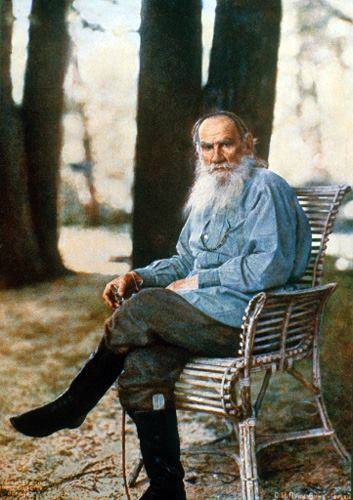
AnnasWorldcoversmallThe work Pat and I do together leads us on some fascinating detours. While we were researching the Shakers for our multiple-award-winning novel Anna’s World, we ran across a startling letter from the great Russian novelist Leo Tolstoy himself …

I received the tracts that you sent me, and read them, not only with interest, but with profit; and cannot criticise them, because I agree with everything that is said in them …

Tolstoy was writing to Frederick W. Evans, a Shaker elder based in New Lebanon, New York. The date was February 15, 1891. By then Tolstoy was a thoroughgoing Christian anarchist-pacifist, cantankerous and iconoclastic enough to look back upon his own masterpieces War and Peace and Anna Karenina with utter disgust. And the communistic, celibate Shakers were right up his alley. He and Evans kept on writing back and forth, exchanging ideas about religion, society, and justice.

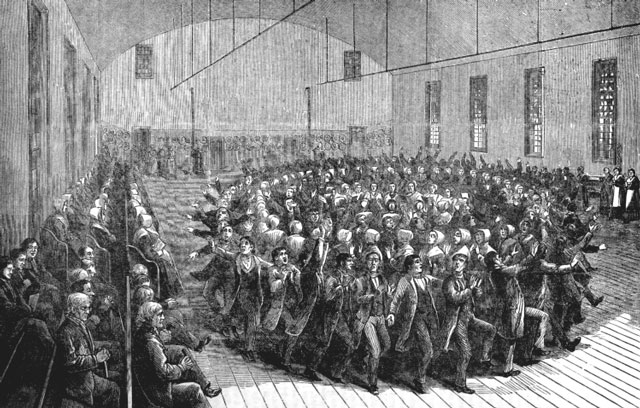
shakers-dancingFrederick Evans had been a socialist since his youth. In 1830, when he was about 22 years old and every inch a materialist and secularist, he went out scouting New York state for a place to found his own utopian community. He stopped in New Lebanon to visit the Shakers there, expecting to find “the most ignorant and fanatical people in existence.” Instead he was promptly converted, convinced that he had found just the ideal society he had envisioned.

Evans’s life as a Shaker was anything but cloistered. He served the Shakers as an ambassador to what they called simply “the World.” At the height of the Civil War, Evans and another elder visited the White House, petitioning President Lincoln for exemption from the draft. Although deeply opposed to slavery and actively supportive of the Union, the Shakers were steadfast and devoted pacifists for whom fighting was morally unthinkable.

Lincoln was impressed by the elders. After they finished making their case, he asked …

“Well, what am I to do?”

“It is not for me,” Elder Frederick replied, “to advise the President of the United States.”

“You ought to be made to fight,” Lincoln said. “We need regiments of such men as you.”

Even so, Lincoln granted the petition.

10606140_910718692290831_759700197982803500_nIn their correspondence, Evans and Tolstoy hit it off famously. When Evans died, Tolstoy wrote a letter of sympathy to another Shaker elder …

I can not tell you how sorry I am, not for the death of our dear and honored friend Evans, but for you and for all those who loved him and were fortified by his spirit. I am one of them.… I loved him very much.

In Anna’s World, I hope that Pat and I wrote a novel that both Frederick Evans and Leo Tolstoy might enjoy. I expect that our chances might have been better with Evans. Shaker intellectuals weren’t too otherworldly to disdain all fiction, and they much admired Tolstoy’s then quite scandalous story “The Kreutzer Sonata.”

But I suspect it would have been tougher to please Tolstoy, whose literary standards eventually got to be downright quirky. In his old age, he had this to say to poor Anton Chekhov

You know, I hate your plays. Shakespeare was a bad writer, and I consider your plays even worse than his.

The Wand Bearer — Still in Progress …

Juggler in the WindOnce in a while Pat and I receive a note from a reader who enjoyed our award-winning novel Juggler in the Wind and asks when to expect the rest of Randy Carmichael’s story. Please rest assured that we are still working on the Wand Bearer chronicle. Like many stories that Pat and I tell together, this one has grown way beyond our expectations. It has become much more ambitious, time-consuming, and I might say life-consuming than we had anticipated. It’s taking time to complete. We’re grateful for your interest, and we hope you can be patient.

Among other things, Randy Carmichael’s tale is becoming a love story of mythic dimensions. Here’s a short sample of what’s to come:

“Look,” she said.

            I followed her gaze. She was staring between the maple trees at the mountains. They were so magnificent, I wondered why I hadn’t stopped to look at them already. Of course, during the drive, I’d been too scared to look at much of anything. And since we’d arrived in Turtle, I hadn’t really had the chance.

            The mountains rose up sharply beyond a stretch of forest at the edge of the town. On the slopes you could see where the timberline abruptly ended, and above that level lay indescribably huge blue-gray slabs of bare rock, all rising toward snowy peaks with clouds forming wispily around them. Those peaks looked so razor sharp, you could imagine cutting your hands if you tried to touch them.

            “Beautiful, huh?” I said, with exactly the lameness I’d hoped to avoid.

            “They’re so white on top.”

            “It’s cold up there. The snow never melts that high.”

            I felt dumb saying that. Of course she knows that already, I thought.

            She turned and looked at me. Her small, jewel-like eyes switched from blue to green, the way I’d seen them change before. You could swear that they talked when they did that. Right then, they spoke of surprise.

            “You’ve seen snow, right?” I said, laughing.

            A hint of darkness burst out of those brilliant eyes. Had I hurt her feelings? She looked back toward the mountains, her mouth slightly open with awe. Those full, wide, glinting lips seemed out of place on her lean, long, pale face—but then, so did all her features: the narrow, inward slope of a nose that appeared to sit just a little off-center, a round little dome on its tip; those sharp cheeks that reminded me of points on a compass; the chin that jutted maybe a fraction of an inch farther than I might have expected; the alarmingly high brow with curling auburn hair parted high above and behind it.

            Not a single feature wasn’t beautiful. It’s just that you’d think they were from different faces—the faces of a dozen or so equally lovely girls. And the blend of features—no, not a blend, more of a collisionwas like a collage, made up of pieces cut out and put together by some super-amazing artist to create a face too wonderful to be quite human.

            The rest of her body was like that. She was willowy but not tall—almost exactly my own height. Standing there in her brightly-embroidered white muslin dress, she reminded me of a twig you might cut from a tree—straight here, turned there. Her legs bowed together a little at the knees, and her slim arms with almost outsized hands hung down and meandered about, as if trying to find out where they belonged exactly. Her back swayed inward lower down, then straightened sharply into her long neck, where her head tilted to and fro, from side to side, striking every possible angle with endless curiosity.

            I guess it was right then that I realized just how drawn to her I was. And somebody who wasn’t—well, me might have seen her quite differently, as a typically gangly teenage girl. “She’ll grow out of it,” an adult might say. People have said that about me.

            But she’d never grow out of it, I was sure. She wasn’t really born into that body—it had been given to her somehow. She would spend all her days trying to find her way into it. And that struggle made her all the more beautiful. It transformed what ought to have been awkwardness into a gracefulness you couldn’t quite make sense of. Even with her odd edges, she seemed all gentle curves—long, sweeping, elegant.

            “The snow—it’s so white,” she murmured, still staring at the mountaintops. “It’s like—like silver, only purer, brighter. It’s … it’s …”

            Her high, hushed voice trailed off as she kept on gazing. I wondered—how could she be so astonished by snow? Well, I knew that Circus Olympus had wandered across the country from Florida, where the troupe likely spent its winters, and where there was never any snow. And during summer tours across the country, the troupe probably didn’t see snow. Still, hadn’t Jill seen snow on, say, television? No, nobody in the circus had a TV as far as I knew. But what about photographs, postcards?

            “You’ve never seen snow?” I asked.

            She didn’t reply for a moment, as if I weren’t there. Finally, without averting her eyes from the mountain, she said …

            “It’s been so many years. So many lives.”

            I remembered something she’d said back on the road, when that hot wind had been so deadly …

            “We’re all old.”

            And again I wondered …

            How can she be old?

            I felt a tingle in my face, especially my cheeks. It’s a familiar tingle that I get whenever I’m upset, worried, frightened, angry—any of a whole variety of emotions. What do I look like when I get that tingle? Does my face tighten or go slack? Do I turn red or pale? I’m sure I don’t look my best when that happens—certainly not smart or cute or handsome or any other way I wanted to look around Jill. I was just as happy that she was looking at the mountains and not at me.

            But then she turned directly toward me. She smiled a stunning, broad smile, her gleaming teeth arranged as oddly and yet as marvelously as everything else about her. If she wanted to see snow-like whiteness, all she had to do was smile at herself in a mirror. But somehow it was hard to imagine Jill ever looking in a mirror. Beauty came so easily to her, surely she never gave it a moment’s thought.

            “Let’s go,” she said.

            “Where?” I asked.

            “There,” she said, pointing to the mountain peaks.

            “To the mountains?”

            “Sure. Way up to the top. Where the snow is.”

            “Uh—we can’t.”

            “Why not?”

            How could I begin to explain? Didn’t she understand already? Didn’t she realize that those mountains were miles away? And as for climbing them, didn’t she have any idea about rope and gear and equipment, not to mention the athletic skill involved—and the daring? Just looking at those peaks, imagining myself up there scaling sheer cliffs at outrageous heights, made my legs wobble queasily. And, oh, how cold it must have been, with air almost too thin to breathe. I’d always figured that mountain climbing was for crazy people. And I doubted that anybody had been crazy enough to scale those peaks.

            “We just can’t,” I said stupidly.

            She laughed brightly, her eyes switching from green to blue again. “Stay here if you like,” she said. “I’m going.”

            That alarmed me. Not that I thought Jill was really going to get near any serious slopes on her own. But what if she headed off into the woods at the edge of the town, trying to make her way toward the mountains? What if she got lost? What if she ran into dangerous animals? I didn’t figure I could talk sense to her about this whole thing. So if she took off in a run, what was I supposed to do—run after her and tackle her?

            Her smile faded, and she turned away from me to look at the mountains again. Her eyes switched from their pale blue to a golden color, and her pupils pulsated in a slow but steady rhythm. She seemed hypnotized. I didn’t understand what was going on in her head, but I was relieved that she was staying put, as rooted where she stood as the nearby maple trees.

            She was somewhere else now—and wherever it was, I wasn’t anywhere nearby. So I turned away from her and walked back toward the inn.

Robert E. Lee’s Mexican “Noche Triste”

… one of the most unjust [wars] ever waged by a stronger against a weaker nation …

Ulysses S. Grant in 1843

Ulysses S. Grant in 1843

That was how Ulysses S. Grant described the Mexican-American War of 1846-48 in his Personal Memoirs. Some two decades before he commanded the Union Armies during the American Civil War, Grant served in Mexico as a young lieutenant.

I ran across the quote back in 1998 while compiling a book of source materials about the war in Mexico. Grant’s eventual nemesis Robert E. Lee also served in that war as a captain. Did Lee share Grant’s bitterness about the conflict? While looking for an answer, I ran across a strangely haunting document. On April 12, 1848, shortly after the war’s end, Lee wrote a letter from Mexico City to a lady cousin back home in Virginia. The letter begins …

Robert E. Lee, c.1850

Robert E. Lee, c.1850

I rode out a few days since for the first time to the church of Our Lady of Remedios. It … is said to be the spot to which Cortez retreated after being driven from the city on the memorable Noche Triste.…

Lee refers here to the fabled Noche Triste of July 1, 1520, when Hernán Cortez and his army, routed by the Aztecs, fled Tenochtitlan. The letter continues …

I saw the cedar tree at Popotla … in which it is said he passed a portion of that night. The “trees of Noche Triste,” so called from their blooming about the period of that event, are now in full bloom. The flower is … of the most magnificent scarlet color I ever saw. I have two of them in my cup before me now. I wish I could send them to you.…la-noche-triste

The letter fascinated me, evoking as it did an image of a man who would later play such a traitorous role in U.S. history treading in footsteps of that much earlier warrior, Hernán Cortez. As I read the rest of it, I wondered what thoughts and emotions lurked between its lines—homesickness, despair, horror, regret? I didn’t know then, and I don’t know now. But the question moved me to write this sestina, loosely based on Robert E. Lee’s letter …

Last night I rode out for the first time, lady—
rode west into the hills that looked like wax
molded by moonlight, and rested beneath a tree
with scarlet blossoms burdening its limbs.
(Even by night they were a brilliant hue.)
The night seemed sorrowful—a Noche Triste.

Long ago on another Noche Triste
(is not the night always a plaintive lady?)
a Spaniard fled, his moonlit face the hue
of pallid rout, as damp as fevered wax.
Conquered Cortés paused and rested his limbs,
weeping lost men and treasure beneath that tree.

I have two perfect blossoms from the tree
in a cup before me—twin flowers of Noche Triste.
They ease my soul, they please my aching limbs;
I wish that I could send them to you, lady.
I’ll bring you two facsimiles of wax,
but they can’t duplicate this scarlet hue.

As the moon shimmered yet more pale in hue,
I rode farther in hills beyond the tree
to where Cortés, conquistador of wax,
ended his retreat on that Noche Triste.
There stands the little chapel of Our Lady
settled beneath the sky’s nocturnal limbs.

Inside, I found the Virgin’s likeness—her limbs
clad in a petticoat of silver hue,
her head encircled with a crown. Our Lady
stood amid branches of a maguey tree,
and as befitted such a Noche, Triste
seemed to me her smile of lovely wax.

And all around her, shaped from pallid wax,
were sundry disembodied human limbs—
offerings left on some past Noche Triste
by those the Virgin healed. Their routed hue
whispered of sad Cortés beneath his tree;
and weary from my ride, I slumbered, lady,

and dreamed her tears were molten wax, the hue
of Our Lord’s bloody limbs nailed to a tree.
Ah, such a Noche Triste for Our Lady!

Ifs, Ands, or Buts?

but: Archaic conjunction indicating exclusion; obsolete in today’s usage.

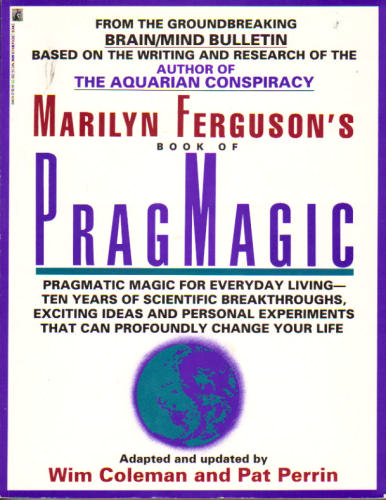
26bdc6da8da0b94015af1110.L… and so the latest edition of Aforista’s dictionary declares the word “but” to be defunct. Can the OED be far behind? I can’t resist mentioning that Pat and I anticipated this lexical milestone in the first book we ever worked on together—PragMagic, a compilation of material from the late Marilyn Ferguson’s newsletter Brain/Mind Bulletin. In it we coined the motto,

Holism means never saying “but.”

Defining holism as “the theory that the universe can be seen in terms of interacting wholes that are more than the mere sum of their individual parts,” we suggested …

In a complex and diverse world, we should try to live increasingly inclusive lives. We must connect in as many ways as possible. Every time we say the word “but,” we implicitly exclude something, make an exception, say that something doesn’t belong.

In my own decades-long writing career, I’ve paid a fair amount of attention how often I use the word “but.” No, I haven’t eliminated it entirely, but I’m pretty sure I use it less and less as time goes on. It’s a habit that Pat and I recommended cultivating in PragMagic …

… living with increasingly fewer “buts”—and a lot more “ifs” and “ands.”

NOT Signed on July 4, 1776 …

230px-Us_declaration_independenceWay back in 1997, I compiled, edited, and introduced a small collection of source materials about the Declaration of Independence. It was fascinating to explore the Story of that great document. Here is the epilogue I wrote for the book:

What really happened during those first four fateful days of July, 1776? As the previous pages of this book suggest, the truth is somewhat at odds with popular legend. American independence was actually approved by Congress on July 2, not on July 4; the vote was twelve to zero, with New York abstaining. New York voted in favor of independence on July 7, finally making the decision unanimous. The adoption of the Declaration of Independence on July 4 was regarded by the delegates as little more than a legal formality—with important public relations implications, of course.

Perhaps most surprisingly, there is no evidence that a signing of the document took place on July 4. The only signatures put onto the document on that day seem to have been those of Congress’s president, John Hancock, and its secretary, Charles Thomson. The iconic engrossed copy of the Declaration didn’t become available for signing until August 2. Many of its famous signatures were not added until weeks or even months after that. Some of the signers had not been present in Congress on July 4, 1776, to vote on the Declaration’s adoption, while some delegates who had been present on that day never became signers (Garry Wills, Inventing America: Jefferson’s Declaration of Independence, New York: Doubleday, 1978, p. 339).

But the myth of a July 4 signing has proven very powerful—so powerful that Thomas Jefferson and John Adams both mistakenly came to believe that it had actually happened! Through good intentions and faulty memories, the two most important instigators of American independence generated their share of misinformation about the Declaration of Independence.

John Adams was correct, however, when he wrote to his wife, Abigail, on July 3, 1776, “It may be the Will of Heaven that America shall suffer Calamities still more wasting and Distresses yet more dreadfull.” The Revolutionary War would continue its destructive course until the United States defeated the British at Yorktown in 1781 with the help of the French Fleet. Even after peace was declared in 1783, the new nation still faced the question of how to govern itself. The Federal Constitution, which went into effect in 1789, created a strong union but left the problem of slavery unsolved. It would take the tragic and terrible Civil War (1861-1865) to bring an end to slavery, but race relations in America remain deeply troubled to this day. With such a turbulent history, perhaps we should be grateful for the benign mythology surrounding our Declaration of Independence and its ennobling language.

The most magical story told about Thomas Jefferson and John Adams happens to be true. On July 4, 1826, the fiftieth anniversary of their Declaration’s adoption, both men were on their deathbeds. That morning, Jefferson awoke from a coma to ask his bedside companions, “Is it the Fourth?” He died shortly after noon. Adams passed away later the same day after murmuring these haunting last words:

“Thomas Jefferson survives.”