Here is the prologue to my full-length play The Mad Scene, which has been aptly described as “an Our Town about the French Reign of Terror.” It was developed during 2020-21 as part of the Theatre at St. John’s Cyber Salon, hosted by Mark Erson. The parts were read by Everett Quinton, Jenne Vath, Sally Plass, Maude Burke, and Shane Baker; Daniel Neiden directed. The Mad Scene has yet to be produced.
The Mad Scene was awarded First Place in the Script category of the 91st Annual Writer’s Digest Writing Competition. It was chosen for the Second Round in the Stage Play category of the 2024 Austin Film Festival’s Script Competition.
The entire text of The Mad Scene is available by clicking right here.
*
PROLOGUE
Characters:
Marie Grosholtz/Madame Tussaud
Marie Antoinette
The scene is the Madeleine Cemetery, Paris, the night of October 16, 1793.
MARIE ANTOINETTE’s head lies in the lap of MARIE GROSHOLTZ, who will later become known as Madame Tussaud. MARIE works by the light of a lantern. At first, ANTOINETTE’s eyes are closed; then they snap open.
ANTOINETTE. There is no sky.
MARIE. Madame, can you hear me?
ANTOINETTE. I never noticed it before.
MARIE. I must take your face.
ANTOINETTE. Carolina, look for yourself. You’ll see it’s true.
MARIE. I’m not Carolina.
ANTOINETTE. There is no sky. There are only stars. Oh, and a slender curved scimitar of a moon, hanging by … an invisible thread, I suppose. But tied to what? There’s nothing to tie it to, nothing to hang it from. There is no sky. (wincing) Don’t. Carolina, why are you touching my face like that?
MARIE. I’m not your sister. I’ve got to make a cast of your face.
ANTOINETTE. What are you smearing on my skin?
MARIE. Oil, so the plaster won’t stick.
ANTOINETTE. What a silly thing to do on such a night, with a moon and so many stars and no sky at all to gaze at. Look.
MARIE. I’m looking.
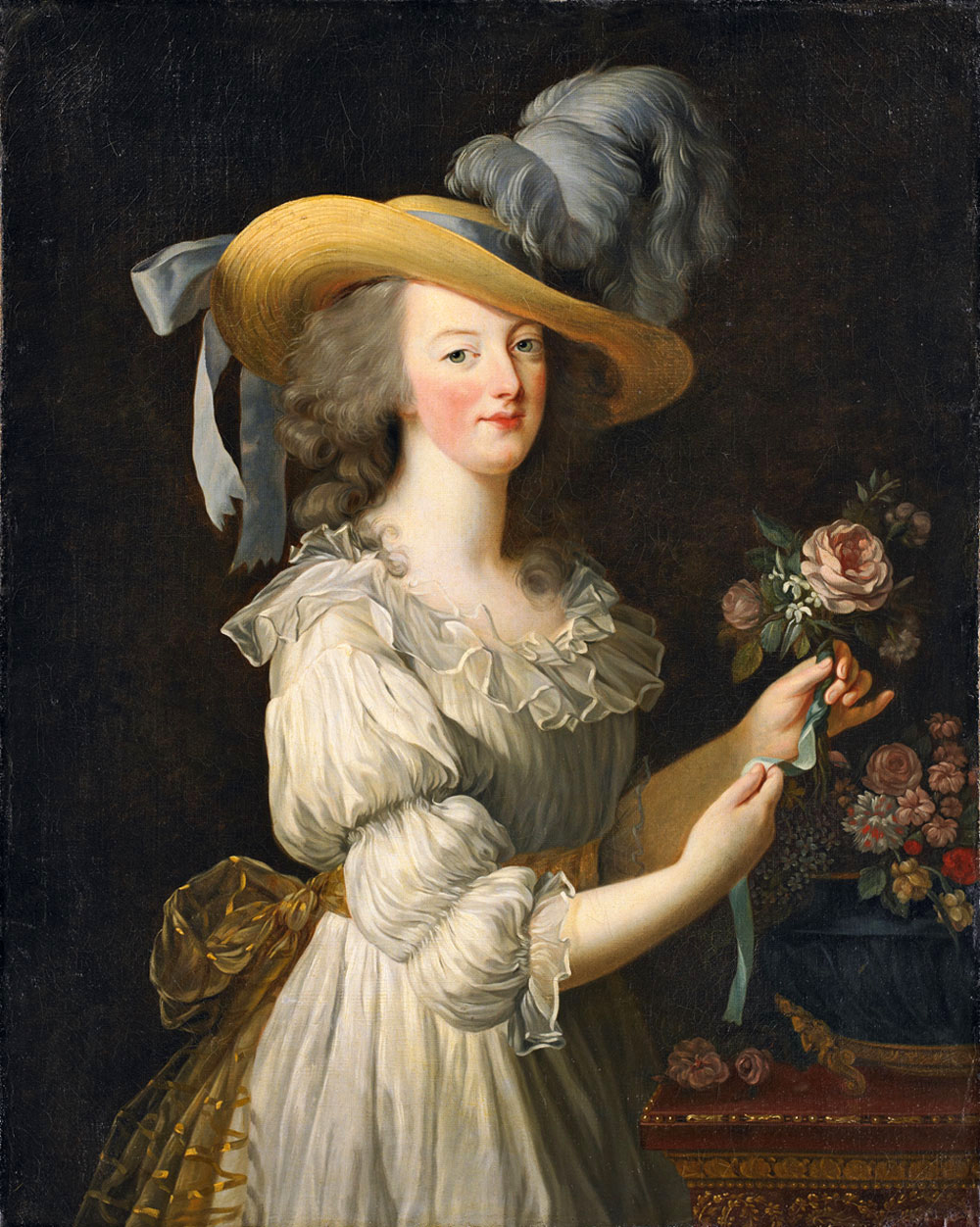
Marie Antoinette, by Élisabeth Vigée Le Brun.
ANTOINETTE. No, you’re not. You’re looking down at me. You’re in the way of my view. But where are we? Oh, we fell asleep in the gardens again, didn’t we? I was counting clouds and you were giving them names and it got dark without us knowing it. Our dresses must be soaked through with dew. Odd, I feel so … dry. We’ve got to get back to the palace. The countess must be angry. Or beside herself with worry. Poor old thing, we’re so much trouble to her.
MARIE. We’re not in your garden in Vienna.
ANTOINETTE. Of course we are.
MARIE. No. This is the Madeleine Cemetery. In Paris
ANTOINETTE. What are we doing in Paris? Don’t touch my eyes.
MARIE. I’m only closing them.
ANTOINETTE. Why?
MARIE. Because they’re not glass. I’m covering them with plaster.
ANTOINETTE. I don’t understand.
MARIE. It’s best not to talk.
ANTOINETTE. Why not?
MARIE. The dead are usually quiet. Or at least they’re supposed to be.
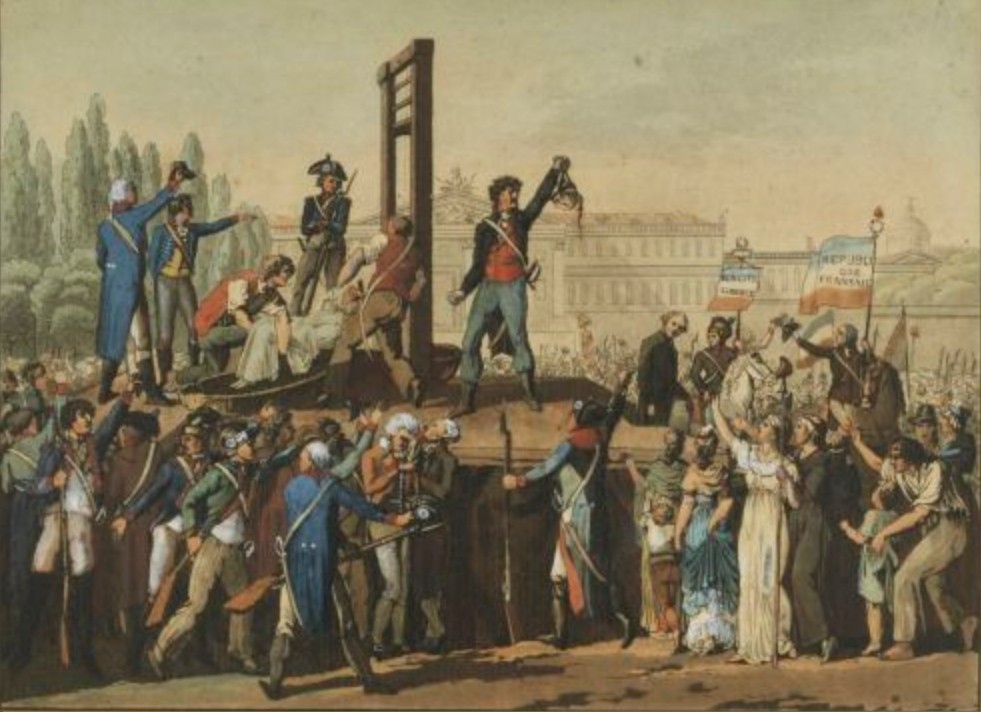
Execution of Marie Antoinette, Museum of the French Revolution. Licensed under the Creative Commons Attribution-Share Alike 4.0 International license: creativecommons.org/licenses/by-sa/4.0/deed.en
ANTOINETTE. I’m not dead.
MARIE. Madame, you have been beheaded. You are certainly dead. Tomorrow you will be buried. It really would be best to keep quiet. You’ll upset yourself.
ANTOINETTE. You’re not Carolina.
MARIE. So I’ve been telling you.
ANTOINETTE. I’ve not been beheaded.
MARIE. You have, and it was hard to find you among so many dead, all thrown about every which way, so it’s hard to tell whose head belongs to whose body. Don’t you smell the stench?
ANTOINETTE. No.
MARIE. Death has its blessings then. I never guessed how blood and flesh could stink. It’s always such a chore, this scrounging through stench and open graves, looking for just a certain head. Your husband was even harder to find than you, and to make things worse, he was already dissolving in quicklime.
ANTOINETTE. My husband?
MARIE. But I found you. I recognized the white morning dress you wore on the scaffold, even though it was stained and caked with blood and dirt. Then your head was easy to spot, plopped right between your knees. But your face looks strange now—so thin and drawn, with a scalp of short white hair. When did your hair turn white? Oh, I hear it was after you were caught trying to escape—you and the king and your children. I can fix all this when I make your new face.
ANTOINETTE. Who are you?
MARIE. I hoped you’d remember me, madame. My name is Marie Grosholtz. I lived at Versailles nine years. I tutored Madame Elizabeth in molding wax, and I lived in her apartments and kept her company. You were very kind to me in those days, madame.
ANTOINETTE. Versailles? Madame Elizabeth?
MARIE. The king’s sister. You don’t remember. You’re confused. But don’t worry. The plaster will set, and we’ll be finished soon, and it won’t matter whether you remember or not. I needn’t tell you to keep still. You’re doing that anyway.
ANTOINETTE. There is no sky.
MARIE. I’m sure you are correct, madame.
ANTOINETTE. Oh, yes. Versailles. They tell me I’m going there. They tell me I am to become the Dauphine of France.
MARIE. If you say so, madame.
ANTOINETTE. I am to marry the Dauphin, they tell me—Louis-Auguste, some cousin I’ve never met. They say he is a clumsy boy, rather stupid, and he’s sure to grow fat, and he can’t dance at all. But then, I’m just a girl myself, and people say I am silly and I laugh more than I should and I like to dance too much. No, don’t deny it, I know that’s what they say. But he’s a boy, just a boy. I wish I could marry a man, someone wiser, someone I could trust to know …
… how to …
But it’s not up to me, is it? Nothing is up to me. And not only must I stop being an archduchess, they tell me I must stop being Austrian, and I must say goodbye to everyone I’ve ever known—even to you, Carolina, and also to Mutti—and I must forget how to speak German and speak French perfectly for the rest of my life. And when I go to France, before I meet the Dauphin in the Forest of Compiègne, I must be stripped of every scrap of my Austrian dress and be clothed anew in the manner of a French princess. Of course there will be people watching me change. It’s always been like that. I’ve never been naked alone. But in France there will be more people than ever, watching my every waking moment, and while I’m sleeping as well. I will put on my rouge in front of the whole world. It will never stop.
MARIE. There. The plaster is set. I’m almost finished.
ANTOINETTE. That pinches.
MARIE. Yes, but only for a moment, while I remove the cast.
(MARIE pulls the cast away.)
MARIE. I must leave you now.
ANTOINETTE. Where are you going?
MARIE. To where I work.
ANTOINETTE. You can’t leave me.
MARIE. I must. I’m sorry.
ANTOINETTE. I am your queen.
MARIE. France has no queen.
ANTOINETTE. Obey me.
MARIE. I must obey the National Assembly. I wish it weren’t so.
ANTOINETTE. Take me with you.
MARIE. I can’t take your head, madame. I’ll lose my own if I try. Adieu.
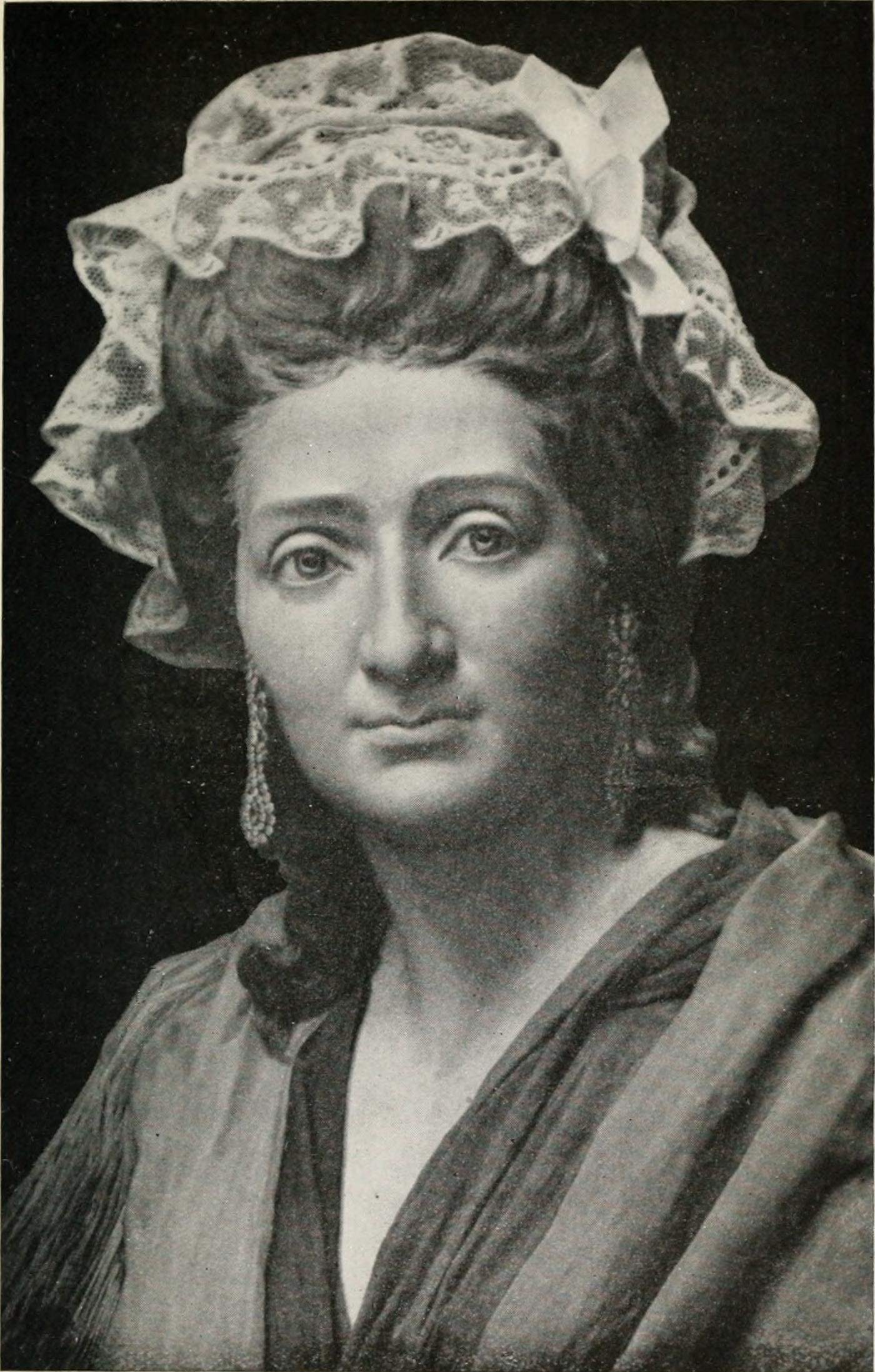
Marie Tussaud, by John Theodore Tussaud.
ANTOINETTE. Wait! I remember! Your name is Marie! You make likenesses from wax! Elizabeth adores you! She came running to me a little while ago to show me a Virgin you taught her how to make. “Look, sister!” she said. “Look at my little wax Mother of God! I made her look just like you without meaning to, I couldn’t help it! Was that blasphemous of me, sister? Must I confess it to the abbé?” “No, sister,” I said. “No blasphemy at all …”
MARIE. Adieu, madame.
ANTOINETTE. But what will happen to me after you go?
MARIE. I don’t know.
ANTOINETTE. Oh, but you do. I’ll vanish. I’ll die. Please, I beg you. It is only by the grace and bounty of your madness that I still live. Don’t let me die.
MARIE. You’ll live again in wax.
ANTOINETTE. But will I remember … ?
MARIE. I don’t know what you’ll remember.
ANTOINETTE. Will I still be myself?
MARIE. I don’t know.
ANTOINETTE. Am I myself even now?
MARIE. I said I don’t know.
ANTOINETTE. Please stay!
MARIE. Dawn is nearing.
ANTOINETTE. We’ll watch it together!
MARIE. I must go.
ANTOINETTE. We’ll skip barefoot in the dew, watch morning burst into blossoms of light, bathe ourselves in mad mists of swirling color! We’ll worship the sun and laugh and dance like Incan priestesses!
MARIE. Adieu.
(MARIE exits, carrying her lantern.)
ANTOINETTE (dying). There … is … no … sky …
BLACKOUT.
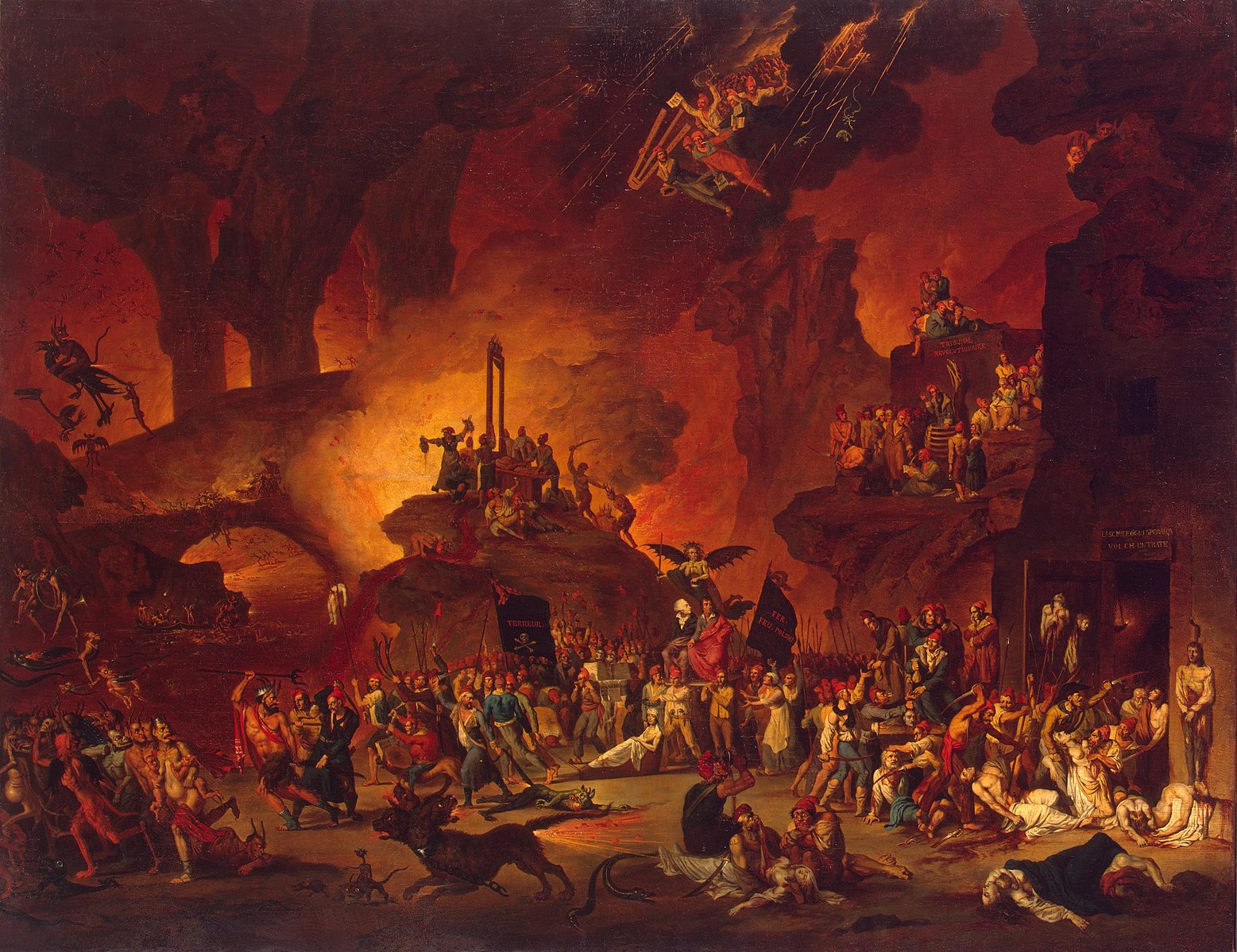
Le triomphe de la guillotine, Nicolas-Antoine Taunay
 playsonideas