When a Hoax Really Meant Something …

The Jamais Vu PapersFake news stories are all the rage these days. And yes, they can be hard to distinguish from real news. I have friends who were taken in by a recent story reporting that Arizona was implementing a gay-to-straight conversion program in its public schools. I wasn’t fooled by that one, but I have been hoodwinked by two or three others.

This may seem an odd sort of question, but … what’s the point?

Back in 1989, the legendary satirist and Yippies-founder Paul Krassner said to L.A. psychiatrist Hector Glasco,

People are jaded, because of this conveyer belt of information. I already forget what it was that I was so horrified about on the news yesterday. And I was horrified! But you develop an emotional callus to the horror. And a danger satirists can run into is to see the news just as grist for their mill.
jvV ebook 180

Krassner himself pioneered hoax news stories in his groundbreaking magazine The Realist. But his hoaxes always had a point—for example, his notorious obituary for Lenny Bruce, written two years before the controversial comedian’s death in 1966. As Krassner explained to Dr. Glasco,

I was hanging around with Lenny at the time, and there was almost a competition among police departments to bust him. Nightclub owners were scared. He was not getting work, and his work was his life. So it was as if he were dead. I wanted to pay tribute and expose that harassment while he was alive.

You can read the obituary in The Realist Archive Project. (Is this a great time or what?) There is nothing glib or superficial about it. It is, in fact, an excellent piece of journalism, and the most disturbing thing about it is how much of it was true …

There was a time when Lenny read a lot, from Jean-Paul Sartre’s study of anti-Semitism to the latest girlie magazine. He carried in his suitcase from city to city a double-volume unabridged dictionary. But in his dying days, he carried around law books instead. And he wasn’t as much fun to be with any more.

Or as Lenny explained it to Krassner,

I’m changing.… I’m not a comedian. I’m Lenny Bruce.

The hoax fooled plenty of people. It also moved and enlightened them. The same was not true of a later hoax, in which somebody else wrote an obituary of Paul Krassner. When Hector Glasco asked him about that …

So there’s a distinction between—what? Honest and dishonest hoaxing?

… Krassner replied,

Creative and easy. Having a point or being pointless.

The problem with many fake news stories going around is that they seem easy, uncreative, and pointless. Back when a hoax really meant something, Krassner even took the trouble of asking Lenny Bruce’s permission before publishing his obituary. Lenny cheerfully complied, but also asked,

What makes you think I’m gonna go before you do?

Paul Krassner turned 81 this year—as Groucho Marx once predicted, “the only live Lenny Bruce.”

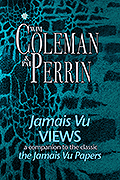
An abridged version of Hector Glasco’s conversation with Paul Krassner appeared in Pat’s and my 1991 novel The Jamais Vu Papers. Now the full-length original version appears for the first time since 1989 in Jamais Vu VIEWS, available both in paperback and on Kindle.

Timothy Leary in Cyberland

chaos_cyberculture

I think about Timothy Leary a lot these days. He is widely believed to have died on May 31, 1996. If so, it’s really too bad. A pioneering technopagan and an elder statesman of Cyberpunk, he would revel in Google, Twitter, Facebook, and all the rest of our digital paraphernalia. What Douglas Rushkoff has called “Present Shock” (we are way beyond Alvin Toffler’s “Future Shock”) wouldn’t faze him one little bit.

Leary wouldn’t even be bothered by encroachments on personal privacy. As I remember, he rather liked having his phone tapped—because whoever was listening might actually learn something. “Privacy is the evil of monotheism,” he once said to me—or rather, he will say it to J. X. Brillig in the year 2040.

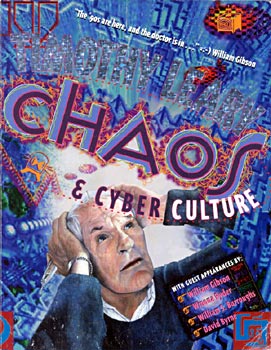
Pat’s and my jamais inter-vu with Leary, entitled “Brillig in Cyberland,” was first published in our jamais vu newsletter in December 1988. In it, Leary plays a garrulous tour guide to a futuristic, William Gibsonesque wonderworld. Leary himself included “Brillig and Cyberland” as the epilog to his last non-posthumous book, Chaos & Cyber Culture (1994).

But why am I somewhat skeptical that he actually died in 1996? Well, talk of Timothy Leary’s demise dates all the way back to 1968 and the lyrics to “Legend of the Mind” by the Moody Blues. “Timothy Leary’s dead,” the song announced. It wasn’t true then, and I’m not so sure it is now.

Leary was obsessed with life extension, and he considered death (or “irreversible involuntary coma”) an inexcusable waste of time and resources. So he didn’t plan on dying if he could possibly help it. It’s well known that Leary arranged to have his head cryonically preserved, only to change his mind shortly before his final “coma.” He grumbled,

I was worried I would wake up in fifty years surrounded by people with clipboards.

He opted for cremation—which would seem to put an end to the matter.

But in an increasingly informational world, immortality isn’t necessarily about the survival of the physical body. In “Brillig in Cyberland,” Leary explained (or will explain in 2040),

Basically, immortality is about digitizing. The more of yourself you digitize, the more of yourself is going to be immortal. The more of your actions and memories you get digitized, the more immortal you’re going to be. I was one of the first people to discover this. My claim to fame today is that there is more of me in digital form than almost any other person from the twentieth century.

There is, indeed, a lot of information about Timothy Leary kicking around, so I wouldn’t write him off just yet. While it’s true that the Moody Blues said that he was dead, they went right on to say otherwise:

The Jamais Vu Papers

No, no, no, no, he’s outside looking in.

“Brillig in Cyberland” is now available in both The Jamais Vu Papers and its brand new companion volume Jamais Vu VIEWS. I hope you’ll check them out.

jvV ebook 180

Metaphor and Tom Robbins

jvV ebook 180In yesterday’s post, we announced the publication of Jamais Vu Views, the long-awaited companion to our underground classic The Jamais Vu PapersIt is available in paperback and Kindle. Both books include jamais inter-views with real people participating in a fictional story. Our first-ever inter-view was with author Tom Robbins in 1987.

At the time, we were fascinated by the role of metaphor in Story (with a capital S). We felt that metaphor was more that just figurative speech, more than just analogy. What was the power of metaphor? We decided to play around with a fictive and admittedly silly idea: that metaphors are literally true, and that you could conceivably make a drug out of a metaphor.

The Jamais Vu Papers began as a newsletter that told the story an addled Los Angeles psychiatrist named Hector Glasco. He was treating a jaded celebrity patient named Hilary, who was suffering from a chronic and potentially fatal case of déjà vu—that condition, of course, in which one has the weirdest feeling that one has been here before. The cure, it seemed, was to instill a sense of jamais vu, a mysterious feeling that one has never been here before—not in this world, this life, or the most familiar circumstances.

So Hector Glasco tried to cure his patient with a dose of a mystery drug called “M”—the chemical equivalent of a metaphor. Disaster ensued, and Hilary escaped from his office on a flying carpet and disappeared. The newsletter itself was Hector’s desperate plea for help; he needed insights into the nature of metaphor. We hoped that this premise would shake loose some interesting thoughts. We were right.

Tom Robbins was our newsletter’s first subscriber/participant. He wrote to us, agreeing to send us 8 answers if we’d send him 7 questions. Naturally, Hector asked him:

As a master of figurative language, what do you think are the transformative and evolutionary properties of metaphors?

Robbins gave this lovely answer:

When we say that “Johnny runs fast,” what have we said that anyone except Johnny’s mother is apt to recall? When we say that “Johnny runs like a deer,” we have provided a memorable totemic image to which our notion of Johnny’s speed might conveniently be stapled. Should we say, however, that “Johnny is a deer,” we have eternalized Johnny, fitting him with antlers and hooves from the unyielding deep forest of primal unconsciousness.

Glasco pushed on, concerned about the use of such a powerful tool:

What will happen if chemical metaphors hit the streets?

Robbins replied:

My suspicion is that chemical metaphors may not belong on the streets. In ancient Greece, the fungoid metaphors dispensed at Eleusis were restricted to those who were deemed spiritually and intellectually evolved enough to benefit from them. Public discussion of the M(ysteries) by initiates was forbidden under penalty of death. That’s probably a sound idea. The problem is, who decides who is or who isn’t qualified for the experience? Certainly, it’s a bit elitist, but as Hermann Hesse pointed out, “The M(agic) Theatre is not for everyone.”

Our Storied discussion was off to a flying start.

Jamais Vu Views

It’s finally out in both paperback and KindleJamais Vu Views, the companion to our underground classic The Jamais Vu Papers.

Image

Some of you have been waiting for this book for two decades or more.

Others of you have no idea what we’re talking about.

So let’s go back to Los Angeles in 1987, for the birth of a crypto-legend …

The two us lived in a little house at the base of Mount Washington; at the top was perched the Self-Realization Fellowship. Its gardens are lovely, tranquil, and open to all. We loved to walk up there to retreat from that intense city, rest, and meditate. One afternoon, we were walking down Mount Washington after some especially stimulating meditation. As we headed home, ideas started flowing, and we talked and talked and talked. And so we started our own newsletter—the jamais vu papers, a monthly publication with a fictional storyline that included far-flung, far-fetched, and far-sighted ideas. (BTW, we got married the month the first issue appeared.)

Publishing a newsletter wasn’t easy back in those days. Does anyone remember waxers and paste-ups? We put the pages together in our little house and took them to a copy shop for printing. We sent free copies to as many people as we could get addresses for. We started asking other people to participate.

Real-life thinkers eagerly pitched into our fictional world, changing the story itself as it galloped waywardly forward, sideways, upward, downward, across parallel realities, and every which way. We interviewed Tom Robbins (our first-ever subscriber), and also María De Céspedes, Fred Chappell, Daniel C. Dennett, Jamake Highwater, Paul Krassner, Timothy Leary, and Fred Alan Wolf. Because these interviews took place in a peculiar no man’s land somewhere between fiction and reality, they became known as jamais inter-vus.

When the New York superagent John Brockman got wind of what we were up to, he signed us up with Harmony Books to rework our material into a novel—and he took part in a jamais inter-vu as well. The novel came out in 1991. Even after it went out of print, copies kept circulating until The Jamais Vu Papers became a bona fide underground classic. As copies grew scarce and zanily expensive, we published a new edition in 2010.

But alas, the novel could not contain nearly everything we’d put in the newsletter. A lot of great material had to be left behind, including jamais inter-vus with Stewart Brand, Jean Houston, Russell Jacoby, Charles Johnston, Russell Targ, and Robert Theobald.

Now, at long last, we’ve compiled Jamais Vu Views, which includes all of the original interviews—those that appeared in the book, and those that haven’t been seen since our newsletter was discontinued in 1991. If you are already a fan of The Jamais Vu Papers, you’ll be delighted by what you have jamais (never) seen before. And if you have jamais (never) experienced the reality-bending phenomenon known as The Jamais Vu Papers, this new collection is a great place to start.

Check it out at Amazon.com—in paperback or Kindle.

The “Single Synapse” Theory

“The transformation of the personality begins with the deliberate activation of a single synapse.” Thus Spake Aforista.

The Postfuturist Sage Aforista makes it sound so easy! Most of us find it difficult to utterly change our personalities from the bottom up. But maybe, in a world on the brink of fiscal cliffs, climate change, global pandemics, and all manner of other crises, we must learn to do so.

In the November 1987 issue of the newsletter version of the jamais vu papers (which eventually served as the basis of an eponymously titled novel), Pat interviewed the late economist Robert Theobald, who made some striking observations on this very issue:

It is a truism that change happens in crisis. Without a crisis people will go on doing things as they have always done them because change is always time-consuming and usually frustrating.…

Bluntly put, homeostasis is the path of the least resistance, and we are stubbornly inclined to follow it, even when change is needed. Even impending crisis typically doesn’t tend to elicit positive change:

If the scope of the crisis seems too extensive people may well panic and simply deny the possibility of affecting the total situation. I believe that there are reasons to fear that this pattern is developing in the world at the current time. We know that things are getting worse but we are so terrified that we continue to keep things going rather than permit some change to happen by forcing situations to the crisis point. All too often the longer we wait the worse the crisis will become.

It’s sad that Theobald’s observations remain so timely a quarter of a century after he made them. Sadder still, we actually invent end times and eschatological deadlines in order to elicit change from without—by extraterrestrial aid, let us say say. Does anybody happen to remember the Harmonic Convergence of 1987?

In an episode little remembered in New Age annals but recorded in a special issue of the jamais vu papers, Quetzalcoatl and the Goddess returned to earth on August 16 of that year to join in the grand fiesta. They were dismayed to find homo sapiens in an evolutionary rut, and dismayed even further that humanity expected them, ancient archetypes that they were, to completely take over the process of terrestrial transformation. In a seldom quoted outburst, Goddess said,

“The idea that a species like yours would just stay immutable for thousands of years at a crack—well, it seems downright ornery, that’s all. I mean, it’s like a kid holding his breath until his face turns blue.”

Will we once again disappoint our archetypal forces and sentient metaphors when the 13th b’ak’tun of the Mayan calendar comes to an end on December 21, 2012? It’s a question that Lydia Rosenstrom, the protagonist of Pat’s and my novel Mayan Interface, pauses to consider as people all over the world await “a force outside themselves to make things right somehow—either by bringing our world to an end or by transforming the whole of humankind”:

“Well, some folks might experience something. Others might miss their best chance while they’re waiting. Some wouldn’t notice transformation if it up and bites them, because it doesn’t fit the story they’re fixed on. Some just expect transformation to be a one-time thing, so they’ll be stuck wherever they arrive that day.”

As Quetzalcoatl and the Goddess tried to tell us back in 1987, we don’t have to wait, and we don’t need extraterrestrial aid. Human nature itself is mutable, after all. And when you get right down to it, it’s simply a matter of deliberately activating that single synapse.