Five new poems …

Wim is grateful to editor Nolcha Fox for including five of his poems—including this one—in Chewers by Masticadores.

The Purloined X

A poem should not mean   
But be.
—Archibald MacLeish

Tomorrow’s assignment
(Mr. Fritz told us,
lo, those many years ago),
is to find the poem’s meaning
and bring it to class,
in cuffs if it resists,
sedated if necessary.

To find its coordinates
(said Mr. Fritz)
make use of concordances—
one for Shakespeare
and one for King James—
and pluck out the heart
of the poem’s mystery
word by word
until you’ve got
the exact latitude and longitude
where the meaning lies in lurk.
And remember,
a poem can only have
one meaning,
like any other equation.
The meaning is x
so solve for x.

But I’d have none of that.

If there was one thing
I already knew for sure
even at that age,
it’s that meaning
can’t be come by honestly,
so I called the cops
who didn’t even bother
with a warrant.
They smashed the door
and stormed right in
and turned the poem
upside down and inside out,
breaking all the furniture in sight—
but still no meaning.

Now I thought I was smarter
when I glimpsed
a folded piece of paper
tucked in a letter compartment
of the rolltop desk
right there in plain sight.
But when I seized it and unfolded it,
it was just a shopping list
for the day’s necessities—

a thing with feathers
a stately pleasure dome
a grain of sand
a wild flower
a red wheelbarrow
a wine dark sea

—just the usual stuff.


But when I went to consult
the little French detective
in his humble digs,
redolent of mildew and a meerschaum,
walls bedecked with Beardsley prints
and Toulouse-Lautrec posters,
he didn’t even have to rise from his divan
to figure it out.

Mon dieu, mon ami!
(he said, pouring each of us a glass of absinthe)
What silliness you talk!
Can you tell me what it is,
this thing you speak of,
this—this meaning?
I can tell you for certain
there is no such animal
as a meaning.  
It is a make-believe creature
for the hazing of—
—how do you call them, you Américains?—
Boy Scouts, n’est-ce pas?
They put a tenderfoot alone
holding a bag by a hollow log
and tell him to stand there waiting
deep in the night
for the meaning
to show his little head,
and they watch
just out of reach of his earshot
snickering to each other,
those comrades of his,
while he keeps waiting there
like an idiot.

No, mon frère,
a meaning is a chimera,
a mere opinion,
and the poem holds opinions in contempt.
The poem is smart,
the poet its useful fool.
Now as for the poem in question—
never having read it
I am quite au fait with it,
for having read one poem,
I have read them all
and know wherein their secrets may be found.

You see, the x you sought
is very big,
the biggest thing there is,
the only thing there is,
and you were—comment tu le dis?—
getting warm
to think you saw it
right where anyone else could see it.
But it wasn’t in plain sight,
it was plain sight.
For a poem is not a thing that means,
it is a handless
springless clock
that tells only the moment,
only what is really there.
It is a thing
that conundrums the sense,
so to speak—
that blisses the heart
and fierces the brain
and verbs its breath into a world.

—Wim
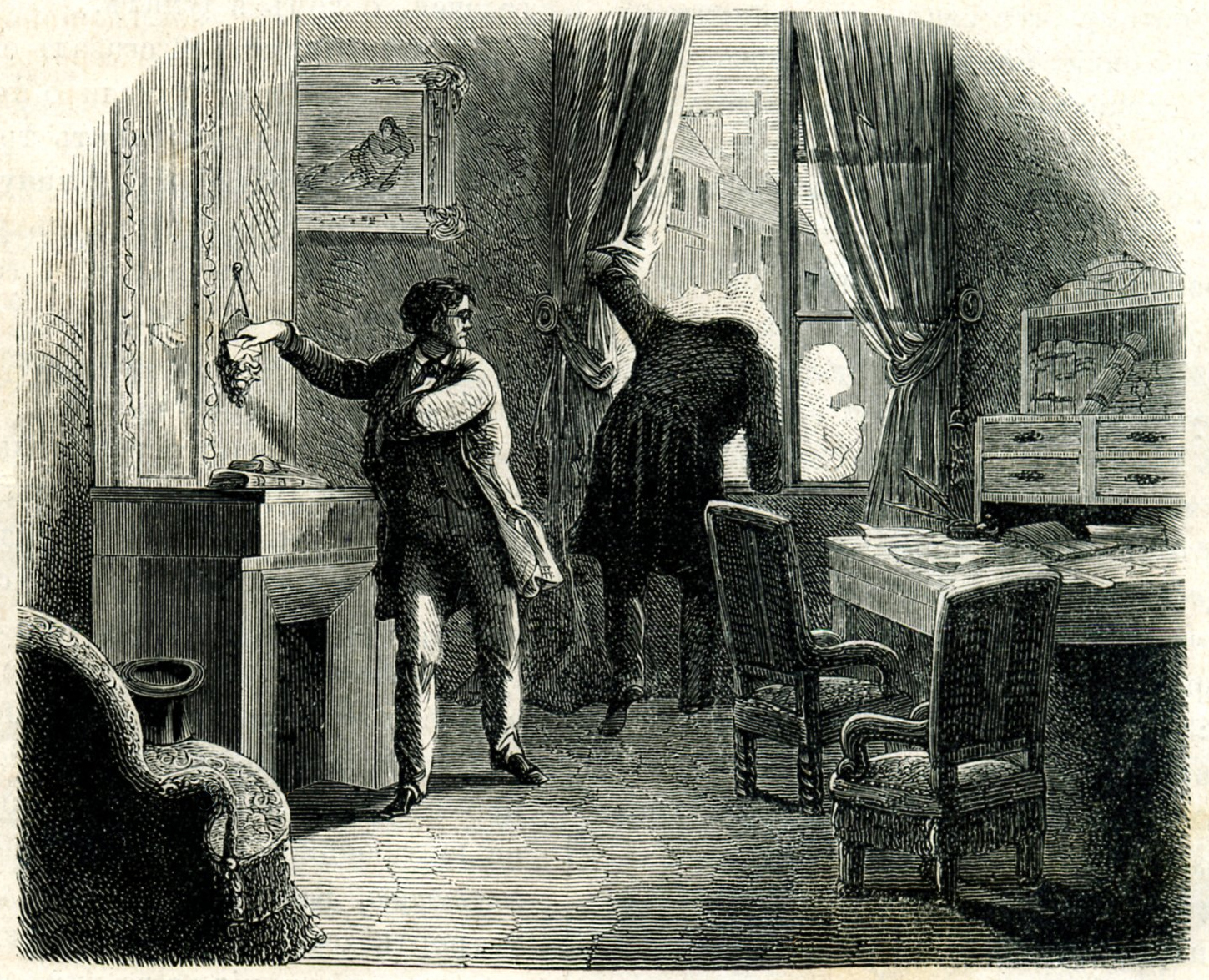
“The letter stolen again,” illustration by Frédéric-Théodore Lix for “The Purloined Letter” by Edgar Allan Poe.

Quintains of the Red Death

And Darkness and Decay and the Red Death
held illimitable dominion over all.

At the last midnight ever to fall,
the clock’s brazen lungs swelled full
and exhaled twelve sonic ebony sighs
that shuddered against the welded gates
and made the airtight abbey shake.

The dancers halted stupefied
and the music hobbled to a hush
at the advent of the uncanny guest
in his cadaverous eyeless mask
clad in the vesture of the grave.

Who presumes, who makes so bold?
Who dares dishonor this masquerade
of laughter and Terpsichore
and lotos-devouring lunacy
with uninvited grief and thought?

So cried the Prince, chasing the stranger
through his seven suites bedight
in lapis blue and lavender,
in emerald and tangerine,
in ivory and heliotrope,

until, in a chamber of sable velvet
glowing vermillion by fiery braziers
shining through panes of tinted glass,
the Prince cornered and challenged him,
guise to guise and mask to mask.

You! Profaner of mockeries,
delinquent in mandatory scorn—
kneel before your sovereign lord;
prepare your flesh for my dagger’s delight,
your blood to quench these stones!

But neither stones nor knife were sated,
and the Prince ached with unbidden sorrow.
How strange, he thought, that any mischance
should visit so noble a potentate,
so wise, so frugal, and so great.

Why, he wondered, should he be sad,
sequestered with his chosen kindred
while the Red Death raged outside?
He gazed upon the faceless stranger,
whose very silence made reply.

You fail to recognize me, sire?
Does the Prince deny his faithful son?
I’ve been too long from home, I fear.
But how could you forget a child
hatched fully grown from your lifeless heart?

You nourished me at your barren breast;
I learned all things at your cruel feet;
all that you are, so I must be;
what your will would have, so I must do;
thus I have served you throughout your realm.

No soul survives in Greed’s dominion;
No children play in the empire of Hate.
No life throbs in the kingdom of Conceit.
Do I appear in the guise of Death?
I am yourself—manifest, incarnate.

The privileged revels now all ended,
the stranger crumbled into dust.
The Prince retraced his wending steps
through the mute particolored suites
and found his merry throng all slain.

But tender no tears for the Prince;
rather you may envy him,
for Hell is Heaven for the Damned.
He abides in welded, airtight bliss
within his castellated walls

roaming among those putrid remains
(worthy companions at long last!)
sheltered forever from all he dreads—
new buds, new blossoms, new hopes, new laughter,
all bourgeoning amid death’s decay.

—Wim

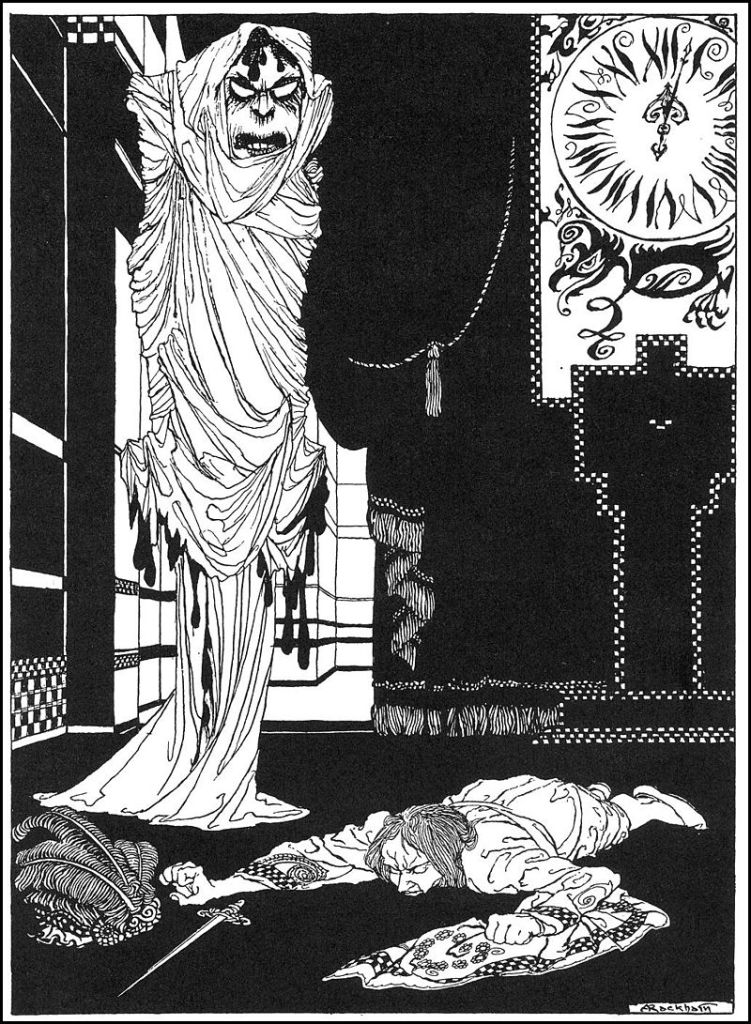
Illustration of Prince Prospero confronting the “Red Death” by Arthur Rackham, 1935

Collaboration and Creativity

I’m admiring the RC James song post of Wim’s poem, and other related pairs that show up on the Open Arts Forum (great place for creative people showing work and exchanging ideas). Collaboration can be like a conversation … Hey, is this what you meant? or How about this in addition to/instead of …? That can contribute mightily to creative experience when creativity is understood as not just a search for a way to express something understood but as a way of discovering more about whatever you’re reaching for. Probably musicians, especially jazz-inclined, get this better than those of us who use more stationary media. Not that either way of working replaces the other, but collaboration can open up possibilities in the process. Maybe it also readjusts our sense of how we function in the world.  — Pat


Three Double Takes

by Wim Coleman

1 allegretto

A zebra with a party
horn and hat has crashed
your thirtieth. This
creature was your friend
when you were three
and lived beneath the
checkered tablecloth
and would come up
from time to time
to munch with you on
globes of milk-drenched
Too-Sweets, but this
was not to be expected.

Hear the horn &
knit your brow &
turn & see &
nod as if you
understand &
turn away.
Your eyes pop out,
you turn right back
& stare amazed.

*

2 allegro

Her husband has
come back again
as you were raising
up your glasses
in a toast to
one another
naked in white
sparkling wine
swapping an
indecent ripe
Greek olive
faintly tinged
with feta. He
called her from
Tibet an hour ago.
This was not
to be expected.

Hear & turn.
Look & nod.
Turn away.
Beat. Beat.
Face react.
Turn again.
Stare afraid.
Beat. Beat.

*

3 presto

Death
has come
in a fake
tuxedo
t-shirt
with a
chainsaw
while you
were adding
a rhythm
section to
St. Matthew’s
Passion.
He calls
you by
a name
you can’t
pronounce.
This
was not
to be
expected.

Hear. Turn.
Look. Nod.
Turn. Six.
Seven. Eight.
Eyes pop.
Turn. Gape.
Stare. Six.
Seven.

That Other Darwin

Here are a few lines to celebrate National Poetry Month

Organic life beneath the shoreless waves
Was born and nurs’d in ocean’s pearly caves;
First forms minute, unseen by spheric glass,
Move on the mud, or pierce the watery mass;
These, as successive generations bloom,
New powers acquire, and larger limbs assume;
Whence countless groups of vegetation spring,
And breathing realms of fin, and feet, and wing.

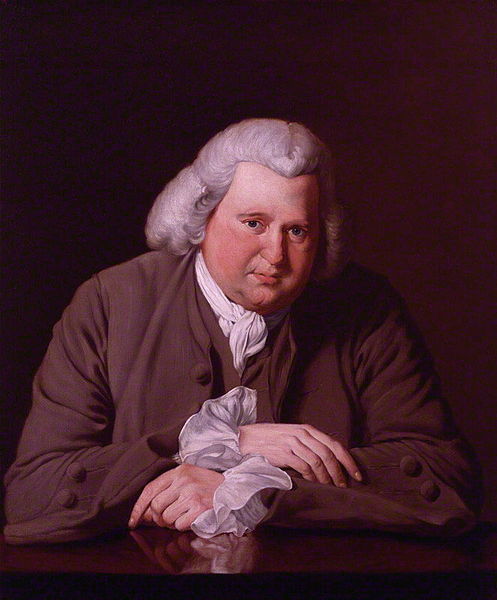
This poetic description of biological evolution was written by Darwin—not Charles Darwin, but his grandfather, Erasmus. And they appear in his poetic masterpiece, The Temple of Nature, posthumously published in 1803.

Erasmus Darwin formulated ideas about evolution (including Natural Selection) during the late eighteenth century, and proposed that all earthly life was descended from a “single living filament”—pretty much the orthodox view of today’s science. His grandson wouldn’t get around to publishing On the Origin of Species, now considered the founding text of evolutionary theory, until 1859.

I just finished re-reading Desmond King-Hele’s inspiring biography, Erasmus Darwin: A Life of Unequalled Achievement. It brought to mind my post of last year about proverbial foxes and hedgehogs. Remember the words of the ancient Greek poet Archilochus?

“The fox knows many things, but the hedgehog knows one big thing.”

If Charles Darwin was the consummate hedgehog, devoting decades at a crack to the single idea of Natural Selection, then Erasmus Darwin was the ultimate fox—a veritable überfox whose accomplishments ranged across all disciplines, all areas of knowledge. Consider just a smattering of facts about him:

He was longtime friends of Joseph Priestley, James Watt, Josiah Wedgewood, and most of the other the intellectual giants of his time. While he maintained a thirty-year friendship with Benjamin Franklin, the great Samuel Johnson was too daunted by Darwin’s genius to have much to do with him.

Erasmus was a philosopher-scientist of the first order, and a member of Britain’s Royal Society. He invented a copying machine and a voice synthesizer. He understood the electrical nature of nerve impulses before Luigi Galvani and Alessandro Volta performed their experiments with frogs’ legs and muscle contractions. He explained the formation of clouds, cold and warm fronts, and the basics of photosynthesis. He was a pioneer in understanding oxygen; he described how the heart and lungs oxygenize blood, and proposed that water was made up of oxygen and hydrogen.

He was a humanitarian who opposed slavery. As a physician, he gave free medical service to the poor. He was an early feminist who advocated education for girls and women, and he insisted on referring to our species as “humankind” instead of “mankind.” Although an Englishman, he was courageously pro-American during the Revolutionary War and supported the French Revolution. A committed freethinker, he advocated a secular morality based on compassion, and he felt touched and honored when the Pope condemned one of his books.

He was also more than a bit of a prophet. He proposed rockets powered by liquid fuel, a goal unrealized until the twentieth century. He dreamed up an internal combustion engine (one which would not pollute!) and designed a steering mechanism that would eventually be used in early automobiles. Some of his speculations are prescient of black holes, the Big Bang, and the DNA molecule.

All this is just the tip of the iceberg—and by the way, he had fascinating ideas about icebergs!

But here’s what I find most interesting. During much of the 1790s, Erasmus Darwin was considered the greatest living poet in the English language. His poetry and ideas were central to founding the Romantic movement, influencing Coleridge, WordsworthShelley, KeatsGoethe, and Sir Walter Scott. William Blake admired Darwin and designed engravings for his poetry. “Dr. Darwin” is cited (albeit erroneously) in the very first sentence of the preface to Mary Shelley’s Frankenstein. And unlike too many poets from his own age until today, he saw nothing incongruous or philistine about putting forth scientific ideas in verse.

What I like most about Erasmus Darwin is his kindness, good cheer, and optimism. Although, like his grandson, he understood that evolution was spurred by a ruthless struggle for survival, he believed that this struggle was ultimately aimed at “organic happiness” or “the Bliss of Being.” And so I’ll close with these joy-affirming lines from The Temple of Nature:

Shout round the globe, how Reproduction strives
With vanquish’d Death—and Happiness survives;
How Life increasing peoples every clime,
And young renascent Nature conquers Time.

497px-Erasmus_Darwin_-_Joseph_Wright_-_1770