Characters:
Queen Elizabeth I
William Shakespeare
The scene is the queen’s privy chamber in the Palace of Whitehall, February 1601. A table is scattered with books and papers. Queen Elizabeth sits at the table reading. Across the table from her is an empty chair. William Shakespeare enters.
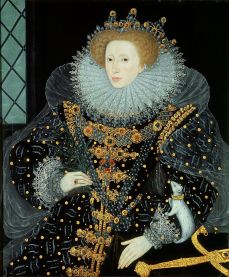
Elizabeth I, the Ermine Portrait; attributed to William Segar
ELIZABETH. Master Shakespeare.
SHAKESPEARE (kneeling). How may I please Your Majesty?
ELIZABETH. Arise.
(SHAKESPEARE does so.)
ELIZABETH. Who am I?
SHAKESPEARE. A lowly scribbler dares not to answer such a question.
ELIZABETH. I am Richard II, know you not that?
SHAKESPEARE. With due humility, I know no such thing.
ELIZABETH. No lies—not here alone with your queen.
(SHAKESPEARE looks around with surprise.)
ELIZABETH. My councilors were against it—Sir Robert especially. “Alone!” he cried. “With a man who aided a rebellion against you!” “Do not fear for my person,” I told him. “There’s such divinity hedging a queen, treason may only peep at what it wishes to do. We’ll have Will’s head soon enough.”
SHAKESPEARE. I did not aid a rebellion.
ELIZABETH (perusing some papers). The day before Essex tried to seize my court, did you not put on a show at his command?
SHAKESPEARE. A trifling play, Your Majesty, so old and out of use, I don’t know why he wanted it. A solid mass of turgid verse; too many end-stops, rhymes, and lockstep iambs; not a scrap of prose for relief, no comedy at all, nothing to please the groundlings but gardeners spouting homilies from some old morality play. Indeed, that’s all it is, a musty and intolerable morality play that—
ELIZABETH (interrupting him as she pores over the papers). Hush. (Pause) The Tragedy of Richard II. (Pause) The tragedy of me.
SHAKESPEARE. I don’t understand.
ELIZABETH. No lies, I said—not when you’re about to meet your maker. I have a transcript here.
(Reading)
Landlord of England art thou now, not king:
Thy state of law is bondslave to the law.
SHAKESPEARE. Exquisitely read. But what have these lines to do with Your Majesty?
ELIZABETH. The story of the righteous deposition of one vulgar landlord by another, of one usurper by another—the story of Essex deposing me, the bastard daughter of King Henry. Surely you knew what your employer wanted with it.
SHAKESPEARE. Who were we humble players to refuse?
ELIZABETH. Especially when he paid you forty shillings for it. Ten more silver pieces than even Judas got for betraying our Good Lord!
SHAKESPEARE. The play is only a play.
ELIZABETH. A monarch is God’s anointed substitute on earth, else he—or she—is nothing. If one monarch was ever a vulgar landlord, then so are all the rest, and so am I. Was Richard a vulgar landlord?
SHAKESPEARE. I cannot say.
ELIZABETH (pointing to the page). You say right here —
SHAKESPEARE. Not I, the dying John of Gaunt.
ELIZABETH. You wrote his words.
SHAKESPEARE. I merely held the pen for him.
ELIZABETH. False.
SHAKESPEARE. Mayn’t I put treason on the stage without standing accused of it?
ELIZABETH. Only if you take care to call it treason.
SHAKESPEARE. And hang signs around my actors’ necks? “Anointed King,” “Treacherous Usurper,” “Vulgar Landlord”?
ELIZABETH. Instructive.
SHAKESPEARE. It’s not my trade to judge—rather to hold a mirror up to nature.
ELIZABETH. Do you suppose nature wishes to look upon her own twisted carcass, her countenance wrinkled and pockmarked, a mangy wig upon her scabby scalp? Paint a flattering portrait—fair, blooming, and buxom. Show it to her. Tell her it’s a perfect likeness.
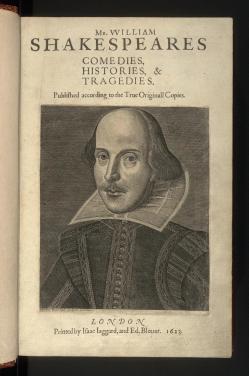
First Folio, 1623
SHAKESPEARE. I’d be a shoddy playwright then.
ELIZABETH. You’d be a live one.
SHAKESPEARE. I implore Your Majesty —
ELIZABETH. No.
SHAKESPEARE. If I have offended —
ELIZABETH. Betrayed.
SHAKESPEARE. I sincerely repent that I —
ELIZABETH. Fear, not love, begets your penitence.
SHAKESPEARE. May I not save myself?
ELIZABETH. Not if you must be yourself.
SHAKESPEARE. I may be no one else.
ELIZABETH. Then we’re done.
(Pause)
SHAKESPEARE. Well. I owe my God a death. If it be not to come, it will be now. I don’t feel especially well. (Indicating a chair by the table) May I?
(SHAKESPEARE sits.)
ELIZABETH. Impudence!
SHAKESPEARE. Your Majesty, if your executioner is half as good at his trade as I’m at mine, I’ll see my cut-out heart bloody and beating before my still-living eyes. Forgive that I’m no longer daunted by your sovereign rage. And now, won’t you indulge a dead man’s whimsy? Let’s chat away these precious moments.
(ELIZABETH glares at him.)
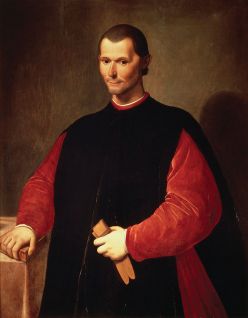
Niccolò Machiavelli by Santi di Tito
SHAKESPEARE. What are you reading? (Picking up a book) Ah—Niccolò Machiavelli, The Prince.
(ELIZABETH snatches the book away from him.)
SHAKESPEARE. “Hatred is acquired as much by good works as by bad ones,” he says. And, “A prince wishing to keep his state is very often forced to do evil.” And, “A prince ought not to mind the reproach of cruelty.” How shocking to find you reading such stuff.
ELIZABETH. You seem to know it by heart.
SHAKESPEARE. It’s my trade. What do you think of our Italian friend?
ELIZABETH. The wickedest of men.
SHAKESPEARE. No lies—not to a man about to meet his maker. We both know what we’re supposed to say. I’ve done my own dutiful best to make his name the same as Satan’s, to render him a man of plots, drunken prophecies, libels, and dreams, murdering men and then wooing their widows, his hands dripping with the blood of babes. I even gave him a frightful shape:
His mother felt more than a mother’s pain,
And yet brought forth less than a mother’s hope,
To wit, an indigested and deformèd lump;
Teeth had he in his head when he was born,
To signify he cam’st to bite the world.
But all that’s stale and false. So just between the two of us—the truth. What do you think of him?
(Silence)
SHAKESPEARE. When I was apprenticed into the players’ art and mystery, I learned to sing, fight, fence, tumble, dance, and—oh, yes, to conjure: make flowers bloom from the palm of my hand, send sleeping maids floating upon the air, snatch a man’s head off his shoulders and put it back again. How I feared that some rival conjuror would go among the crowd, telling the secrets of all my illusions! And that’s what Machiavelli did to you, isn’t it? Exposed your trade, the art and mystery of princehood, revealed your trapdoors, wires, and mirrors.
ELIZABETH. Revealed that God had nothing to do with what we are.
SHAKESPEARE. Your words, Your Majesty.
ELIZABETH. Clever fellow.
SHAKESPEARE. Me or him?
ELIZABETH. When I was apprenticed, my tutor made me learn much of him by memory. Tell me—is it better to be loved or feared?
SHAKESPEARE. To be feared, of course.
ELIZABETH. Ay, “for love is preserved by the link of obligation which, owing to the baseness of men, is broken at every opportunity for their advantage — ”
SHAKESPEARE. “ — but fear preserves you by a dread of punishment which never fails.”
ELIZABETH. And yet—whether he is feared or loved, a prince must always avoid being hated. “Learn this lesson well,” my tutor said, “for it shall be your doing or undoing.”
SHAKESPEARE. He would be well-pleased.
ELIZABETH. Oh, no—for as I near my grave, hatred grows against me, and also justly-earned contempt. This late rebellion proves it. I failed to follow Machiavelli’s advice. I made myself loved rather than feared.
SHAKESPEARE. All of your subjects fear you.
(As she speaks, ELIZABETH folds a makeshift “crown” out of a sheet of the paper upon which the play is transcribed.)
ELIZABETH. Why so? My tyranny touches but a handful of them. I am a lone woman, and old. How many commands are mine to give? But put Machiavelli’s book into the hands of every Englishman who can read, and each of them becomes a tyrant. Then blossom too many commands for all the generations of Adam to obey, and bloody oppression waxes infinite. The tyranny of the one is not worth fearing; the tyranny of the many, of the all—now that’s a tyranny to terrify any sane soul. (Pause) I summoned you to take off your head. Instead, I’ll put something on it. Approach.
(SHAKESPEARE rises and steps toward her, then kneels; ELIZABETH’s “scepter” is a quill pen.)
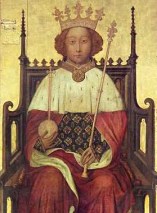
Richard II
ELIZABETH. Now mark me, how I will undo myself:
I give this heavy weight from off my head
And this unwieldy scepter from my hand,
The pride of queenly sway from out my heart;
With mine own tears I wash away my balm,
With mine own hands I give away my crown,
With mine own tongue deny my sacred state,
With mine own breath release all duteous oaths:
All pomp and majesty I do forswear.
Make me, that nothing have, with nothing griev’d,
And thou with all pleas’d, that hast all achiev’d!
(She places the paper “crown” on SHAKESPEARE’s head, the quill “scepter” in his hand.)
ELIZABETH. Hail, William Rex—Stratford Glover’s Son, Student of Machiavelli, Tyrant Among Untold Multitudes of Tyrants. I, humble Elizabeth, the sole remaining subject in all the realm, do kneel before you.
(ELIZABETH kneels.)
END OF PLAY
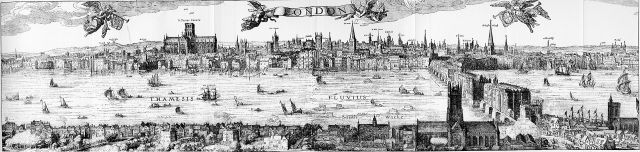
Panorama of London by Claes Van Visscher, 1616
 Q: What is The Shackles of Liberty about?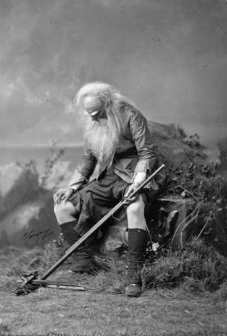
 playsonideas