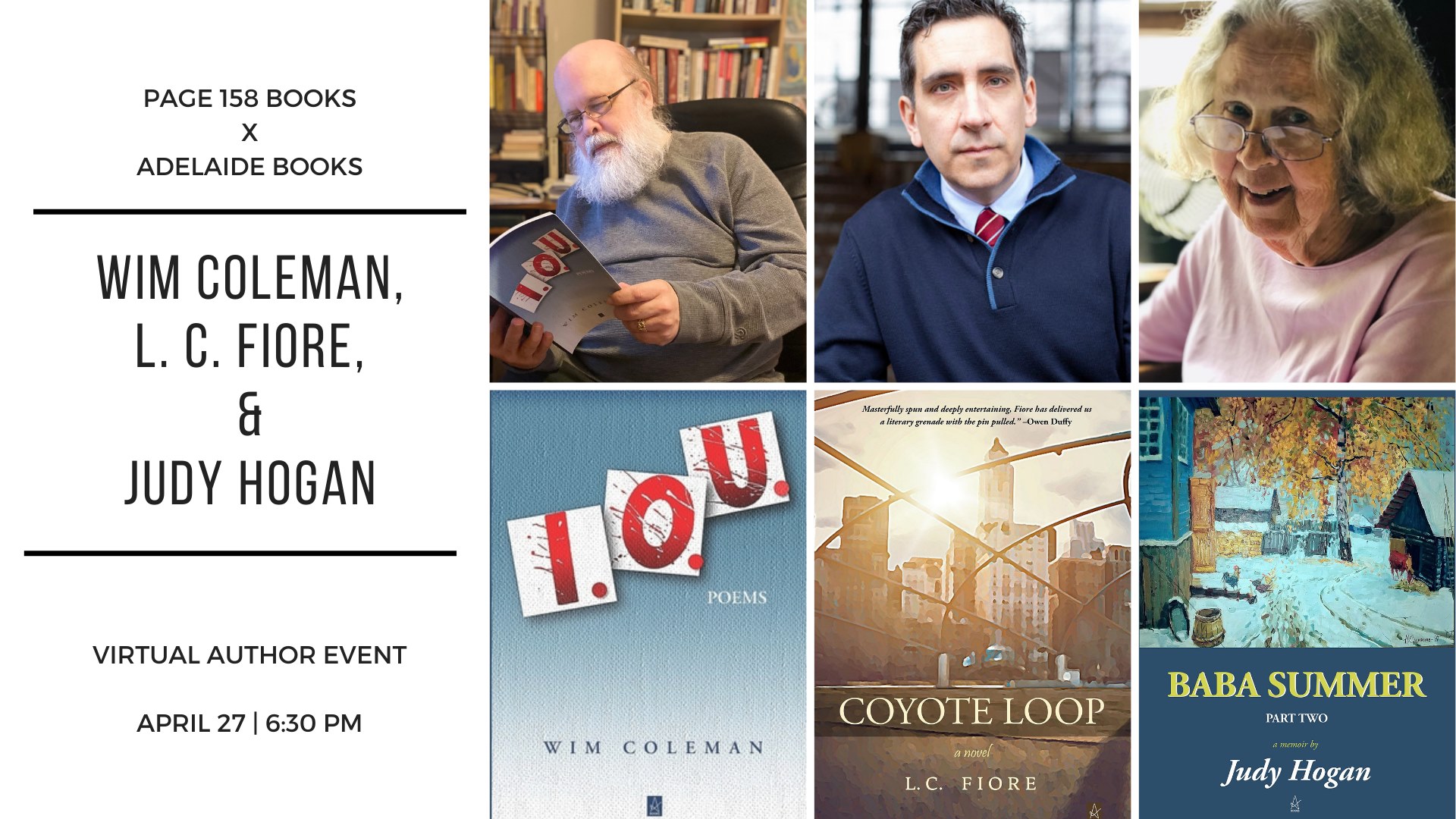
“Page 158 Books is pleased to present a digital event in partnership with Adelaide Books featuring three authors from the North Carolina Writers’ Network. Join us for a conversation with Wim Coleman, L. C. Fiore, and Judy Hogan. Please note that this is a digital author event and will be hosted on our Crowdcast channel.”
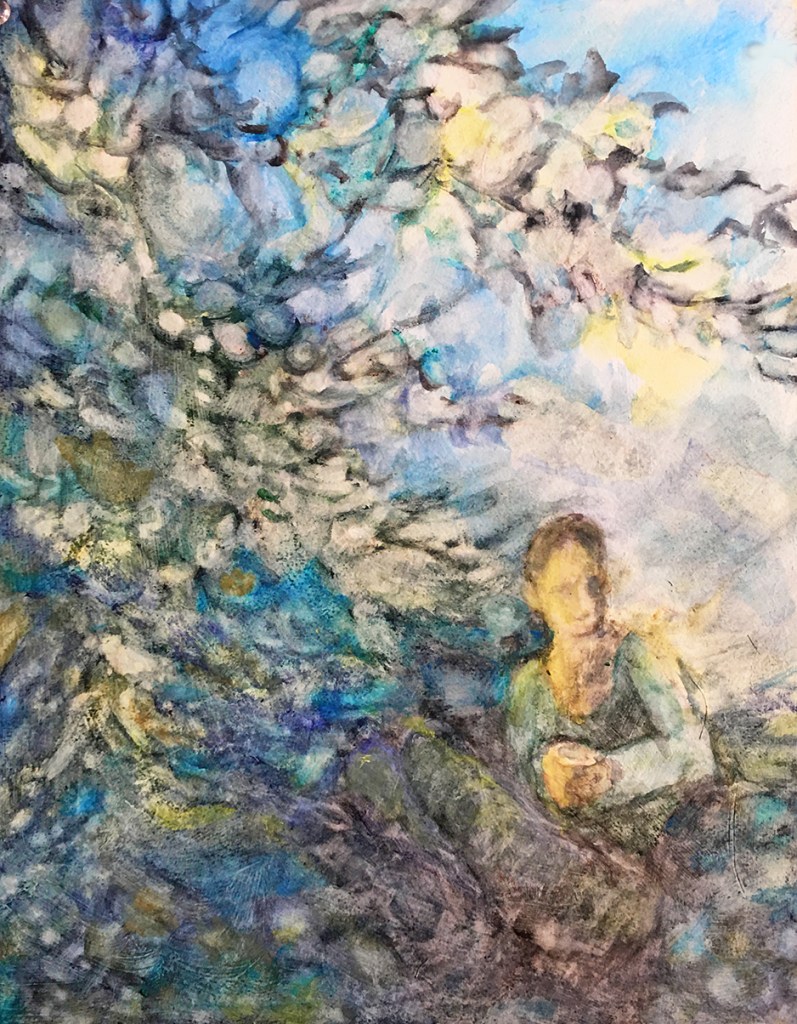
Even though it’s getting late in the day, I find myself thinking about my new series of watercolors about feeling our connections with the natural/organic world we live in.
These are watercolors on a gessoed surface, painted with brushes, fingers, rags, Q-tips, whatever is at hand. The images are based on drawing sessions in several locations over past years, on some sketches made outdoors, on the organic qualities of the fiber sculptures I’ve worked with over a long period of time, and on the experience of simply living in the world.
We’re told it’s only been unleashed one time by a lone fanatical guerrilla sent by some silent foreign power. People talk about him all the time, but most don’t dare say too much about his self-immolation— how he cold-bloodedly provoked the fury of priests and prefect to detonate the deadly charge of love strapped to his heart, damn near putting an end to everything.
Even now we don’t know the whole scary truth of what happened after that conflagration, those three dark days verging on apocalypse, how close we came again to shapelessness and void and darkness upon the face of the deep— and without doubt it’s just as well. The wise illuminati who rule from shadows might someday make public those seven files sealed up some two thousand years ago, but only when we’re ready for the truth—and frankly, I wouldn’t hold my breath for that fine day.
The vestiges of ruin lie all around us. We’re damaged, too, in our guts and in our souls. Nobody could foresee back when it happened the terrible genetic consequences such an indiscriminate weapon would wreak on generations yet unborn—the seizures, the boils, the lesions, the burning eruptions of morality and justice, pandemic outbreaks of conscience and goodwill, and worst of all, the mutant and grotesque progeny too crippled and misshapen by compassion for the cruel works of a sound and robust functioning society.
But by the skin of our teeth, as they say, humanity pulled through, and here we are today, a heartier species than ever.
There’s no denying, though, we have been lucky. The role of diplomacy has, I think, been overstated. Scant progress has been made by sovereign global powers to dismantle their silos and armories, their insanely massive stockpiles of lethal lovingkindness. (So weird, all this frenzied hoarding of something too terrible to contemplate its use!) Worse, attempts to halt the proliferation of agape have been a laughingstock— the same with eros, philia, and storge. Would-be Jesuses find such materials in their kitchens, and instructions and designs are available on the Darkest Web.
As the experts say, it’s not a matter of if, but of when, and we are long overdue. This time if one lone zealot sets off the spark, the critical mass of deadly altruism will be more than sufficient to destroy civilization several times over, leaving nothing but the naked infrastructure of human bodies, guileless and zombified, baffled by purposes and meanings you and I take for granted—the pedagogic utility of sweatshops; the culinary smorgasbords of mass assembly lines; the pious, sweet indentured duties of the supermarket aisle; office cubicles where we roam at liberty in our endangered tameness as if in our natural habitat …
What use are these, our mindless heirs will ask, their limbs and gazes alike entangled in throes of folly, now that we have fallen in love?
For frantic boast and foolish word— Thy mercy on Thy People, Lord! —Rudyard Kipling
The City on the Hill is turning out its lights and closing up for a long, long night. Heroes are cast out of their Valhalla; the halls ring with a clamor of cowards.
Closed up for a long, long night of drunken revels in the dark, the halls ring with a clamor of cowards gloating in the exile of heroes.
Their drunken revels befit the dark; it was false morning in America too long. Those who gloat in the exile of heroes believed in a painted dawn, a sun that never rose.
The heroes, after mourning America too long, retreat across the frozen bridge yearning for a warming dawn, a sun to rise, their bleeding feet wrapped up in rags.
Retreating across the frozen bridge, the general reads a pamphlet to troops whose feet are numb in icy rags: “These are the times that try men’s souls.”
The general shivers as he reads to his troops about summer soldiers and sunshine patriots: “These are the times that try men’s souls.” A woman with a face of iron and coal
leads freezing slaves and snowblind refugees across the bridge toward freedom and new life. Her posted face of iron and coal offers tens of thousands in reward for her.
“Cross the bridge to freedom or you die,” she says, threatening a lead ball from her flintlock. “Don’t make me lag, there’s a reward for me. Keep up, keep walking, or I’ll put an end to you.”
The choice is freedom or a lead ball from her flintlock. Does safety lie behind them in the darkened hall? They keep walking toward some doubtful end. Only cowards mistake puniness for greatness;
safety is a lie told in their darkened hall where thieves thieve all innocence away and cowards take their puniness for greatness and lies are held for truest scripture.
How can thieves thieve when no one left is innocent, when everything is stolen, nothing earned, and nothing is true and lies are scripture? Surely thieves must then turn into cannibals.
When everything is stolen, nothing earned, sacrifice is the sole obscenity. When all thieves turn into cannibals, they have no one to devour but one another.
“Sacrifice is the sole necessity; the want of one is the want of all,” say those who cling fast and dear to one another; beyond the bridge’s end lies only darkness.
The suffering one, the suffering all, cast one last glance back at their Valhalla, then plunge into the darkness beyond the bridge; they’ll light another City on another Hill.
From Wim’s new book of poems, available on Amazon.com.
Double Takes are perhaps a less baleful way of looking back on 2020. Happy New Year to All!
*
Three Double Takes
1 andante
A zebra with a party horn and hat has crashed your thirtieth. This creature was your friend when you were three and lived beneath the checkered tablecloth and would come up from time to time to munch with you on globes of milk-drenched Too-Sweets, but this was not to be expected.
Hear the horn & knit your brow & turn & see & nod as if you understand & turn away. Your eyes pop out, you turn right back & stare amazed.
*
2 allegretto
Her husband has come back again as you were raising up your glasses in a toast to one another naked in white sparkling wine swapping an indecent ripe Greek olive faintly tinged with feta. He called her from Tibet an hour ago. This was not to be expected.
Hear & turn. Look & nod. Turn away. Beat. Beat. Face react. Turn again. Stare afraid. Beat. Beat.
*
3 vivace
Death has come in a fake tuxedo t-shirt with a chainsaw while you were adding a rhythm section to St. Matthew’s Passion. He calls you by a name you can’t pronounce. This was not to be expected.

 playsonideas