Shared Story

How much are we shaped by stories told by others?

I left that question hanging at the end of my last post. As it happens, the ever-popular neurologist Oliver Sacks touched on it in a recent article. In his 2001 memoir, Uncle Tungsten: Memories of a Chemical Boyhood, Sacks recalled a childhood incident that took place during the London Blitz of 1940-41. Here’s how he described it in his book:

[A]n incendiary bomb, a thermite bomb, fell behind our house and burned with a terrible, white-hot heat. My father had a stirrup pump, and my brothers carried pails of water to him, but water seemed useless against this infernal fire—indeed, made it burn even more furiously. There was a vicious hissing and sputtering when the water hit the white-hot metal, and meanwhile the bomb was melting its own casing and throwing blobs and jets of molten metal in all directions.

Not surprisingly, the incident was seared on Sacks’s memory in fearsome detail. But after his memoir was published, Sacks found out something alarming. He hadn’t been at home during the time of the firebombing. He had learned about it via a letter from his brother—a letter so vivid that the incident eventually became, for him, indistinguishable from a true memory.

Sacks’s error prompted him to consider how our memories can be altered by written accounts, photographs, verbal narratives, and countless other sources. He realized that “source confusion” leads not only to “fallibilities, frailties, and imperfections” of memory, but to “great flexibility and creativity”:

It allows us to see and hear with other eyes and ears, to enter into other minds, to assimilate the art and science and religion of the whole culture, to enter into and contribute to the common mind, the general commonwealth of knowledge. This sort of sharing and participation, this communion, would not be possible if all our knowledge, our memories, were tagged and identified, seen as private, exclusively ours. Memory is dialogic and arises not only from direct experience but from the intercourse of many minds.

Devoted as we are to the topic of Story (with a capital S), and also to collaboration, Pat and I might put it this way:

Consciousness itself is an act of collaborative storytelling.

So to return to my question, “How much are we shaped by stories told by others?” The answer would seem to be, “Enormously.” And all of our lives are richer for it. As the late psychologist Julian Jaynes pithily put it,

We are all subjects, one of another.

Concerning Bones and Thrones and Parking Lot Stones

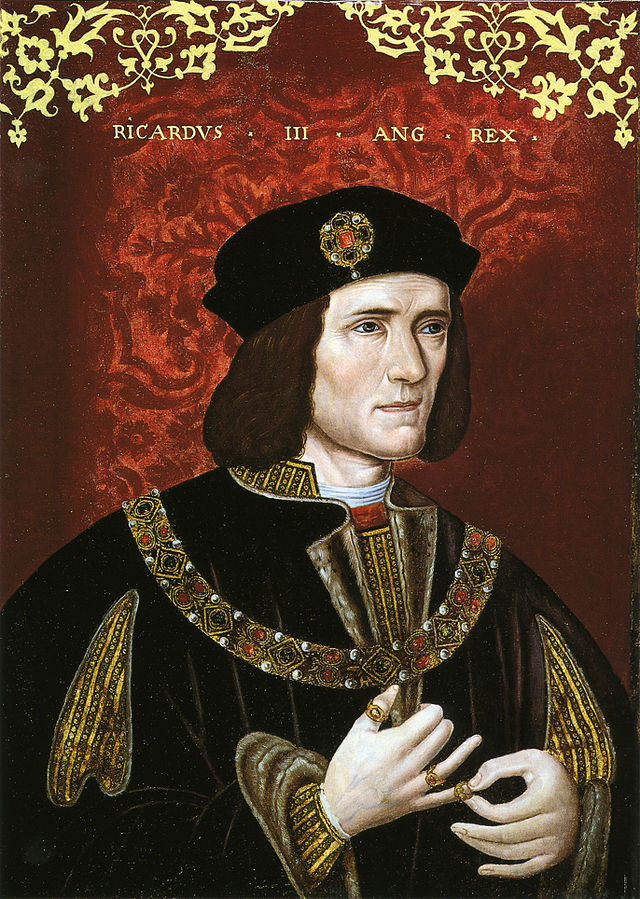
640px-King_Richard_IIIIt’s a story perfectly suited for a blog entitled “Story.”

I mean the recent unearthing of the bones of King Richard III under a parking lot in Leicester—a discovery so fresh that the bones are still cold, so to speak. The find has me thinking about another king, a currently reigning queen, and the power of Story to shape their lives and ours.

Not surprisingly, the find has rekindled that hoary debate about the character of the Plantagenet monarch, who reigned between 1461 and 1483. His popular image comes from Shakespeare’s tragedy Richard III, in which he is portrayed as murderous and conniving, both physically and morally deformed. The real Richard, who reigned from 1483 until his death in 1485, seems to have been a well-meaning reformer whose good works were thwarted by the brevity of his reign.

All that’s unfair, of course. But I can’t help fretting about a monarch even more unjustly reviled than Richard III, and that’s King Macbeth of Scotland. Once again, the Bard is the chief culprit in his defamation.

As Garry Wills shows in his book Witches and Jesuits, Shakespeare’s Macbeth is as much a propaganda piece as it is a literary masterpiece. Written in the wake of the notorious, failed “Gunpowder Plot” of 1605 to blow up the British Parliament, the play is filled to the brim with scarcely veiled flattery to the reigning King James I, who claimed descent from the play’s King Duncan and quasi-mythical Banquo. If Shakespeare’s earlier Richard III was a paean to Tudor rule under Elizabeth, Macbeth was a paean to the ascendency of the Stuarts under James.

Shakespeare’s story has precious little to do with facts. King Duncan, whom Shakespeare portrays as blameless, kindly, and fatally naïve, was actually a cruel, aggressive, war-mongering, and rather incompetent tyrant whose six-year reign was bloody and oppressive. Macbeth had good reason to get rid of him, and he did so in open combat, not while he lay asleep as a guest in his castle.

As for Macbeth himself, Scotland greeted him as a welcome change and prospered under his reign of nearly two decades. He ended long wars, generously supported monasteries, preserved the Celtic language and traditions, and made a holy pilgrimage to Rome. Macbeth’s defeat by Malcolm in 1057 with English aid was nothing for the Scots to cheer about.

As Marc Antony said of the title character in Julius Caesar,

The evil that men do lives after them:
The good is oft interred with their bones.
So let it be with Caesar.

And so let it be with both Richard III and Macbeth. But let’s pause to consider the power of Story to transform a person’s life. Is the Richard III whose bones lay under that parking lot fundamentally more real than Shakespeare’s “subtle, false, and treacherous” Machiavellian fiend? And is the historically benign Macbeth more real than Shakespeare’s murderous necromancer?

The cognitive philosopher Daniel C. Dennett once chatted with the fictional Hector Glasco about the supremacy of public image over private reality:

I remember some years ago seeing on the BBC in England a series of interviews with young schoolchildren … about Queen Elizabeth II. And they were asked, “Well, what does she do? Tell us about her day.” And it was fascinating. These children were very sure they knew exactly what the queen did. For instance, she vacuumed Buckingham Palace while wearing her crown. And she sat on her throne while she watched television, things like that. It was wonderful. And it struck me then that [the children’s beliefs about] Elizabeth II … had a much more important role to play in British social history than the actual living woman … and also had a certain power over her.jvpold-new

So let it be with Queen Elizabeth II.

And as for the rest of us …
… how much are we shaped by stories told by others?

Gutenberg-Punk

“Gutenberg-punk?” you ask. It’s not a well known genre category—I Googled it and got precisely nothing. Perhaps that’s because, to the best of my knowledge, only one work in all of literature fits it. I’ll get to it shortly

In my post of December 10, 2012, I mentioned certain historical catastrophes that heralded the end of civilization, including poetry slams, back-of-the-book indexes, the death of Levon Helm, the Internet, and even writing itself. I conspicuously didn’t bring up the introduction of the printing press to Europe by Johannes Gutenberg in the fifteenth century, which was perhaps the most notorious catastrophe of all.

By spreading literacy and information indiscriminately among the formerly ignorant, Gutenberg’s machine spurred the Reformation, unleashed the ideas of Copernicus, encouraged vernacular literature, and in myriad other ways provoked universal social chaos. The religious and political powers-that-were weren’t the only folks who were terrified. Philosophers also raised cries of alarm, among them the Swiss naturalist Conrad Gessner (1516-1565) who fretted over the confusing and harmful abundance of books that Gutenberg’s gadget had turned loose.

But getting back to the title of this post …

Gargantua and Pantagruel, by the humanist priest/physician François Rabelais (1494-1553), seems to be the world’s sole example of Gutenberg-punk. Now Rabelais was no technophobe, and he had no fear of the printing press. I would even say that his entire encyclopedic novel—carnal, spiritual, cruel, compassionate, heroic, cowardly, vulgar, and sublime as it is—is really a celebration of the unfettered intellectual liberty and evolutionary potential let loose by Gutenberg. As one of his title characters puts it,

The elegant and accurate art of printing, which is now in use, was invented in my time, by divine inspiration; as, by contrast, artillery was inspired by diabolical suggestion.… I find robbers, hangmen, freebooters, and grooms nowadays more learned than the doctors and preachers were in my time.

Indeed, far from fearing technology, Rabelais seems to have had no fear of anything. For as the Russian critic Mikhail Baktin (1895-1975) put it in his own wondrous book Rabelais and His World,

this is a work in which fear is destroyed at its very origin and everything is turned into gaiety. It the most fearless book in world literature.

Not surprisingly, Rabelais found that timid humans wouldn’t do for his cast of characters. His protagonists had to be giants, preposterously huge in their appetites and curiosities, their very bodies containing vast and unexplored worlds and civilizations. Concerning a young giant’s education, Rabelais tells us,

As you may well suppose, Pantagruel studied very hard. For he had a double-sized intelligence and a memory equal in capacity to the measure of twelve skins and twelve casks of oil.

And then there’s the mysterious wonder-substance called Pantagruelion (a fanciful word for good old-fashioned hemp—make of that what you will!), so emblematic of the printing press in its capacity to unleash transhuman possibilities:

In a … fright the gods of Olympus cried: “By the power and uses of this herb of his, Pantagruel has given us something new to think about.… Perhaps his children will discover a plant of equal power, by whose aid mortals will be able to visit the sources of the hail, the flood-gates of the rain, and the smithy of the thunder; will be able to invade the regions of the moon, enter the territory of the celestial signs, and there take lodging, some at the Golden Eagle, others at the Ram, others at the Crown, others at the Harp, others at the Silver Lion; and sit down with us at table there, and marry our goddesses: which is their one means of rising to be gods.”

Arrogant and obnoxious? Certainly. Hubristic and profane? Without a doubt. Gross and scatological? Unless you’ve read it, you have no idea. But above all else, Gargantua and Pantagruel paints a picture of world overcome by a tsunami of pure Story, and it’s a genre unto itself—a Gutenberg-punk masterpiece. It evokes a crazed giddiness that many of us feel in the infoworld, that unchartable terrain that Pat and I once described as

an infinite ocean of uncut metaphor, a neuroelectric realm containing the absolute essence of literally everything.

And oh, for an equivalent cast of outsized monster-heroes to lead us into the dizzying evolutionary heights of our information age!

Of Dragonflies and Pepper Pods

220px-MatsuoBashoChusonjiIf you’re serious as a writer (or sculptor, painter, composer, fishing-fly maker, or anything else that involves creative work), you can surely remember some lesson from a master that had a lasting impact on your work. I was just re-reading Harold G. Henderson’s classic book An Introduction to Haiku and ran into this anecdotal gem about the Haiku master Matsuo Bashō:

One day, when he [Bashō] and [his young pupil] Kikaku were going through the fields, looking at the darting dragonflies, the boy made a seventeen-syllable verse:

Red dragonflies!
Take off their wings,
and they are pepper pods!

“No!” said Bashō, “that is not haiku. If you wish to make a haiku on the subject, you must say:

Red pepper pods!
Add wings to them,
and they are dragonflies!”