Talking Leaves: Sequoyah and the Conjurors — a short play

250px-SequoyahCharacters:

Three Cherokee Conjurors
Sequoyah

The scene is a forest clearing near the Cherokee town of Willstown, Alabama, in 1821. Sequoyah stands facing three conjurors, a leather bag hanging from his shoulder.

1ST CONJUROR.  George Guess, do you know why we have summoned you?

SEQUOYAH.  So I may plead for my life. But I don’t know why. You’ve already decided to kill me.

1ST CONJUROR.  It’s said that you’re possessed by an evil spirit.

SEQUOYAH.  A shee-leh.

2ND CONJUROR.  Yes.

SEQUOYAH.  And the only way to destroy a shee-leh is to kill the creature it possesses. Go on and do it, then.

2ND CONJUROR.  But is it true?

3RD CONJUROR.  Are you possessed?

SEQUOYAH.  Wouldn’t I be the last to know?

1ST CONJUROR.  Tell us.

SEQUOYAH.  So I must plead for my life, or you’ll bore me to death. Wait just a moment …

(SEQUOYAH reaches into his bag, takes out a small wooden board, a few pieces of paper, and a pencil. He squats on the ground, puts the board on his knees as a makeshift desk with paper on top of it, then takes the pencil in hand.)

SEQUOYAH.  I’m ready.

3RD CONJUROR.  What are those things?

SEQUOYAH.  This is paper, of course. But here’s something new, even to me. A pencil, white men call it. Like a pen, except it doesn’t use ink. Yesterday I bought a dozen of them from a passing white peddler. A fine tool. Have a look.

(SEQUOYAH holds the pencil toward the CONJURORS, who draw back fearfully.)

SEQUOYAH.  It won’t bite. Just a little wooden rod with a core of hard black stuff—graphite, it’s called. When it’s whittled to a point, the graphite leaves lines—like ink, only dry. While I’m weeping and groveling, I don’t want to keep dipping a quill in an inkwell.

(SEQUOYAH begins to write.)

1ST CONJUROR.  What are you doing?

SEQUOYAH.  Writing down what we say.

2ND CONJUROR.  So you use your magic right in front of us!

3RD CONJUROR.  The magic of talking leaves!

SEQUOYAH.  It’s not magic. I learned how to do it on my own. I listened to the sounds of our speech, then made up marks for them.

1ST CONJUROR.  White men make marks like yours. They’re evil magic.

SEQUOYAH (writing furiously).  Could you talk more slowly?

1ST CONJUROR.  We’ll talk as fast as we like.

SEQUOYAH.  Well, then. I won’t try to write everything.

(SEQUOYAH writes more slowly, and only intermittently.)

SEQUOYAH.  Talking leaves give the white man power. He can put his thoughts on paper, then send those thoughts to a friend far away—over hills, plains, and rivers. Then that friend can reply with leaves of his own. Talking leaves destroy distance—that great, invisible shee-leh that thwarts us all. Without talking leaves, the white man could never subdue us. They are his most powerful tool.

3RD CONJUROR.  His tool, not ours.

1ST CONJUROR.  His way, not ours.

SEQUOYAH.  How odd. I sit here accused of practicing his magic while neglecting my cattle and hogs, my plow and manure. But farming is the white man’s way. He forced it upon us to stop us from hunting and roaming. If I tear up my magic leaves, will you burn down your barns, kill your livestock, salt your fields? And what about horses, which I’m told the white man brought here ages ago?

1ST CONJUROR.  Horses have always been ours. The Great Spirit gave them to us.

SEQUOYAH.  Well, so you say. What about rifles? Each of them is stamped with the name of the white man who made it. Give yours to me, and I’ll melt them down in my forge, make lumps of iron out of them, put them back in the hills where they belong. Oh, but I forgot—blacksmithing is also the white man’s way. I must destroy my forge. To become pure Cherokee again, we must reject all the white man’s ways—even those we need to defend ourselves against him.

(Pause)

3RD CONJUROR.  Tell us, George Guess—do you know why talking leaves belong to the white man and not to us?

SEQUOYAH.  I’ve never heard the story.

1ST CONJUROR.  In the beginning, the Great Spirit created us real people, and then he created the white men. Because we came first, he gave us a great gift—books with talking leaves that would grant our every wish. To the white men, he gave a lesser gift—the bow and arrow. But we Indians never bothered to use our books. They lay gathering dust. At last, the white men crept along and snatched them away, leaving bows and arrows in their place. Since then, we have lived short, hard lives pursuing and killing creatures of the wild, while the talking leaves have blessed the white men, giving them command of all creation. The Great Spirit has never forgiven our neglect and thanklessness. Few are the blessings he has granted us.

(SEQUOYAH laughs.)

1ST CONJUROR.  You find it funny?

SEQUOYAH.  Yes, because I know the real truth. The moon laughs—laughs loudly, day and night.

2ND CONJUROR.  I’ve never heard the moon laugh.

SEQUOYAH.  Neither have I. But the white man does hear it—and the Great Spirit blesses him for that.

3RD CONJUROR.  This story is a lie.

SEQUOYAH.  But it was told to me by my mother—Wurteh, sister of Old Tassel.

2ND CONJUROR.  The sister of Old Tassel could never lie.

SEQUOYAH.  Ah, but mightn’t I lie—say that my mother told me a story when she didn’t? And how can I know that your story isn’t a lie? How can we Cherokee ever know what’s truth or lie, fact or imagination? The white man knows. His talking leaves tell him.

(SEQUOYAH shows them a piece of paper.)

SEQUOYAH.  Imagine that my mother had written the story of the laughing moon on this paper, many years ago. Imagine that she swore to its truth by making a mark right here—a mark that was hers alone. Would you believe it then?

1ST CONJUROR.  Yes.

SEQUOYAH.  Then you grasp the greatest gift of the talking leaves—the gift of memory. The white man knows who he is, remembers all he has done, possesses a power he calls history. We Cherokee scarcely remember our grandfathers. And though our heads are full of old stories, how can we be sure that we recall those stories aright? Have we changed them in telling and retelling them again and again?

3RD CONJUROR.  We trust the Great Spirit to preserve the truth of our stories.

SEQUOYAH.  Yes, and it’s your job to keep telling them. But look at yourselves. You’re old and near death. How many young men stand trained and ready to carry on your work? None. The missionaries have converted them all to the white man’s religion. This way of writing I’ve made—it’s all that stands between you and forgetfulness. Your spells, your charms, your medicines, your wonder-working dances and songs—all will be lost without magic leaves.

(Silence)

SEQUOYAH.  You don’t care, then? I see you’ve accepted the white man’s religion after all.

1ST CONJUROR.  We’ll never do that.

SEQUOYAH.  Oh, but you have. You love your enemies, bless those who curse you. And if a man steals your coat, you give him your pants and shoes and hat as well. And if he hits you on one side of the head, you turn so he can hit you on the other side. And most of all, you always do for others what you wish they would do for you. And why should I blame you? Those are good ways, blessed ways. After all, the missionaries teach that the meek shall inherit the earth.

2ND CONJUROR.  The meek inherit nothing.

3RD CONJUROR.  The white man overruns the earth by force.

SEQUOYAH.  That’s the clever wickedness of his religion. Its lessons are meant to be disobeyed. When their chief spirit came among them, the first thing the white men did was kill him. They fastened him to a tree with iron barbs made in their forges, riddled him with spears, tormented him with thorns, until at last he died of pain. When he returned from the dead, he blessed his murderers for their cruelty—and that’s been the secret of the white man’s religion ever since. When they disobey their spirit, he blesses them; when they obey him, he curses them. Always do what the spirit says not to do—that’s the white man’s creed. Disobedience is the only path to Christian salvation. But every day, the missionaries teach our children to obey this religion of disobedience, making them fit for slaughter. Our only weapon against this evil is the talking leaves.

(Silence)Sequoyah_Arranged_Syllabary

SEQUOYAH.  And I’ll show you how to use them. Do you wish it?

(Silence)

SEQUOYAH.  Well. Stop calling me by the name I got from my white father. Call me by the one my mother gave me. I’ll write it for you sound by sound. Look.

(The CONJURORS huddle around SEQUOYAH, watching as he writes.)

SEQUOYAH.  Se … quo … yah.

END OF PLAY

The Fair Youth of the Sonnets

Image

“The best response to a poem is another poem.”

I don’t know who first said that. But I try it out myself every now and then, whenever a poem leaves me with nagging questions. Consider Shakespeare’s Sonnet XVIII …

Shall I compare thee to a summer’s day?
Thou art more lovely and more temperate:
Rough winds do shake the darling buds of May,
And summer’s lease hath all too short a date:

Sometime too hot the eye of heaven shines,
And often is his gold complexion dimm’d;
And every fair from fair sometime declines,
By chance, or nature’s changing course, untrimm’d;

But thy eternal summer shall not fade
Nor lose possession of that fair thou ow’st;
Nor shall Death brag thou wand’rest in his shade,
When in eternal lines to time thou grow’st;

So long as men can breathe or eyes can see,
So long lives this, and this gives life to thee.

I’ve often wondered just how the fabled “Fair Youth” of Shakespeare’s Sonnets felt about this bit of flattery. Is it even flattery? If so, just who is being flattered, the subject or the poet? And how might the youth have responded in lines of his own? Here’s my own best guess …

Who cares if I am lovely and serene?
Your summer’s day is all they shall recall:
Rough winds, wracked buds, the sky’s sweltering ball—
Nothing of me in all your torrid scene.

What of my blest and tantalizing dimple
Which you have likened to a sylvan lair
Wherein you dedicate yourself to prayer?
Fine figure—so felicitous, so simple!

Such words alone would grant the lasting fame
Of that fat knight who from all havoc flees,
That gypsy queen of wild varieties.
Why not at least have written down my name?

The deathless days you promised for all time—
You’ve granted them to nothing but your rhyme.

Image

The Maiden and the Nation: Joan of Arc at Orléans — a short play

Image

Characters:

Joan of Arc
An English Soldier
St. Margaret
St. Catherine

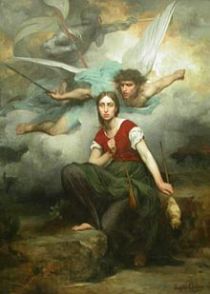
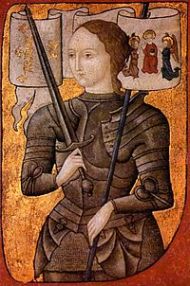
The scene is the English fortress of the Augustinians, near Orléans in France, May 6, 1429. A battle has just ended. Joan tends to a dying English soldier. Behind her hover two saints, Margaret and Catherine. (The entire play is staged as a tableau—a sort of pietà.)

SOLDIER.  I’m thirsty.

JOAN.  You’re dying.

ST. MARGARET.  Give him a sip of water.

ST.  CATHERINE.  Sprinkle some on his forehead.

JOAN  (to SAINTS as she sprinkles water from a flask).  Don’t tell me how to help him. Save your wisdom for when I need it.

SOLDIER.  Who are you talking to?

JOAN.  My Council—St. Catherine and St. Margaret. They talk to me. Sometimes they talk too much.

SOLDIER.  Oh—you are La Pucelle.

JOAN. You know my name?

SOLDIER. We all do. Every English soldier. The witch of the French. The whore of the dauphin. Your banner, your amulets—laden with black spells. Hot wax—you pour upon the faces of children. You opened your veins—offered your blood—for fiends to drink. Your body—you gave it to Satan for his pleasure.

ST. MARGARET.  Such lies!

ST. CATHERINE.  Tell him that none of it is true.

ST. MARGARET.  Tell him what you really are.

JOAN  (to SAINTS).  Let the English think I’m evil. For now, anyway. They dread me and that’s good. We won this battle and we’ll drive them from France. They’ll soon know God righteously condemned them. They’ll know Jesus fought for us. (to SOLDIER) But poor boy—you must confess! And all the priests, busy with dying Frenchmen!

SOLDIER.  Take my confession.

JOAN.  You’d trust a witch with your eternal soul?

SOLDIER.  You’ve been close to God. You spat in his face. That’s closer than a priest.

ST. MARGARET.  A sensible lad!

ST. CATHERINE.  A practical lad!

SOLDIER. My last confession—it’s not been long. I’ve only one sin—just one—it troubles me. Marching through France, I saw a shepherd girl. All alone with her flock she was. Her sheep were scared—our troops’ trudging—it scattered them. But the girl didn’t move. My eyes met hers. Her eyes were frightened. She feared me. Her fear filled me with lust. I gazed at her with lust.

JOAN.  You did not act upon that lust?

SOLDIER.  No.

JOAN.  The Lord forgives you. But you came to a land that wasn’t yours. You gazed on it with lust. You acted upon that lust. You troubled people who never troubled you. That is the greater sin.

SOLDIER.  I obeyed my king. He rules by God’s grace. How can that be a sin? Is it a sin to be English?

JOAN.  Many things we do not choose are sins. Our greatest sin was being born. I beg forgiveness every day. I repent that I weigh down my soul with flesh and bone. But ridding myself of flesh and bone would also be a sin. Freedom is scarce in this world.

SOLDIER.  And so—it is holy for you to kill.

JOAN.  God keeps me chaste, and he keeps me from killing. God preserves my innocence. (Showing him her sword) This sword—it has a secret. At Tours, before I joined the fighting, I needed a weapon. I asked my saints, where could I find one? St. Catherine told me to look in her church. My followers found it hidden there, a miracle.

SOLDIER.  The devil can work a miracle.

JOAN.  But that’s not the secret. I wouldn’t tell it to you if you weren’t dying. It’s dull as sandstone. It’s no good for fighting. The Good Lord gave me a weapon that can’t draw blood. It’s fit only for a schoolmaster’s paddle. And that’s how I use it. To smack knuckles and backsides. To send you Englishmen crying home to your mothers like naughty schoolboys.

SOLDIER.  And so—the men who follow you—you leave killing to them. You march at their head—face English ranks—they have no choice but to kill—kill to save your life. You deliver them into temptation—into evil—yet keep your innocence—your chastity of blood. (With a groan) Oh, I hear a voice! High and clear it rings—like a trumpet!

JOAN.  Surely it’s a demon.

ST. MARGARET.  And how would you know?

ST. CATHERINE.  Who are you to judge?

ST. MARGARET.  You of all people!

ST. CATHERINE.  Hear the boy out.

SOLDIER.  “You French!” it cries out to you. “We’ve struck your cheek—now offer the other. We’ve stolen your coat, now give us your cloak. Love us, your enemies—bless us who curse you—do good to us who hate you—pray for us who despise you—and persecute you!”

ST. MARGARET.  Tell him.

ST. CATHERINE.  Tell him that war is holy, just as peace is holy.

ST. MARGARET.  Tell him that the Prince of Peace Himself brought the Sword of War into this world, setting man against father and daughter against mother.

ST. CATHERINE.  Tell him that war must have its saints, the same as peace.

ST. MARGARET.  Tell him that the King of Heaven has chosen you as France’s Saint of War.

ST. CATHERINE.  Tell him.

ST. MARGARET.  Tell him now.

JOAN.  It is too late.

ST. CATHERINE.  He is gone, indeed.

ST. MARGARET.  I see his soul fluttering from his breast, darting across the fields like a butterfly.

ST. CATHERINE.  Where is it bound, I wonder?

ST. MARGARET.  But look—though his heart is stilled, it glows.

ST. CATHERINE.  Some other soul has lighted there, taking the departed one’s place.

ST. MARGARET.  Who might it be—an angel or a demon?

SOLDIER  (in a strange and powerful voice).  I am he who slew the dragon.

ST. MARGARET.  Oh, wonderful!

ST. CATHERINE.  Oh, splendid!

JOAN  (to SOLDIER).  Who are you?

ST. MARGARET.  Didn’t you hear?

ST. CATHERINE.  It is St. George, our brother in Christ!

ST. MARGARET  (to SOLDIER).  So it was you who spoke through the boy just now.

SOLDIER  (as before).  And ’twas I who brought him to Orléans; I who whispered to him all the evils of La Pucelle; I who filled his loins with lust for a maiden and a nation; I who thrust him in the path of a crossbow dart, so he might know an English hero’s blissful death. His mother shall rejoice that the sacrificial offering of her womb was deemed worthy of God. His father shall weep glad tears that his boy followed his footsteps into wayward France. For ’twas I who summoned that father to the field of Agincourt, where the English won a mighty victory. ’Twas I who guided that father’s ax to hack a score of Frenchman.

JOAN.  You speak for hell!

ST. MARGARET.  Silence, girl!

ST. CATHERINE.  How dare you blaspheme!

SOLDIER  (as before).  But this dead tongue grows stiff. I can speak no more. I must hasten myself to other English breasts, fill up their hearts and lungs with the eternal cry, “God for Harry, England, and St. George!”

ST. CATHERINE.  Farewell, our brother!

ST. MARGARET.  Godspeed in all you do!

JOAN  (to SOLDIER).  No! Don’t pass, you devil! Listen to me! Listen to my Council! (to SAINTS) Tell him, wise friends! Tell him the truth you told me! Tell him that the English are marked for disgrace! The King of Heaven wills it!

ST. CATHERINE.  That is your truth.

ST. MARGARET.  That is France’s truth.

ST. CATHERINE.  The English have their truth also.

ST. MARGARET.  They read your Bible.

ST. CATHERINE.  They pray to your God.

ST. MARGARET.  They invoke His aid against you.

JOAN.  How can God answer both their prayers and mine?

ST. CATHERINE.  Would you deny them the truth of their saints?

JOAN.  Two truths from one God?

ST. MARGARET.  With God all things are possible.

ST. CATHERINE.  You do not understand but you shall.

ST. MARGARET.  In betrayal you shall be blessed.

ST. CATHERINE.  In persecution you shall find wisdom.

ST. MARGARET.  In death you shall find peace.

ST. CATHERINE.  In paradise you shall grasp all mysteries.

ST. MARGARET.  But now your soul is weighted down by flesh and bone.

ST. CATHERINE.  You have earthly work to do.

ST. MARGARET.  Therefore, arise and win glory!

ST. CATHERINE.  Defeat the English and fulfill your sainthood!

ST. MARGARET.  Be God’s instrument, the archer by His side!

ST. MARGARET and ST. CATHERINE  (together).  Your foes are already killed by Him!

END OF PLAY
Image

play © 2008, Wim Coleman

Llixgrijb Again … and Again

Coyote3in“I was just thinking,” said Coyote/Llixgrijb, “that maybe I’ve chosen the wrong realm to live in altogether. I created this physical, temporal realm, and put Brillig in it to experience it for me. But, really, all this physicality spells nothing but trouble. It seems that suffering, ignorance, and mortality are the only things that hold the temporal realm together. It leads to more grief than gratis.”

“Indeed,” said Wolf. “Buddha taught us that suffering and sacrifice are key ingredients in this realm.”

“Then why stick around? I believe I’ll scrap the whole thing and move on to the mythic realm—the world of flow, of determinacy. A world without surprises. I like the sound of that.”

“So are you contemplating destroying our world altogether?”

“What do you think?”

“Be careful, my friend,” said Wolf. “If you try to scrap this world, you may find the mythic world extremely boring. There will be no meaning or purpose to it, without information from our temporal realm leaking into it. The mythic world is only important because of the physical world, and the physical world is only important because of the mythic world. Here, at least, you get to experience the heroic myth of the mystic experience, because death is real here.”

Coyote/Llixgrijb grinned at him. “You’re trying to scare me out of it, aren’t you?”

“Besides,” continued Wolf, “getting rid of either realm would prove rather difficult. Dividing the mythic from the physical or the temporal is like cutting a magnet in two; the pieces will divide into physical or mythic wherever you make the cut. It’s either both realms, or nothing. It’s a cosmic/mythic complementarity. You must have both to have your dream.”

“I think you’re bluffing,” said Coyote/Llixgrijb.

—physicist Fred Alan Wolf in conversation with Llixgrijb, from The Jamais Vu Papers newsletter and book by Wim Coleman and Pat Perrin. Reprinted in Jamais Vu Views along with additional material.

We thought that Llixgrijb was a fictional character, but if you Google that name today, you’ll get about 12,000 results. Some are quotes, usually (but not always) attributed to The Jamais Vu Papers, and sometimes translated into various other languages. Many are said to be posts by Llixgrijb, who apparently speaks Russian and a bevy of other languages as well as English and lives in various parts of the world. Here are just a few Llixgrijb links:

offering to be a pen pal

playing music

playing chess

discussing software

tweeting

lurking

You can read how that came about in our blog of 2012/10/05

CLICK for prints of Coyote/Llixgrijb and other illustrations from The Jamais Vu Papers.

Avoid Mere Self-expression!

Avoid mere4inThat’s a line that I once scrawled inside a paper sculpture—one of a series of artworks called “messages.”

Google “self-expression.” Today I got 2,480,000 results in less than a second. At a glance, it’s obvious that a lot of our cultural dialogue is dedicated to self-expression. A Wikipedia article connects it with a “creative class” of people who get to express themselves in their work. Centers, classes, and various kinds of gurus offer to teach people how to express themselves. And self-expression is highly recommended in discussions on leadership, spirituality, democracy, self-esteem—to say nothing of selling pitches for cars and clothes (which, of course, look just like a lot of other cars and clothes).

OK, so that could go on and on. Clearly, self-expression has many advocates.

First have a self. Wim reminds me of the observation—probably originally from Julia Cameron in The Artist’s Way—that one must have a self to express. But that self must be an evolving thing. So we sort of dance around in circles—find self … express … find … express … Maybe that’s not a bad way to go about a creative life. (Though I must note that art galleries and publishers can resist the finding and expressing of a new self—they often prefer the repetition of whatever has already proved commercially successful.) Why should anyone avoid expressing the self?

Let’s get back to that word mere.

In essays, articles, books, academic research, and artworks, I’ve tried to understand, identify, and explain the creative experience. In my definition, “self-expression” is not nearly enough. Those very words seem to imply the expression of something you already know, and that’s what a lot of self-expression seems to be about. But as the expression of a self in a state of discovery it can become part of the whole creative experience. At that point, it’s no longer “mere.”

The creative experience is more like hanging off the edge of a cliff … or jumping off … or falling off. It’s risky. You’re writing about something you almost know, or barely know, but that you’re in the process of finding out more about.

Comments from other cliffhangers are welcome. —Pat