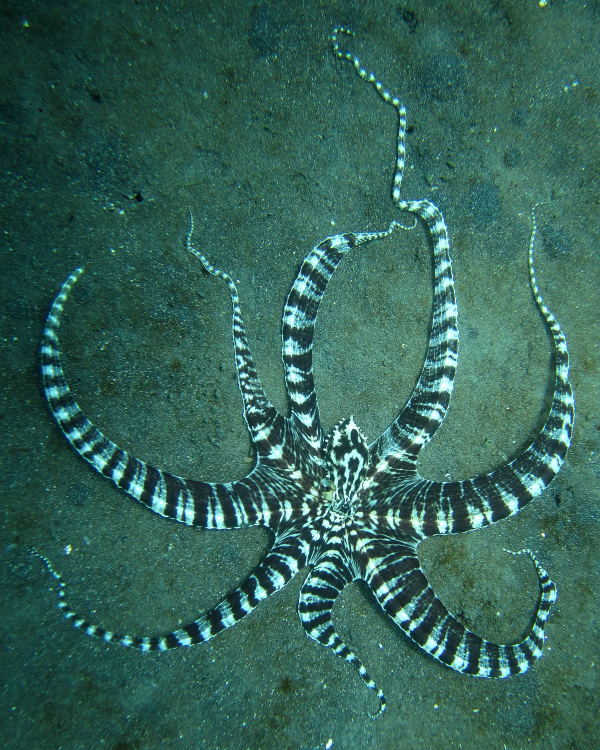
Mimic Octopus by Steve Childs
from Wikimedia Commons
So observed the late biologist Lynn Margulis, who formulated the Gaia hypothesis in collaboration with James Lovelock. Margulis was warning us not to sentimentalize Gaia as “an Earth goddess for a cuddly, furry human environment …” Despite humanity’s perverse determination to destroy biodiversity, Gaia will eventually bounce back—but “probably in a world devoid of people.”
But if human beings go the proverbial “way of the dodo,” which animal might take our place as the planet’s dominant species? Not that there has to be a dominant species, of course. After her dismal experience with us, Gaia might prefer to do without one altogether.
Even so, Pat’s and my money is on octopuses. We’ve been running into story after story about their vast dexterity, sensitivity, intelligence, and grace. With excellent eyesight, light-sensitive skin, and suckers equipped with ultra-keen taste receptors, octopuses undoubtedly enjoy a far more vivid sensory experience of the world than we clunky humans do.
Octopuses are also tool users that have been observed turning broken coconut shells into “mobile homes.” And they are infinitely resourceful, even capable of deliberate trickery. Once at the Monterey Bay Aquarium, the staff noticed that its live crabs were mysteriously disappearing at night. It turned out that a red octopus had secretly entered the facility by stowing away on the back of a sponge. The creature hid in a tank during the day, then by night sneaked out of water and across the aquarium floor to the crab tank, where it partook of tasty crab dinners.
Pat and I are most dazzled by the abilities of the mimic octopus, with its capacity to swiftly assume the shapes of algae-encrusted rocks, sea snakes, venomous sole, sea anemones, lionfish, flatfish, jellyfish, and an untold repertoire of other forms. Moreover, mimic octopus’s choice of shapes requires highly sophisticated decision-making. This video takes our breath away:
As Caspar Henderson puts it in an excerpt from his new book, The Book of Barely Imagined Beings: A 21st Century Bestiary, the octopus has
a mind that calculates and even, perhaps, possesses a form of awareness. In some ways, their abilities surpass ours.
Considering that the nearest common ancestor of humans and cephalopods disappeared some 540 million years ago, Pat and I can’t help but wonder—why isn’t the octopus now the world’s dominant species instead of Homo sapiens? Virtual reality pioneer and octopus-fancier Jaron Lanier has asked the same question:
[They] taunt us with clues about the potential future of our species…. [Their] raw brain power seems to have more potential than the mammalian brain…. By all rights, [they] should be running the show and we should be their pets.
The explanation is painfully simple, as Henderson explains,
The Common octopus typically lives less than a year and even the largest species only live three to five years …. As a consequence, they do not get a chance to pass on what they learn to the next generation. Cephalopods have no culture: no childhood in which they are guided by their parents. They must start from scratch in every new generation.
But this might not be the status quo forever. In less-explored ocean depths, cephalopods are now thought to live markedly longer than they do in more familiar waters. Recently, a deep-sea octopus was observed protecting her eggs for an astonishing 4.5 years. As science writer Megan Gannon puts it,
Not only is that four times longer than most shallow-water octopuses even live, it’s also the longest brooding period known of any animal on the planet, elephants and emperor penguins included ….
“In the deep sea, we have so much to discover,” commented zoologist Janet Voight.
Indeed, might some new type of culture already be burgeoning in uncharted depths? And if Gaia, tough bitch that she is, soon relegates the Homo sapiens nuisance to the ash heap of natural history, mightn’t she summon forth cephalopods to be the new Stewards of the Earth?
 playsonideas